


New laboratory evidence for the association between endothelial dysfunction and COVID-19 disease progression
- PMID: 35246853
- PMCID: PMC9088409
- DOI: 10.1002/jmv.27693
New laboratory evidence for the association between endothelial dysfunction and COVID-19 disease progression
Abstract
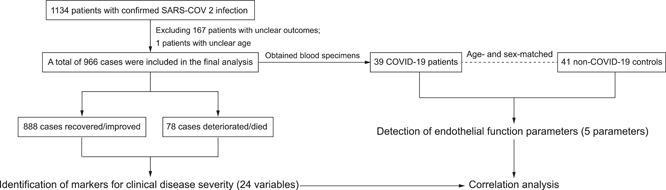
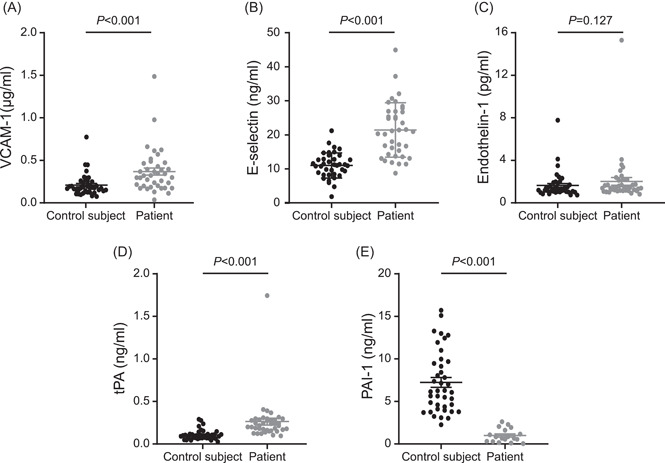
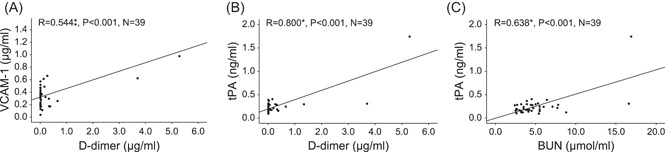
There is growing evidence that angiotensin-converting enzyme 2 is highly expressed on endothelial cells, endothelial dysfunction plays a critical role in coronavirus disease 2019 (COVID-19) progression, but laboratory evidence is still lacking. This study established a multicenter retrospective cohort of 966 COVID-19 patients from three hospitals in Wuhan, China. We found that male (62.8% vs. 46.5%), old age [72 (17) vs. 60.5 (21)], and coexisting chronic diseases (88.5% vs. 60.0%) were associated with poor clinical prognosis in COVID-19. Furthermore, the deteriorated patients exhibited more severe multiorgan damage, coagulation dysfunction, and extensive inflammation. Additionally, a cross-sectional study including 41 non-COVID-19 controls and 39 COVID-19 patients assayed endothelial function parameters in plasma and showed that COVID-19 patients exhibited elevated vascular cell adhesion molecule-1 (VCAM-1) (median [IQR]: 0.32 [0.27] vs. 0.17 [0.11] μg/ml, p < 0.001), E-selectin (21.06 [12.60] vs. 11.01 [4.63] ng/ml, p < 0.001), tissue-type plasminogen activator (tPA) (0.22 [0.12] vs. 0.09 [0.04] ng/ml, p < 0.001), and decreased plasminogen activator inhibitor-1 (0.75 [1.31] vs 6.20 [5.34] ng/ml, p < 0.001), as compared to normal controls. Moreover, VCAM-1 was positively correlated with d-dimer (R = 0.544, p < 0.001); tPA was positively correlated with d-dimer (R = 0.800, p < 0.001) and blood urea nitrogen (R = 0.638, p < 0.001). Our findings further confirm the strong association between endothelial dysfunction and poor prognosis of COVID-19, which offers a rationale for targeting endothelial dysfunction as a therapeutic strategy for COVID-19.
Keywords: COVID-19; endothelial dysfunction; laboratory evidence; prognosis.
© 2022 Wiley Periodicals LLC.
Conflict of interest statement
The authors declare no conflicts of interest.
Figures
References
-
- European Centre for Disease Prevention and Control . Threat assessment brief: emergence of SARS‐CoV‐2 B.1.617 variants in India and situation in the EU/EEA. Accessed May 11, 2021. https://www.ecdc.europa.eu/en/publications-data/threat-assessment-emerge...
Publication types
MeSH terms
Substances
LinkOut - more resources
Full Text Sources
Medical
Miscellaneous
