


A Change of Heart: Human Cardiac Tissue Engineering as a Platform for Drug Development
- PMID: 35247166
- PMCID: PMC8897733
- DOI: 10.1007/s11886-022-01668-7
A Change of Heart: Human Cardiac Tissue Engineering as a Platform for Drug Development
Abstract
Purpose of review: Human cardiac tissue engineering holds great promise for early detection of drug-related cardiac toxicity and arrhythmogenicity during drug discovery and development. We describe shortcomings of the current drug development pathway, recent advances in the development of cardiac tissue constructs as drug testing platforms, and the challenges remaining in their widespread adoption.
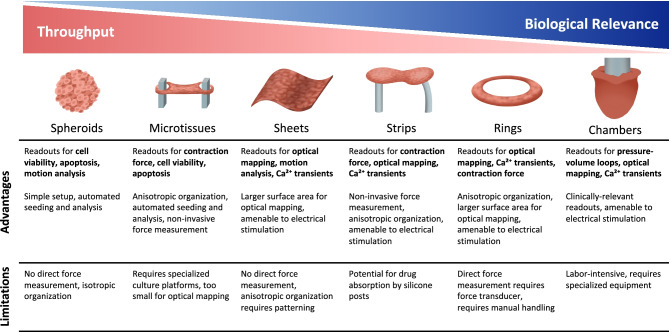
Recent findings: Human pluripotent stem cell-derived cardiomyocytes (hPSC-CMs) have been used to develop a variety of constructs including cardiac spheroids, microtissues, strips, rings, and chambers. Several ambitious studies have used these constructs to test a significant number of drugs, and while most have shown proper negative inotropic and arrhythmogenic responses, few have been able to demonstrate positive inotropy, indicative of relative hPSC-CM immaturity. Several engineered human cardiac tissue platforms have demonstrated native cardiac physiology and proper drug responses. Future studies addressing hPSC-CM immaturity and inclusion of patient-specific cell lines will further advance the utility of such models for in vitro drug development.
Keywords: Cardiac tissue engineering; Cardiotoxicity; Drug screening; Pluripotent stem cells.
© 2022. The Author(s).
Conflict of interest statement
Samantha B. Bremner reports grants from National Science Foundation Graduate Research Fellowship (Grant No. DGE-1762114), during the conduct of the study. Karen S. Gaffney has nothing to disclose. Nathan J. Sniadecki reports grants from the National Science Foundation (CMMI-1824792), National Institutes of Health (HL149734, TR003519, DE029827), and Sana Biotechnology during the conduct of the study and others from Curi Bio and Stasys Medical outside the submitted work. In addition, Dr. Sniadecki has a patent US20190029549A1 “System for magnetic detection of myocardial forces” licensed to Curi Bio. David L. Mack reports grants from Institute for Stem Cell and Regenerative Medicine Innovation Pilot Award, Senator Paul D. Wellstone Muscular Dystrophy Cooperative Research Center P50AR065139, and Jesse’s Journey Foundation, during the conduct of the study, and others from Curi Bio, Inc. and Kinea Bio, Inc., outside the submitted work.
Figures
References
-
- Packer M. Unbelievable folly of clinical trials in heart failure. Circ Hear Fail. 2016;9(4). 10.1161/CIRCHEARTFAILURE.116.002837. - PubMed
Publication types
MeSH terms
Grants and funding
LinkOut - more resources
Full Text Sources
Research Materials
