Review
. 2022 Apr;82(5):511-531.
doi: 10.1007/s40265-022-01685-4. Epub 2022 Mar 5.

From a Symptom-Based to a Mechanism-Based Pharmacotherapeutic Treatment in Complex Regional Pain Syndrome

Affiliations
Review

From a Symptom-Based to a Mechanism-Based Pharmacotherapeutic Treatment in Complex Regional Pain Syndrome

Thomas J P Mangnus et al. Drugs. 2022 Apr.

Abstract

Complex regional pain syndrome (CRPS) is a debilitating painful condition of a distal extremity that can develop after tissue damage. CRPS is thought to be a multimechanism syndrome and ideally the most prominent mechanism(s) should be targeted by drugs in an individually tailored manner. This review gives an overview of the action and evidence of current and future pharmacotherapeutic options for CRPS. The available options are grouped in four categories by their therapeutic actions on the CRPS mechanisms, i.e. inflammation, central sensitisation, vasomotor disturbances and motor disturbances. More knowledge about the underlying mechanisms of CRPS helps to specifically target important CRPS mechanisms. In the future, objective biomarkers could potentially aid in selecting appropriate mechanism-based drugs in order to increase the effectiveness of CRPS treatment. Using this approach, current and future pharmacotherapeutic options for CRPS should be studied in multicentre trials to prove their efficacy. The ultimate goal is to shift the symptom-based selection of therapy into a mechanism-based selection of therapy in CRPS.


Conflict of interest statement

Frank J.P.M. Huygen reports personal fees from Abbott; grants and personal fees from Saluda; and personal fees from Boston Scientific, Grunenthal, and Pfizer outside the submitted work. Thomas J.P. Mangnus, Krishna D. Bharwani, and Maaike Dirckx report no other conflicts of interest that are relevant to the contents of this article.

Figures

Fig. 1
Fig. 1
Overview of mechanism-based pharmacotherapeutic options in complex regional pain syndrome. Experimental therapies are light-coloured and italicised. CRPS complex regional pain syndrome, NMDA N-methyl-d-aspartate, TNF tumour necrosis factor
Fig. 2
Fig. 2
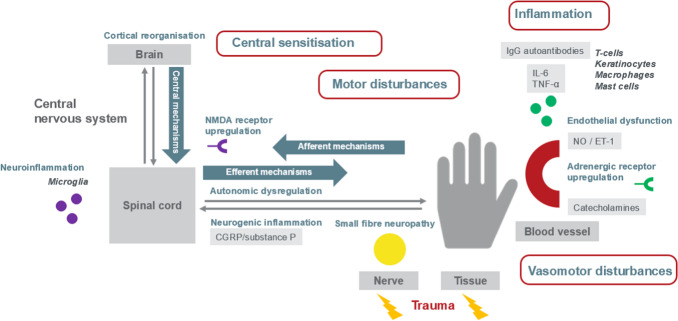
Overview of afferent, efferent and central mechanisms that contribute to complex regional pain syndrome. Different afferent (transit signals to the central nervous system), efferent (transit signals away from the central nervous system) and central mechanisms play a role in CRPS. Afferent mechanisms are inflammation, small fibre neuropathy and vasomotor dysfunction through endothelial dysfunction and adrenergic receptor upregulation; efferent mechanisms are autonomic dysregulation, central sensitisation through NMDA receptor upregulation and GABA-mediated motor disturbances; and central mechanisms are neuroinflammation and cortical reorganisation. Derived from the Handbook of Pain Medicine [207]. CGRP calcitonin gene-related peptide, CRPS complex regional pain syndrome, ET-1 endothelin-1, GABA γ-aminobutyric acid, Ig immunoglobulin, IL interleukin, NO nitric oxide, NMDA N-methyl-d-aspartate, TNF tumour necrosis factor
Fig. 3
Fig. 3
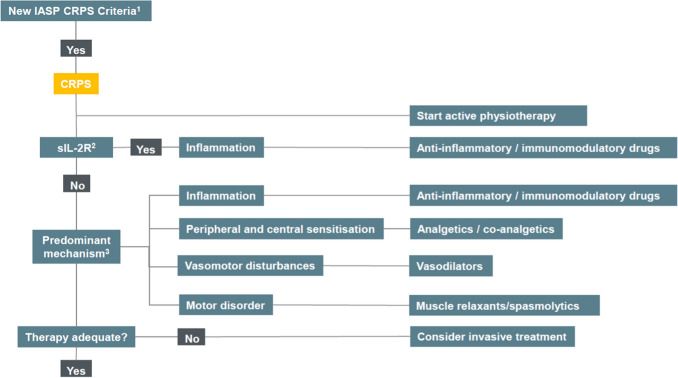
Suggested treatment algorithm for CRPS. Derived from Bharwani et al. [7]. 1New IASP clinical diagnostic criteria for CRPS [8]. 2The sIL-2R is a surrogate marker for T-cell activation [30]. Although serum sIL-2R may not be useful in establishing the diagnosis of CRPS [209], we use the biomarker for monitoring the activity of (T-cell mediated) inflammation in CRPS. 3Predominant CRPS mechanisms at history taking and physical examination. CRPS complex regional pain syndrome, IASP International Association for the Study of Pain, sIL-2R soluble interleukin-2 receptor

References

    1. Veldman PH, Reynen HM, Arntz IE, Goris RJ. Signs and symptoms of reflex sympathetic dystrophy: prospective study of 829 patients. Lancet. 1993;342(8878):1012–1016. doi: 10.1016/0140-6736(93)92877-v. - DOI - PubMed
    1. de Rooij AM, Perez RSGM, Huygen FJ, Eijs FV, Kleef MV, Bauer MCR, et al. Spontaneous onset of complex regional pain syndrome. Eur J Pain. 2010;14(5):510–513. doi: 10.1016/j.ejpain.2009.08.007. - DOI - PubMed
    1. de Mos M, de Bruijn AG, Huygen FJ, Dieleman JP, Stricker BH, Sturkenboom MC. The incidence of complex regional pain syndrome: a population-based study. Pain. 2007;129(1–2):12–20. doi: 10.1016/j.pain.2006.09.008. - DOI - PubMed
    1. Ott S, Maihöfner C. Signs and symptoms in 1,043 patients with complex regional pain syndrome. J Pain. 2018;19(6):599–611. doi: 10.1016/j.jpain.2018.01.004. - DOI - PubMed
    1. Sandroni P, Benrud-Larson LM, McClelland RL, Low PA. Complex regional pain syndrome type I: incidence and prevalence in Olmsted county, a population-based study. Pain. 2003;103(1–2):199–207. doi: 10.1016/s0304-3959(03)00065-4. - DOI - PubMed