


Running-Related Biomechanical Risk Factors for Overuse Injuries in Distance Runners: A Systematic Review Considering Injury Specificity and the Potentials for Future Research
- PMID: 35247202
- PMCID: PMC9325808
- DOI: 10.1007/s40279-022-01666-3
Running-Related Biomechanical Risk Factors for Overuse Injuries in Distance Runners: A Systematic Review Considering Injury Specificity and the Potentials for Future Research
Abstract
Background: Running overuse injuries (ROIs) occur within a complex, partly injury-specific interplay between training loads and extrinsic and intrinsic risk factors. Biomechanical risk factors (BRFs) are related to the individual running style. While BRFs have been reviewed regarding general ROI risk, no systematic review has addressed BRFs for specific ROIs using a standardized methodology.
Objective: To identify and evaluate the evidence for the most relevant BRFs for ROIs determined during running and to suggest future research directions.
Design: Systematic review considering prospective and retrospective studies. (PROSPERO_ID: 236,832).
Data sources: PubMed. Connected Papers. The search was performed in February 2021.
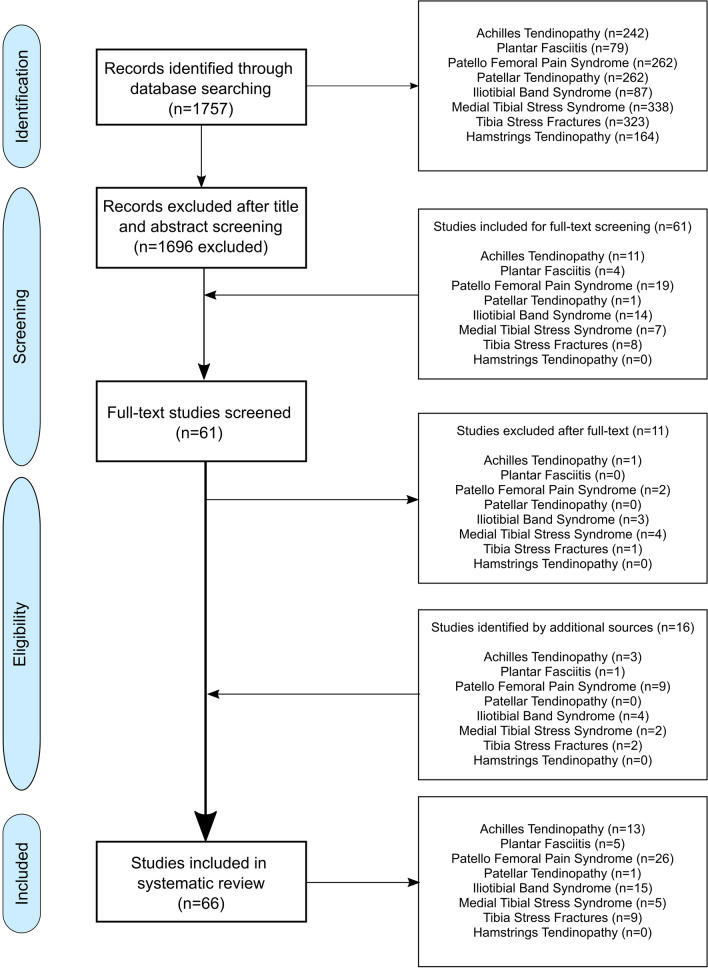
Eligibility criteria: English language. Studies on participants whose primary sport is running addressing the risk for the seven most common ROIs and at least one kinematic, kinetic (including pressure measurements), or electromyographic BRF. A BRF needed to be identified in at least one prospective or two independent retrospective studies. BRFs needed to be determined during running.
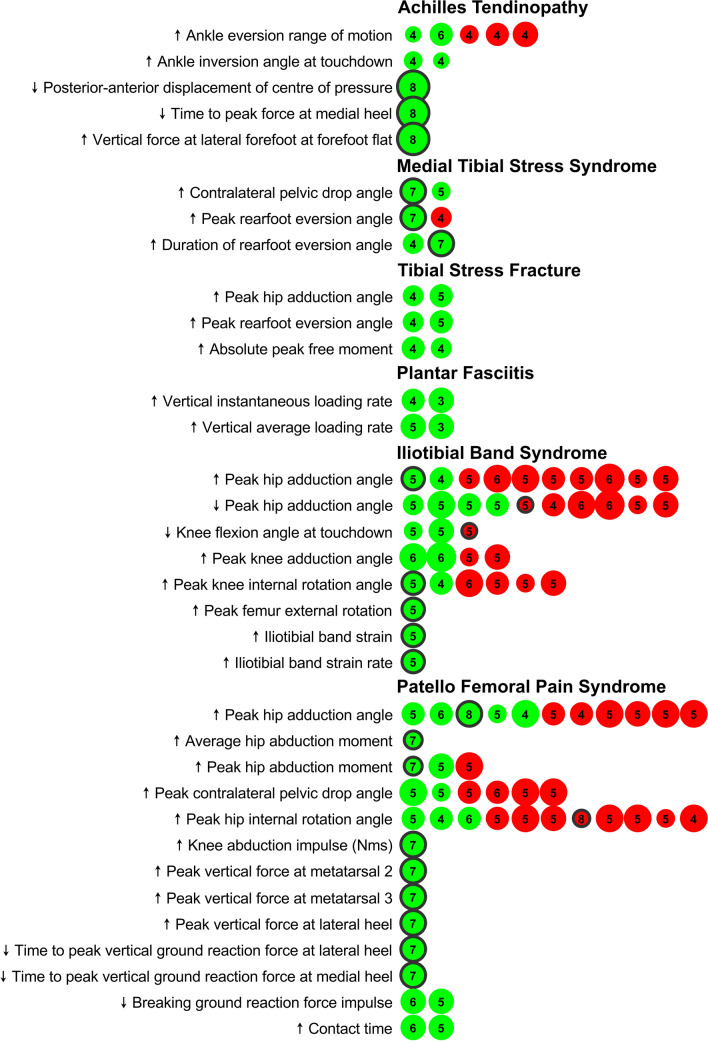
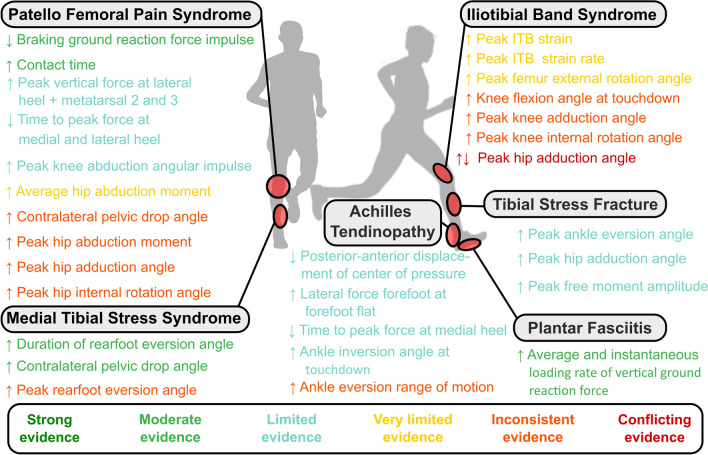
Results: Sixty-six articles fulfilled our eligibility criteria. Levels of evidence for specific ROIs ranged from conflicting to moderate evidence. Running populations and methods applied varied considerably between studies. While some BRFs appeared for several ROIs, most BRFs were specific for a particular ROI. Most BRFs derived from lower-extremity joint kinematics and kinetics were located in the frontal and transverse planes of motion. Further, plantar pressure, vertical ground reaction force loading rate and free moment-related parameters were identified as kinetic BRFs.
Conclusion: This study offers a comprehensive overview of BRFs for the most common ROIs, which might serve as a starting point to develop ROI-specific risk profiles of individual runners. We identified limited evidence for most ROI-specific risk factors, highlighting the need for performing further high-quality studies in the future. However, consensus on data collection standards (including the quantification of workload and stress tolerance variables and the reporting of injuries) is warranted.
© 2022. The Author(s).
Conflict of interest statement
Steffen Willwacher, Markus Kurz, Johanna Robbin, Matthias Thelen, Joseph Hamill, Luke Kelly and Patrick Mai declare that they have no conflicts of interest relevant to the content of this review.
Figures
Comment in
-
Comment on "Running‑Related Biomechanical Risk Factors for Overuse Injuries in Distance Runners: A Systematic Review Considering Injury Specificity and the Potentials for Future Research".Sports Med. 2023 May;53(5):1103-1105. doi: 10.1007/s40279-023-01809-0. Epub 2023 Jan 21. Sports Med. 2023. PMID: 36680708 No abstract available.
References
-
- Willwacher S, et al. Running shoes: injury protection and performance enhancement. In: Müller B, Wolf SI, Brueggemann G-P, Deng Z, McIntosh A, Miller F, et al., editors. Handbook of Human motion [Internet] Springer International Publishing; 2017. pp. 1–16.
Publication types
MeSH terms
LinkOut - more resources
Full Text Sources
