


Treatment of Patients with Acute Myeloid Leukemia with the Targeted Alpha-Particle Nanogenerator Actinium-225-Lintuzumab
- PMID: 35247915
- PMCID: PMC9106874
- DOI: 10.1158/1078-0432.CCR-21-3712
Treatment of Patients with Acute Myeloid Leukemia with the Targeted Alpha-Particle Nanogenerator Actinium-225-Lintuzumab
Abstract
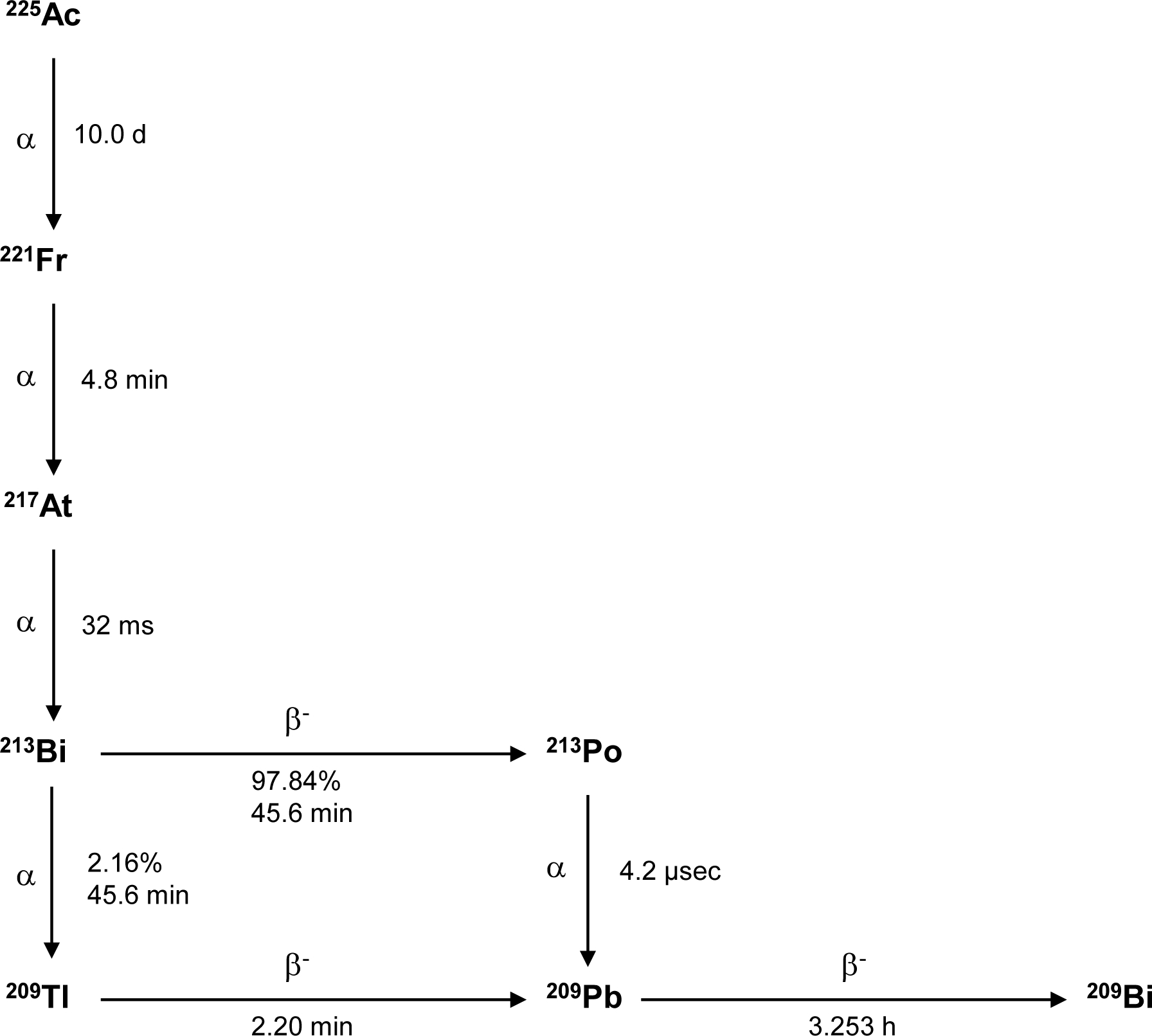
Purpose: The anti-CD33 antibody lintuzumab has modest activity against acute myeloid leukemia (AML). To increase its potency, lintuzumab was conjugated to actinium-225 (225Ac), a radionuclide yielding 4 α-particles. This first-in-human, phase I trial was conducted to determine the safety, pharmacology, and biological activity of 225Ac-lintuzumab.
Patients and methods: Eighteen patients (median age, 64 years; range, 45-80) with relapsed or refractory AML received a single infusion of 225Ac-lintuzumab at activities of 18.5 to 148 kBq/kg.
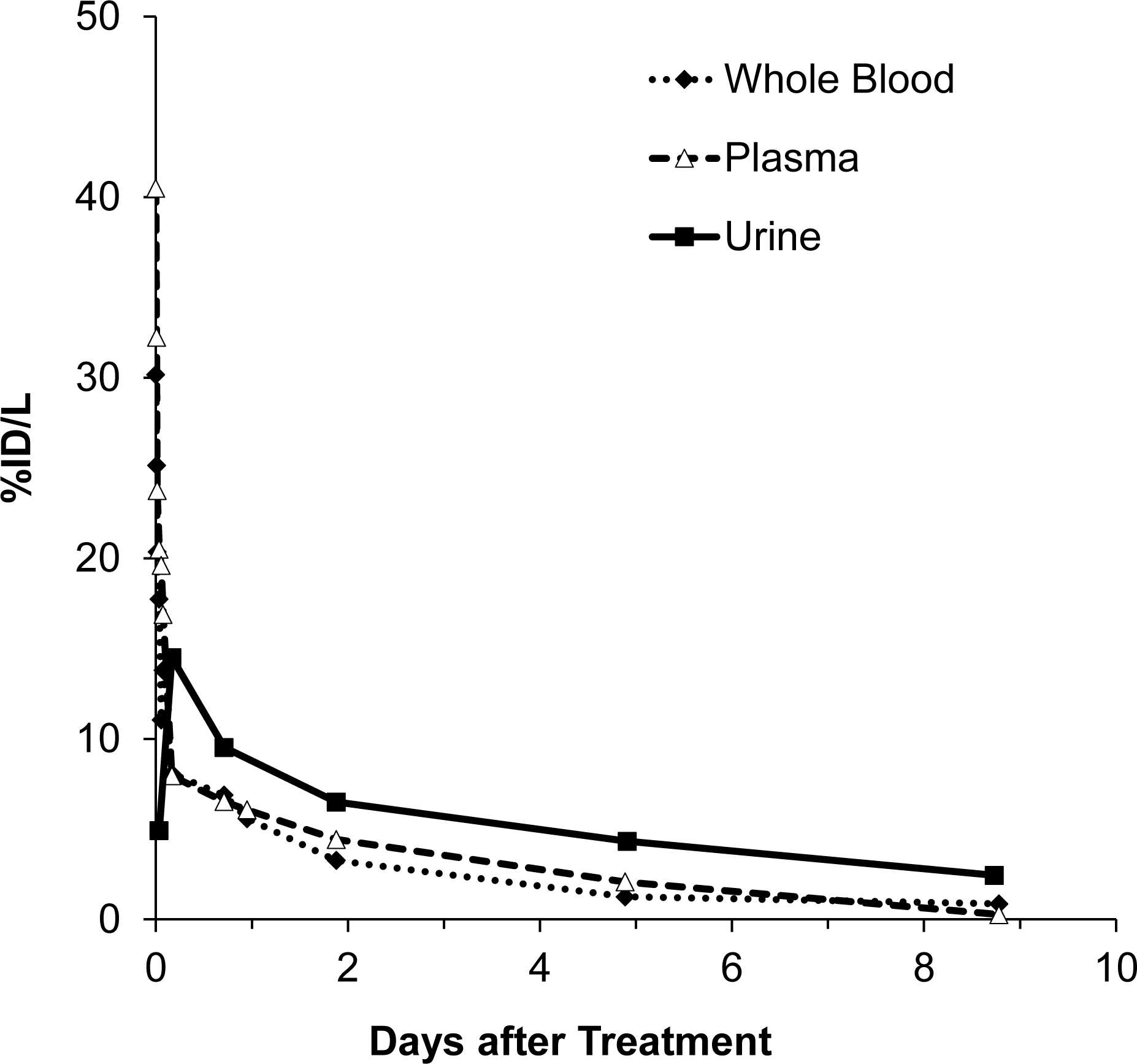
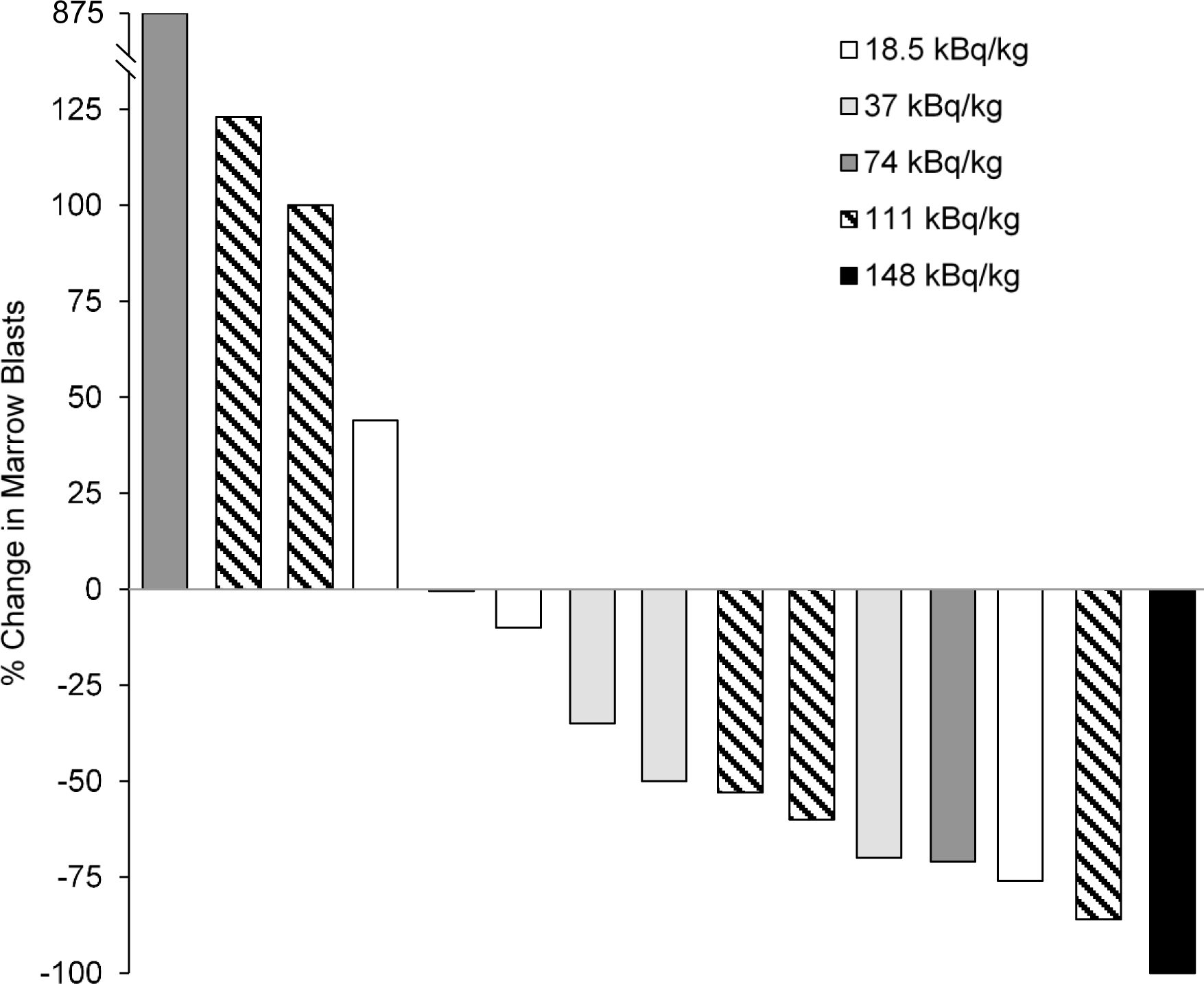
Results: The maximum tolerated dose was 111 kBq/kg. Dose-limiting toxicities included myelosuppression lasting > 35 days in one patient receiving 148 kBq/kg and death from sepsis in two patients treated with 111 and 148 kBq/kg. Myelosuppression was the most common toxicity. Significant extramedullary toxicities were limited to transient grade 3 liver function abnormalities. Pharmacokinetics were determined by gamma counting serial whole blood, plasma, and urine samples at energy windows for the 225Ac daughters, francium-221 and bismuth-213. Two-phase elimination kinetics were seen with mean plasma t1/2 - α and t1/2 - β of 1.9 and 38 hours, respectively. Peripheral blood blasts were eliminated in 10 of 16 evaluable patients (63%) but only at doses of ≥ 37 kBq/kg. Bone marrow blasts were reduced in 10 of 15 evaluable patients (67%), including 3 patients with marrow blasts ≤ 5% and one patient with a morphologic leukemia-free state.
Conclusions: Therapy for AML with the targeted α-particle generator 225Ac-lintuzumab was feasible with an acceptable safety profile. Elimination of circulating blasts or reductions in marrow blasts were observed across all dose levels.
©2022 American Association for Cancer Research.
Conflict of interest statement
Conflict of interest disclosure statement:
MRM is a co-inventor of intellectual property licensed by MSK to Actinium Pharmaceuticals Inc. and Y-mAbs Therapeutics Inc. and is a consultant for Crinetics Pharmaceuticals.
JAC serves in a consulting or advisory role for Y-mAbs Therapeutics Inc.
NP-T has served as a consultant for or been on an advisory board and has received honoraria for Actinium Pharmaceuticals Inc, Progenics Pharmaceuticals Inc, Medimmune/AstraZeneca, Illumina Inc, ImaginAb, and conducts research institutionally supported by Y-mAbs Therapeutics Inc, ImaginAb, BMS, Bayer, Clarity Pharma, Janssen Pharmaceuticals, and Regeneron.
MGF has equity ownership in BMS/Celgene and employment and equity ownership in Cellectis Inc.
PGM receives research funding from BD Biosciences.
JHP serves in a consulting on advisory role for Amgen, Novartis, Kite Pharma, Autolus, Incyte, Takeda, Pfizer, Artiva, Servier, BMS, Kura Oncology, Affyimmune, Innate Pharma, Minerva, and Precision Bio.
SML has financial interest in Y-mAbs Therapeutics Inc and Elucid Oncology Inc; has received commercial research grants from Y-mAbs Therapeutics Inc; was named as inventor on multiple patents filed by MSK, including those licensed to Y-mAbs Therapeutics Inc, Elucida Oncology Inc, and Samus Therapeutics LLC; is a consultant and advisor to Bristol Myers Squibb, Prescient Imaging LLC, Janssen Pharmaceuticals, Exini, Advanced Innovative Partners; and in the past received project support funds from Genetech, Eli Lilly, Tellix, Regeneron, National Cancer Institute, and Department of Energy.
DAS serves on a board of, or has equity in, Lantheus Pharmaceuticals, Sellas Life Sciences, Iovance Biotherapeutics Inc, Pfizer, Actinium Pharmaceuticals Inc, OncoPep, Bridge Medicines, Repertoire, Sapience, and Eureka Therapeutics.
JGJ serves in a consulting or advisory role for AbbVie Inc., Actinium Pharmaceuticals Inc., BMS/Celgene, Jazz Pharmaceuticals, Novartis, and Syros Pharmaceuticals, Inc. and receives research funding (institutional) from AbbVie Inc., Arog Pharmaceuticals, Astellas, BMS/Celgene, Cellularity, Inc., Forma Therapeutics, Genentech, Gilead Sciences, GlycoMimetics, Inc., PTC Therapeutics, and Syros Pharmaceuticals Inc.
Figures
References
-
- Howlader N, Noone AM, Krapcho M, Miller D, Brest A, Yu M, et al. (eds). SEER Cancer Statistics Review, 1975–2017, National Cancer Institute. Bethesda, MD, https://seer.cancer.gov/csr/1975_2017/, based on November 2019 SEER data submission, posted to the SEER web site, April 2020.
-
- Caron PC, Jurcic JG, Scott AM, Finn RD, Divgi CR, Graham MC, et al. A phase 1B trial of humanized monoclonal antibody M195 (anti-CD33) in myeloid leukemia: specific targeting without immunogenicity. Blood 1994;83:1760–8. - PubMed
-
- Jurcic JG, DeBlasio T, Dumont L, Yao TJ, Scheinberg DA. Molecular remission induction with retinoic acid and anti-CD33 monoclonal antibody HuM195 in acute promyelocytic leukemia. Clin Cancer Res 2000;6:372–80. - PubMed
-
- Caron PC, Dumont L, Scheinberg DA. Supersaturating infusional humanized anti-CD33 monoclonal antibody HuM195 in myelogenous leukemia. Clin Cancer Res 1998;4:1421–8. - PubMed
-
- Feldman E, Kalaycio M, Weiner G, Frankel S, Schulman P, Schwartzbert L, et al. Treatment of relapsed or refractory acute myeloid leukemia with humanized anti-CD33 monoclonal antibody HuM195. Leukemia 2003;17:314–8. - PubMed
Publication types
MeSH terms
Substances
Grants and funding
LinkOut - more resources
Full Text Sources
Medical
