


High RAD51 gene expression is associated with aggressive biology and with poor survival in breast cancer
- PMID: 35249172
- PMCID: PMC8995390
- DOI: 10.1007/s10549-022-06552-0
High RAD51 gene expression is associated with aggressive biology and with poor survival in breast cancer
Abstract
Purpose: Although the DNA repair mechanism is important in preventing carcinogenesis, its activation in established cancer cells may support their proliferation and aggravate cancer progression. RAD51 cooperates with BRCA2 and is essential in the homologous recombination of DNA repair. To this end, we hypothesized that RAD51 gene expression is associated with cancer cell proliferation and poor prognosis of breast cancer (BC) patients.
Methods: A total of 8515 primary BC patients with transcriptome and clinical data from 17 independent cohorts were analyzed. The median value was used to divide each cohort into high and low RAD51 expression groups.
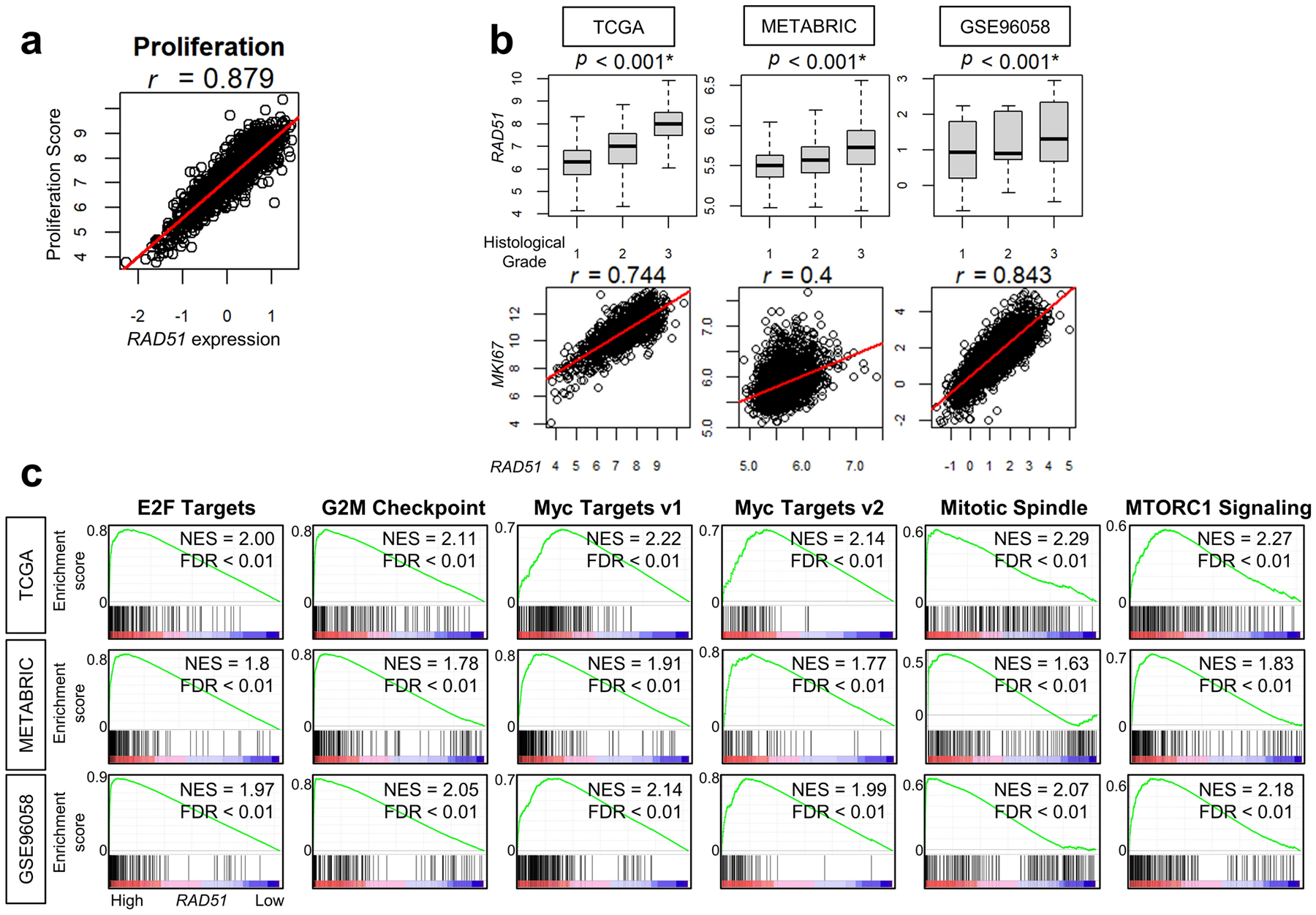
Results: High RAD51 expression enriched the DNA repair gene set and was correlated with DNA repair-related genes. Nottingham histological grade, Ki67 expression and cell proliferation-related gene sets (E2F Targets, G2M Checkpoint and Myc Targets) were all significantly associated with the high RAD51 BC group. RAD51 expression was positively correlated with Homologous Recombination Deficiency, as well as both mutational burden and neoantigens that accompanied a higher infiltration of immune cells. Primary BC with lymph node metastases was associated with high expression of RAD51 in two cohorts. There was no strong correlation between RAD51 expression and drug sensitivity in cell lines, and RAD51 expression was lower after the neoadjuvant chemotherapy compared to before the treatment. High RAD51 BC was associated with poor prognosis consistently in three independent cohorts.
Conclusion: RAD51 gene expression is associated with aggressive cancer biology, cancer cell proliferation, and poor survival in breast cancer.
Keywords: BRCA; Breast cancer; DNA repair; HRD; Neoadjuvant chemotherapy; RAD51.
© 2022. The Author(s), under exclusive licence to Springer Science+Business Media, LLC, part of Springer Nature.
Conflict of interest statement
Conflict of interest
No conflicts of interest to disclose.
Figures



References
-
- Teraoka S, Muguruma M, Takano N, Miyahara K, Kawate T, Kaise H, Yamada K, Miyazawa K, Ishikawa T (2020) Association of BRCA Mutations and BRCAness Status With Anticancer Drug Sensitivities in Triple-Negative Breast Cancer Cell Lines. J Surg Res 250:200–208. doi: 10.1016/j.jss.2019.12.040 - DOI - PubMed
MeSH terms
Substances
Grants and funding
- R37 CA248018/CA/NCI NIH HHS/United States
- P30 CA016056/CA/NCI NIH HHS/United States
- W81XWH-19-1-0674/U.S. Department of Defense
- R37CA248018/Foundation for the National Institutes of Health
- R01 CA251545/CA/NCI NIH HHS/United States
- R01 CA250412/CA/NCI NIH HHS/United States
- W81XWH-19-1-0111/U.S. Department of Defense
- R01 EB029596/EB/NIBIB NIH HHS/United States
- P30CA016056/Roswell Park Cancer Institute
- R01EB029596/Foundation for the National Institutes of Health
- R01CA250412/Foundation for the National Institutes of Health
- R01CA251545/Foundation for the National Institutes of Health
LinkOut - more resources
Full Text Sources
Medical
Research Materials
Miscellaneous
