


The Synaptic Gene Study: Design and Methodology to Identify Neurocognitive Markers in Phelan-McDermid Syndrome and NRXN1 Deletions
- PMID: 35250452
- PMCID: PMC8894872
- DOI: 10.3389/fnins.2022.806990
The Synaptic Gene Study: Design and Methodology to Identify Neurocognitive Markers in Phelan-McDermid Syndrome and NRXN1 Deletions
Abstract
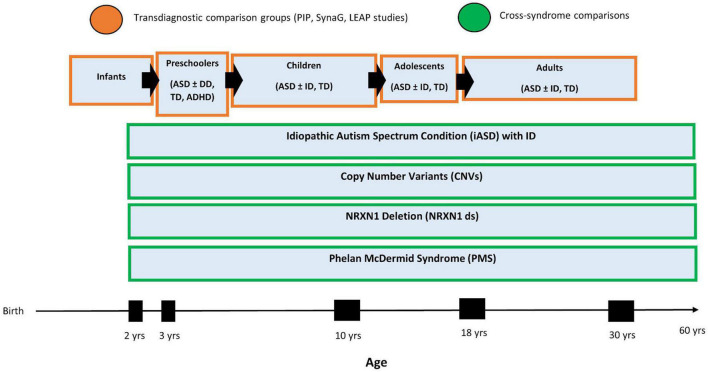
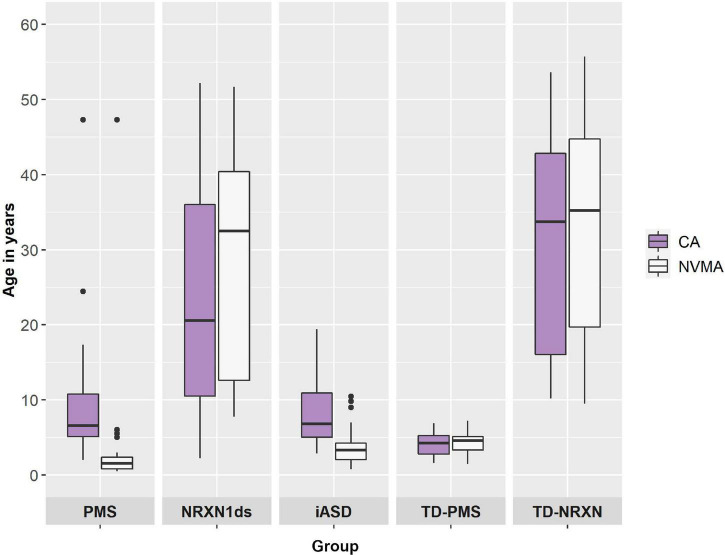
Synaptic gene conditions, i.e., "synaptopathies," involve disruption to genes expressed at the synapse and account for between 0.5 and 2% of autism cases. They provide a unique entry point to understanding the molecular and biological mechanisms underpinning autism-related phenotypes. Phelan-McDermid Syndrome (PMS, also known as 22q13 deletion syndrome) and NRXN1 deletions (NRXN1ds) are two synaptopathies associated with autism and related neurodevelopmental disorders (NDDs). PMS often incorporates disruption to the SHANK3 gene, implicated in excitatory postsynaptic scaffolding, whereas the NRXN1 gene encodes neurexin-1, a presynaptic cell adhesion protein; both are implicated in trans-synaptic signaling in the brain. Around 70% of individuals with PMS and 43-70% of those with NRXN1ds receive a diagnosis of autism, suggesting that alterations in synaptic development may play a crucial role in explaining the aetiology of autism. However, a substantial amount of heterogeneity exists between conditions. Most individuals with PMS have moderate to profound intellectual disability (ID), while those with NRXN1ds have no ID to severe ID. Speech abnormalities are common to both, although appear more severe in PMS. Very little is currently known about the neurocognitive underpinnings of phenotypic presentations in PMS and NRXN1ds. The Synaptic Gene (SynaG) study adopts a gene-first approach and comprehensively assesses these two syndromic forms of autism. The study compliments preclinical efforts within AIMS-2-TRIALS focused on SHANK3 and NRXN1. The aims of the study are to (1) establish the frequency of autism diagnosis and features in individuals with PMS and NRXN1ds, (2) to compare the clinical profile of PMS, NRXN1ds, and individuals with 'idiopathic' autism (iASD), (3) to identify mechanistic biomarkers that may account for autistic features and/or heterogeneity in clinical profiles, and (4) investigate the impact of second or multiple genetic hits on heterogeneity in clinical profiles. In the current paper we describe our methodology for phenotyping the sample and our planned comparisons, with information on the necessary adaptations made during the global COVID-19 pandemic. We also describe the demographics of the data collected thus far, including 25 PMS, 36 NRXN1ds, 33 iASD, and 52 NTD participants, and present an interim analysis of autistic features and adaptive functioning.
Keywords: NRXN1 deletion; Phelan-McDermid syndrome; autism; biomarker; rare genetic variants; synaptopathies.
Copyright © 2022 Cooke, Molloy, Cáceres, Dinneen, Bourgeron, Murphy, Gallagher and Loth.
Conflict of interest statement
ASJC has worked as a consultant in several different projects for Servier and Roche. The remaining authors declare that the research was conducted in the absence of any commercial or financial relationships that could be construed as a potential conflict of interest. The reviewer EB declared a past co-authorship with the authors TB and LG to the handling editor.
Figures
References
-
- Ajram L. A., Pereira A. C., Durieux A. M. S., Velthius H. E., Petrinovic M. M., McAlonan G. M. (2019). The contribution of [1H] magnetic resonance spectroscopy to the study of excitation-inhibition in autism. Prog. Neuropsychopharmacol. Biol. Psychiatry 89 236–244. 10.1016/j.pnpbp.2018.09.010 - DOI - PubMed
-
- American Psychiatric Association [APA] (2000). Diagnostic and Statistical Manual of Mental Disorders, 4th Edn. Washington, DC: APA.
-
- American Psychiatric Association [APA] (2013). Diagnostic and Statistical Manual of Mental Disorders, 5th Edn. Arlington, TX: APA.
LinkOut - more resources
Full Text Sources
