


Mobile Heart Rate Variability Biofeedback Improves Autonomic Activation and Subjective Sleep Quality of Healthy Adults - A Pilot Study
- PMID: 35250623
- PMCID: PMC8892186
- DOI: 10.3389/fphys.2022.821741
Mobile Heart Rate Variability Biofeedback Improves Autonomic Activation and Subjective Sleep Quality of Healthy Adults - A Pilot Study
Abstract
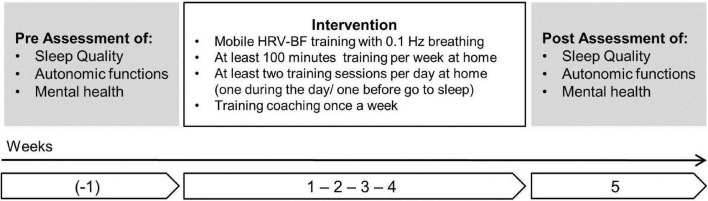
Objective: Restorative sleep is associated with increased autonomous parasympathetic nervous system activity that might be improved by heart rate variability-biofeedback (HRV-BF) training. Hence the aim of this study was to investigate the effect of a four-week mobile HRV-BF intervention on the sleep quality and HRV of healthy adults.
Methods: In a prospective study, 26 healthy participants (11 females; mean age: 26.04 ± 4.52 years; mean body mass index: 23.76 ± 3.91 kg/m2) performed mobile HRV-BF training with 0.1 Hz breathing over four weeks, while sleep quality, actigraphy and HRV were measured before and after the intervention.
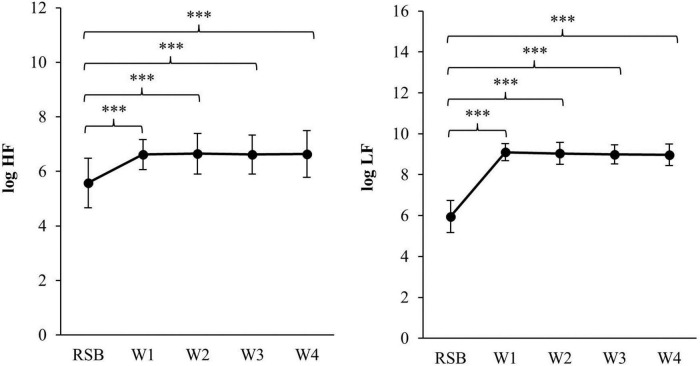
Results: Mobile HRV-BF training with 0.1 Hz breathing improved the subjective sleep quality in healthy adults [t(24) = 4.9127, p ≤ 0.001, d = 0.99] as measured by the Pittsburgh Sleep Quality Index. In addition, mobile HRV-BF training with 0.1 Hz breathing was associated with an increase in the time and frequency domain parameters SDNN, Total Power and LF after four weeks of intervention. No effect was found on actigraphy metrics.
Conclusions: Mobile HRV-BF intervention with 0.1 Hz breathing increased the reported subjective sleep quality and may enhance the vagal activity in healthy young adults. HRV-BF training emerges as a promising tool for improving sleep quality and sleep-related symptom severity by means of normalizing an impaired autonomic imbalance during sleep.
Keywords: 0.1 Hz breathing; actigraphy; biofeedback (BF); heart rate variability (HRV); sleep.
Copyright © 2022 Herhaus, Kalin, Gouveris and Petrowski.
Conflict of interest statement
The authors declare that the research was conducted in the absence of any commercial or financial relationships that could be construed as a potential conflict of interest.
Figures
References
-
- American Psychiatric Association [APA] (2000). Diagnostic and Statistical Manual of Mental disorders. DSM-IV-TR, 4th Edn. Washington DC: American Psychiatric Association.
-
- Chong Y., Fryer C. D., Gu Q. (2013). Prescription sleep aid use among adults: United States, 2005-2010. NCHS Data Brief 1–8. **VQ, - PubMed
LinkOut - more resources
Full Text Sources
Medical
Miscellaneous
