. 2021 Jul 15;9(2):nwab125.
doi: 10.1093/nsr/nwab125. eCollection 2022 Feb.

A single nucleotide mutation in the dual-oxidase 2 (DUOX2) gene causes some of the panda's unique metabolic phenotypes

Affiliations

A single nucleotide mutation in the dual-oxidase 2 (DUOX2) gene causes some of the panda's unique metabolic phenotypes

Agata M Rudolf et al. Natl Sci Rev. .

Abstract

The giant panda (Ailuropoda melanoleuca) is an iconic bear native to China, famous for eating almost exclusively bamboo. This unusual dietary behavior for a carnivore is enabled by several key adaptations including low physical activity, reduced organ sizes and hypothyroidism leading to lowered energy expenditure. These adaptive phenotypes have been hypothesized to arise from a panda-unique single-nucleotide mutation in the dual-oxidase 2 (DUOX2) gene, involved in thyroid hormone synthesis. To test this hypothesis, we created genome-edited mice carrying the same point mutation as the panda and investigated its effect on metabolic phenotype. Homozygous mice were 27% smaller than heterozygous and wild-type ones, had 13% lower body mass-adjusted food intake, 55% decreased physical activity, lower mass of kidneys (11%) and brain (5%), lower serum thyroxine (T4: 36%), decreased absolute (12%) and mass-adjusted (5%) daily energy expenditure, and altered gut microbiota. Supplementation with T4 reversed the effects of the mutation. This work uses a state-of-the-art genome editing approach to demonstrate the link between a single-nucleotide mutation in a key endocrine-related gene and profound adaptive changes in the metabolic phenotype, with great importance in ecology and evolution.

Keywords: DUOX2; DUOX2 mutation; giant panda; metabolic rate; mice and microbiota; thyroid hormones.


Figures

Figure 1.
Figure 1.
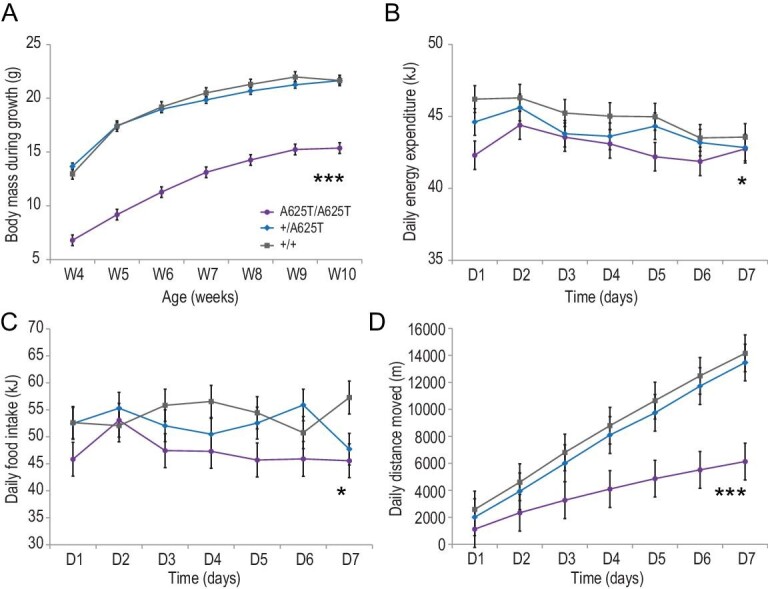
(A) Body mass between 4 and 10 weeks old (g/week), (B) body-mass-adjusted daily energy expenditure (kJ/day) and (C) daily food intake (kJ/day) in respirometry chamber, and (D) accumulated daily distance moved (m/day) in mutant homozygous (Duox2A625T/A625T), heterozygous (Duox2+/A625T) and wild-type homozygous (Duox2+/+) mice carrying a giant-panda-specific mutation in the Duox2 gene; LSM with SE.
Figure 2.
Figure 2.
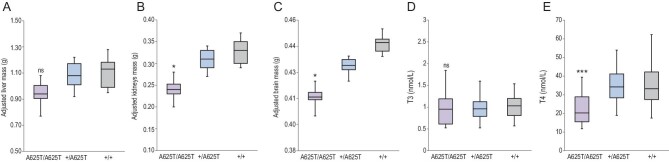
(A) Body-mass-adjusted liver, (B) kidneys and (C) brain mass, and (D) levels of T3-triiodothyronine and (E) T4-thyroxine (nmol/L) in mutant homozygous (Duox2A625T/A625T), heterozygous (Duox2+/A625T) and wild-type homozygous (Duox2+/+) mice carrying a giant-panda-specific mutation in the Duox2 gene.
Figure 3.
Figure 3.
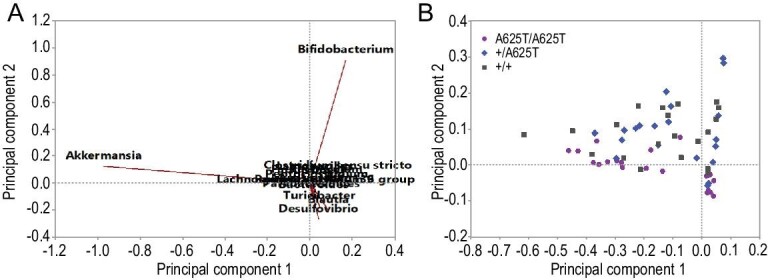
PCA analysis of fecal microbiota in mutant homozygous (Duox2A625T/A625T), heterozygous (Duox2+/A625T) and wild-type homozygous (Duox2+/+) mice carrying a giant-panda-specific mutation in the Duox2 gene at the age of 10–11 weeks old: (A) PC1 and PC2 with microbiota genus; (B) PC1 and PC2 with genotype.
Figure 4.
Figure 4.
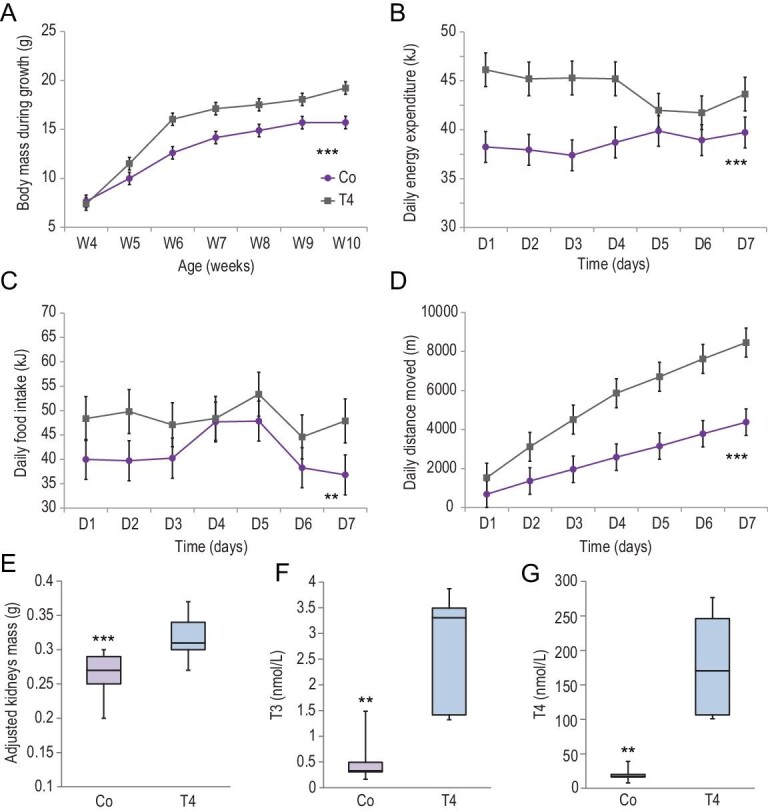
Reversal of the impact of the Duox2 mutation by supplementation with T4. (A) Body mass between 4 and 10 weeks old (g/week), (B) body-mass-adjusted daily energy expenditure (kJ/day) and (C) daily food intake (kJ/day) in respirometry chamber, (D) accumulated daily distance moved (m/day), (E) body-mass-adjusted kidney mass and (F) levels of T3-triiodothyronine and (G) T4-thyroxine (nmol/L) in mutant homozygous (Duox2A625T/A625T) mice carrying a giant-panda-specific mutation in the Duox2 gene; exposed (T4) and non-exposed (Co) to 0.5 µg/mL of T4 supplementation; LSM with SE.

References

    1. Brown JH, Gillooly JF, Allen APet al. . Toward a metabolic theory of ecology. Ecology 2004; 85: 1771–89.10.1890/03-9000 - DOI
    1. Slodkowicz G, Goldman N.. Integrated structural and evolutionary analysis reveals common mechanisms underlying adaptive evolution in mammals. Proc Natl Acad Sci USA 2020; 117: 5977–86.10.1073/pnas.1916786117 - DOI - PMC - PubMed
    1. Jones CT, Youssef N, Susko Eet al. . A phenotype-genotype codon model for detecting adaptive evolution. Syst Biol 2020; 69: 722–38.10.1093/sysbio/syz075 - DOI - PubMed
    1. Johnson KR, Marden CC, Ward-Bailey Pet al. . Congenital hypothyroidism, dwarfism, and hearing impairment caused by a missense mutation in the mouse dual oxidase 2 gene, Duox2. Mol Endocrinol 2007; 21: 1593–602.10.1210/me.2007-0085 - DOI - PubMed
    1. Sun F, Zhang JX, Yang CYet al. . The genetic characteristics of congenital hypothyroidism in China by comprehensive screening of 21 candidate genes. Eur J Endocrinol 2018; 178: 623–33.10.1530/EJE-17-1017 - DOI - PMC - PubMed