


When do children avoid infection risks: Lessons for schools during the COVID-19 pandemic
- PMID: 35252803
- PMCID: PMC8881814
- DOI: 10.1016/j.isci.2022.103989
When do children avoid infection risks: Lessons for schools during the COVID-19 pandemic
Abstract
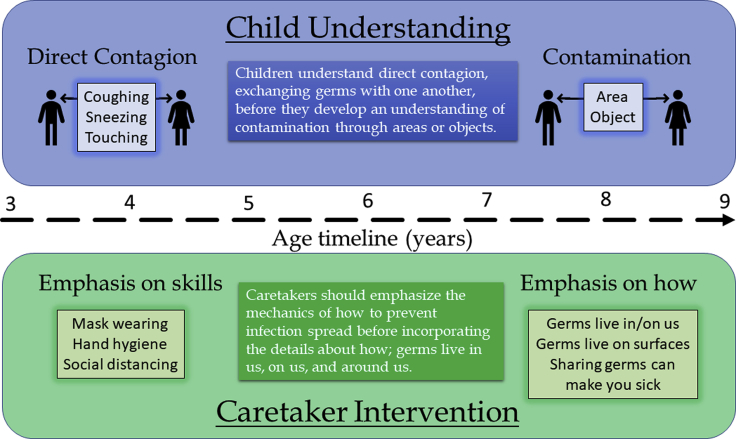
The physical closing of schools because of COVID-19 has disrupted both student learning and family logistics. There is significant pressure for in-person learning to remain open for all children. However, as is expected with outbreaks of novel infections, vaccines and other pharmaceutical therapeutics may not be instantly available. This raises serious public health questions about the risks to children and society at large. The best protective measures for keeping young children in school focus on behaviors that limit transmission. It is therefore critical to understand how we can engage children in age-appropriate ways that will best support their ability to adhere to protocols effectively. Here, we synthesize published studies with new results to investigate the earliest ages at which children form an understanding of infection risk and when they can translate that understanding effectively to protective action.
Keywords: Behavioral neuroscience; Virology.
© 2022 The Author(s).
Conflict of interest statement
The authors declare no competing interests.
Figures
References
-
- Au T.K., Sidle A.L., Rollins K.B. Developing an intuitive understanding of conservation and contamination: invisible particles as a plausible mechanism. Dev. Psychol. 1993;29:286.
-
- Bieri F.A., Gray D.J., Williams G.M., Raso G., Li Y.-S., Yuan L., He Y., Li R.S., Guo F.-Y., Li S.-M. Health-education package to prevent worm infections in Chinese schoolchildren. N. Engl. J. Med. 2013;368:1603–1612. - PubMed
Publication types
LinkOut - more resources
Full Text Sources
