


Internalized stigma, depressive symptoms, and the modifying role of antiretroviral therapy: A cohort study in rural Uganda
- PMID: 35252904
- PMCID: PMC8896824
- DOI: 10.1016/j.ssmmh.2021.100034
Internalized stigma, depressive symptoms, and the modifying role of antiretroviral therapy: A cohort study in rural Uganda
Abstract
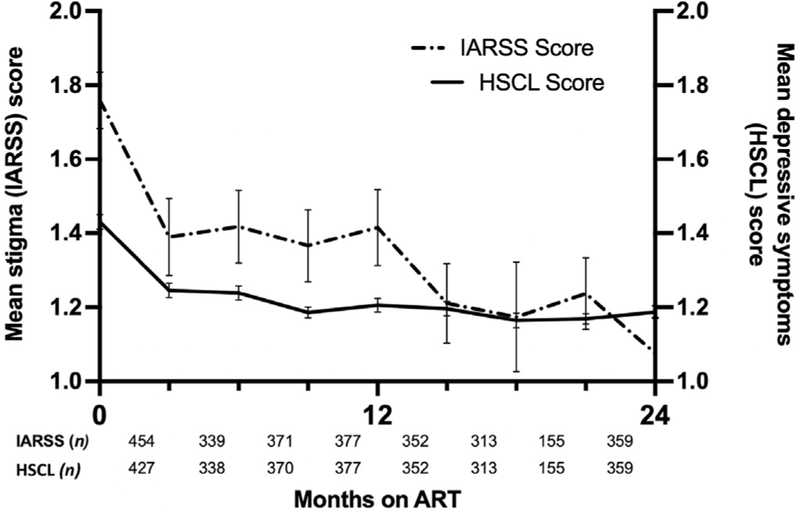
Depression affects over 40% of people with HIV (PHIV) in low- and middle-income countries, and over half of PHIV report HIV-related internalized stigma. However, few longitudinal studies of PHIV have examined the relationship between HIV-related stigma and depression. Data were analyzed from the 2007-15 Uganda AIDS Rural Treatment Outcomes (UARTO) Study, a cohort of 454 antiretroviral therapy (ART)-naïve PHIV (68% women) starting ART. Our primary outcome was depression symptom severity over the first two years of ART, measured using a locally adapted version of the Hopkins Symptom Checklist; our primary exposure was the 6-item Internalized AIDS-Related Stigma Scale. Both scores were measured at enrollment and at quarterly follow-up visits. We fit linear generalized estimating equations (GEE) regression models to estimate the association between stigma and depression symptom severity, adjusting for potential confounders. We included a stigma×time product term to assess the modifying effect of ART on the association between internalized stigma and depression symptom severity. UARTO participants had a median age of 32 years and median enrollment CD4 count of 217 cells/mm3. Both depression symptom severity and internalized stigma declined on ART, particularly during the first treatment year. In multivariable regression models, depression symptom severity was positively associated with internalized stigma (b=0.03; 95% confidence interval [CI], 0.02 to 0.04) and negatively associated with ART duration >6 months (b =- 0.16; 95% CI,- 0.19 to -0.13). The estimated product term coefficient was negative and statistically significant (P = 0.004), suggesting that the association between internalized stigma and depression symptom severity weakened over time on ART. Thus, in this large cohort of PHIV initiating ART in rural Uganda, depression symptom severity was associated with internalized stigma but the association declined with time on ART. These findings underscore the potential value of ART as a stigma reduction intervention for PHIV, particularly during early treatment.
Keywords: Antiretroviral therapy; Depression; Discrimination; HIV; Mental health; Prejudice; Stigma; Sub-saharan africa; Uganda.
Conflict of interest statement
Declaration of competing interest The authors declare that they have no known competing financial interests or personal relationships that could have appeared to influence the work reported in this paper.
Figures
References
-
- Asiimwe SB, Fatch R, Emenyonu NI, Muyindike WR, Kekibiina A, Santos GM, et al. (2015). Comparison of traditional and novel self-report measures to an alcohol biomarker for quantifying alcohol consumption among HIV-infected adults in sub-saharan Africa. Alcoholism: Clinical and Experimental Research, 39(8), 1518–1527. - PMC - PubMed
Grants and funding
LinkOut - more resources
Full Text Sources
Research Materials