


Observational Study
doi: 10.1002/lt.26452.
Epub 2022 Apr 28.
Sinusoidal obstruction syndrome after liver transplantation: A multicenter observational study
Affiliations
- PMID: 35255179
- PMCID: PMC9324821
- DOI: 10.1002/lt.26452
Item in Clipboard
Observational Study
Sinusoidal obstruction syndrome after liver transplantation: A multicenter observational study
Liver Transpl.
2022 Jul.
No abstract available
Conflict of interest statement
Jordi Colmenero consults for and is on the speakers' bureau for Chiesi. He is on the speakers' bureau for Astellas. The other authors do not have any conflicts.
Figures
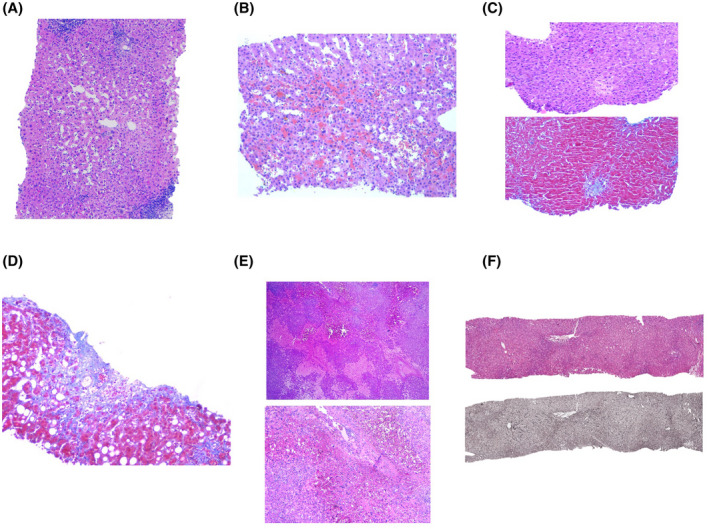
(A) Sinusoidal dilatation around central vein (zone 3). (B) Perisinusoidal hemorrhage and sinusoidal dilatation. (C) Centrilobular vein fibrosis (hematoxylin‐eosin and Masson’s stain), obliterative fibrous lesion. (D) Centrilobular vein fibrosis, evolved obliterative lesion. (E) Peliosis hepatis. Irregular blood‐filled cavities with no endothelial lining (hematoxylin‐eosin). (F) Nodular regenerative hyperplasia (hematoxylin‐eosin and reticulin stain). The nodularity results from zones of atrophic hepatocytes alternating with areas of normal‐sized hepatocytes
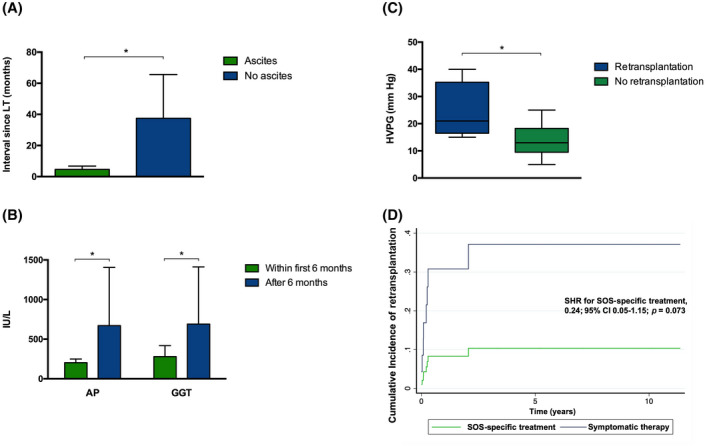
Clinical presentation of SOS. (A) Interval between LT and SOS onset according to the presence of ascites. Bars represent mean time from liver transplantation to SOS in months. Error bars indicate the 95% confidence interval. (B) AP and GGT levels according to the interval between LT and SOS. Bars represent mean levels of AP and GGT. Error bars indicate the 95% confidence interval. (C) Comparison of HVPG according to the need of retransplantation. The box ranges from Q1 (the first quartile) to Q3 (the third quartile) of the distribution and the range represent the IQR. The median is indicated by a line across the box. The whiskers on box plots extend from Q1 and Q3 to the most extreme data points. (D) Cumulative incidence of retransplantation in the presence of competing risks in patients with SOS according to the type of treatment. Retransplantation as the event of interest and death as the competing event. (*p < 0.005)
References
-
- Mohty M, Malard F, Abecassis M, Aerts E, Alaskar AS, Aljurf M, et al. Sinusoidal obstruction syndrome/veno‐occlusive disease: current situation and perspectives—a position statement from the European Society for Blood and Marrow Transplantation (EBMT). Bone Marrow Transplant. 2015;50:781–9. - PMC - PubMed
-
- Sebagh M, Azoulay D, Roche B, Hoti E, Karam V, Teicher E, et al. Significance of isolated hepatic veno‐occlusive disease/sinusoidal obstruction syndrome after liver transplantation. Liver Transpl. 2011;17:798–808. - PubMed
-
- Sebagh M, Debette M, Samuel D, Emile J‐F, Falissard B, Cailliez V, et al. “Silent” presentation of veno‐occlusive disease after liver transplantation as part of the process of cellular rejection with endothelial predilection. Hepatology. 1999;30:1144–50. - PubMed
-
- Rubbia‐Brandt L, Lauwers GY, Wang H, Majno PE, Tanabe K, Zhu AX, et al. Sinusoidal obstruction syndrome and nodular regenerative hyperplasia are frequent oxaliplatin‐associated liver lesions and partially prevented by bevacizumab in patients with hepatic colorectal metastasis. Histopathology. 2010;56:430–9. - PubMed
-
- Sinusoidal R‐B, Syndrome O. Sinusoidal obstruction syndrome. Clin Liver Dis. 2010;14:651–68. - PubMed
