Effect of Hearing Rehabilitation Therapy Program in Hearing Aid Users: A Prospective Randomized Controlled Study
- PMID: 35255665
- PMCID: PMC9149230
- DOI: 10.21053/ceo.2021.00948
Effect of Hearing Rehabilitation Therapy Program in Hearing Aid Users: A Prospective Randomized Controlled Study
Abstract
Objectives: Despite sufficient hearing gains, many patients with hearing loss have difficulty using hearing aids due to poor word recognition ability. This study was performed to introduce our hearing rehabilitation therapy (HRT) program for hearing aid users and to evaluate its effect on hearing improvement.
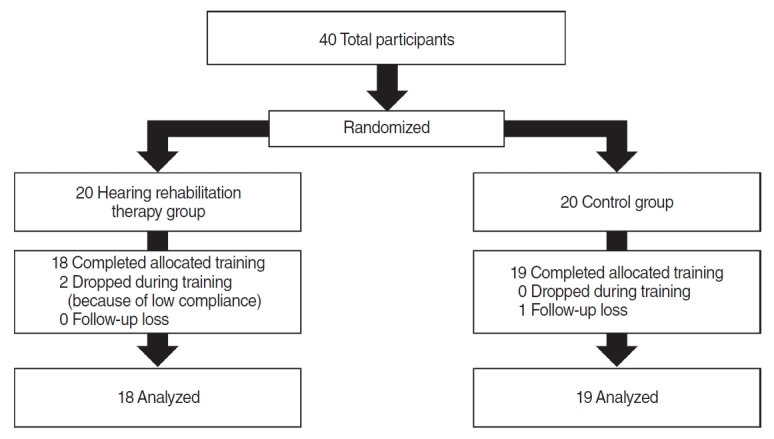
Methods: In this prospective randomized case-control study, 37 participants with moderate or moderate-severe sensorineural hearing loss who had used bilateral hearing aids for more than 3 months with sufficient functional hearing gain were enrolled in this study. Nineteen participants were randomly assigned to the control group (CG) and 18 patients were assigned to participate in our HRT program once a week for 8 consecutive weeks (hearing rehabilitation therapy group [HRTG]). Their hearing results and questionnaire scores for hearing handicap and hearing aid outcomes were prospectively collected and compared between the two groups.
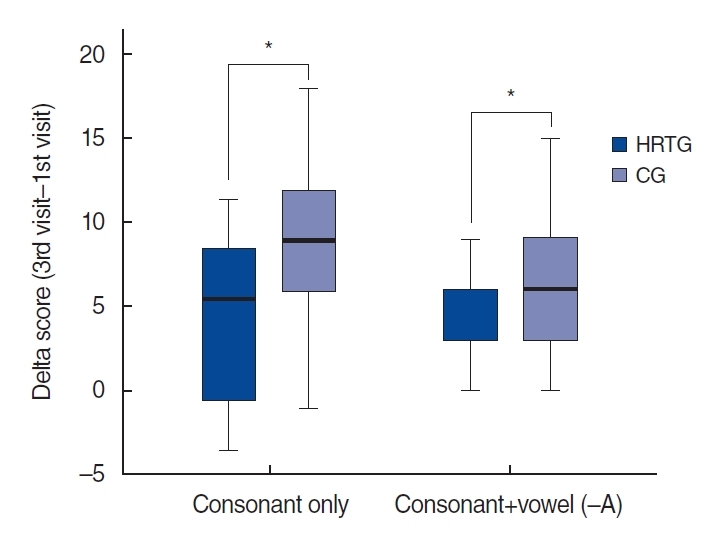
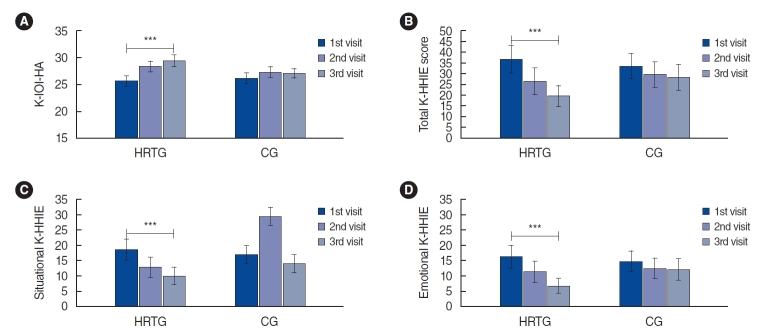
Results: After completing 8 weeks of the HRT program, the HRTG showed a significantly greater improvement in scores for consonant-only and consonant-vowel sound perception than the CG (P<0.05). In addition, the HRTG showed a significant improvement in hearing ability as measured by two questionnaires (p<0.05), while no differences were observed in the CG. However, word and sentence recognition test results did not show significant differences between the two groups.
Conclusion: Even after short-term HRT, patients had subjectively better hearing outcomes and improved phoneme perception ability; this provides scientific evidence regarding a possible positive role for HRT programs in hearing aid users. Further validation in a larger population through a long-term follow-up study is needed.
Keywords: Hearing Aids; Hearing Loss; Rehabilitation.
Conflict of interest statement
This study was partially funded by GN ReSound. No other potential conflicts of interest relevant to this article were reported.
Figures

References
-
- Gates GA, Mills JH. Presbycusis. Lancet. 2005 Sep;366(9491):1111–20. - PubMed
-
- Ng JH, Loke AY. Determinants of hearing-aid adoption and use among the elderly: a systematic review. Int J Audiol. 2015 May;54(5):291–300. - PubMed
-
- Chisolm TH, Johnson CE, Danhauer JL, Portz LJ, Abrams HB, Lesner S, et al. A systematic review of health-related quality of life and hearing aids: final report of the American Academy of Audiology Task Force on the Health-Related Quality of Life Benefits of Amplification in Adults. J Am Acad Audiol. 2007 Feb;18(2):151–83. - PubMed
-
- Bisgaard N, Ruf S. Findings from EuroTrak surveys from 2009 to 2015: hearing loss prevalence, hearing aid adoption, and benefits of hearing aid use. Am J Audiol. 2017 Oct;26(3S):451–61. - PubMed