


Association of body mass index and COPD exacerbation among patients with chronic bronchitis
- PMID: 35255901
- PMCID: PMC8900381
- DOI: 10.1186/s12931-022-01957-3
Association of body mass index and COPD exacerbation among patients with chronic bronchitis
Abstract
Background and objective: Chronic obstructive pulmonary disease (COPD) patients with a body mass index (BMI) < 25 kg/m2 are prone to develop adverse event of pharmacological treatment for frequent exacerbation. As chronic bronchitis (CB) is one of the strong risk factors of exacerbation, we investigated the associations between BMI and COPD exacerbations in patients with CB.
Methods: Patients with COPD were included from the Korean COPD Subgroup Study (KOCOSS), a multicenter observational cohort study. CB was defined using the St. George's Respiratory Questionnaire and the participants were categorized according to BMI cut-off of 25 kg/m2. Exacerbations during a 1-year follow-up were compared among four groups: non-CB with BMI ≥ 25 kg/m2, non-CB with BMI < 25 kg/m2, CB with BMI ≥ 25 kg/m2, and CB with BMI < 25 kg/m2.
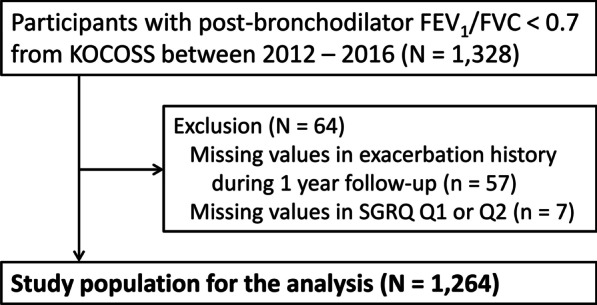
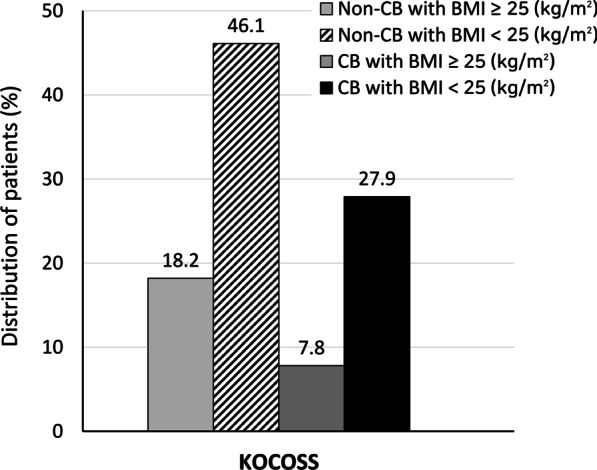
Results: Among the 1264 patients with COPD, 451 (35.7%) had CB and 353 (27.9%) had both CB and BMI < 25 kg/m2. The COPD exacerbation risk increased across the non-CB with BMI < 25 kg/m2, CB with BMI ≥ 25 kg/m2, and CB with BMI < 25 kg/m2 groups (adjusted incidence rate ratio [95% confidence interval] 1.21 [0.89-1.62], 1.20 [0.77-1.88], and 1.41 [1.02-1.91], respectively, compared to the non-CB with BMI ≥ 25 kg/m2 group).
Conclusions: COPD patients having both CB and a BMI < 25 kg/m2 are at higher risk of exacerbations. Considering that a BMI < 25 kg/m2 often limits treatment options preventing exacerbations, modified guidelines might be needed for non-obese CB patients in Asia.
Keywords: Body mass index; COPD; Chronic bronchitis; Exacerbation.
© 2022. The Author(s).
Conflict of interest statement
None of the authors has a financial relationship with a commercial entity that has an interest in the subject of this manuscript.
Figures
References
-
- Spencer S, Calverley PM, Burge PS, Jones PW. Impact of preventing exacerbations on deterioration of health status in COPD. Eur Respir J. 2004;23:698–702. - PubMed
-
- Hoogendoorn M, Hoogenveen RT, Rutten-van Molken MP, Vestbo J, Feenstra TL. Case fatality of COPD exacerbations: a meta-analysis and statistical modelling approach. Eur Respir J. 2011;37:508–515. - PubMed
-
- Hurst JR, Vestbo J, Anzueto A, Locantore N, Mullerova H, Tal-Singer R, et al. Susceptibility to exacerbation in chronic obstructive pulmonary disease. N Engl J Med. 2010;363:1128–1138. - PubMed
-
- Mullerova H, Maselli DJ, Locantore N, Vestbo J, Hurst JR, Wedzicha JA, et al. Hospitalized exacerbations of COPD: risk factors and outcomes in the ECLIPSE cohort. Chest. 2015;147:999–1007. - PubMed
Publication types
MeSH terms
Grants and funding
LinkOut - more resources
Full Text Sources
Medical
Research Materials
