Review
. 2022 Aug;23(8):505-518.
doi: 10.1038/s41576-022-00459-8. Epub 2022 Mar 7.

Functions and consequences of AID/APOBEC-mediated DNA and RNA deamination

Affiliations
Review

Functions and consequences of AID/APOBEC-mediated DNA and RNA deamination

Riccardo Pecori et al. Nat Rev Genet. 2022 Aug.

Abstract

The AID/APOBEC polynucleotide cytidine deaminases have historically been classified as either DNA mutators or RNA editors based on their first identified nucleic acid substrate preference. DNA mutators can generate functional diversity at antibody genes but also cause genomic instability in cancer. RNA editors can generate informational diversity in the transcriptome of innate immune cells, and of cancer cells. Members of both classes can act as antiviral restriction factors. Recent structural work has illuminated differences and similarities between AID/APOBEC enzymes that can catalyse DNA mutation, RNA editing or both, suggesting that the strict functional classification of members of this family should be reconsidered. As many of these enzymes have been employed for targeted genome (or transcriptome) editing, a more holistic understanding will help improve the design of therapeutically relevant programmable base editors.


Conflict of interest statement

The authors declare no competing interests.

Figures

Fig. 1
Fig. 1. Physiological and aberrant functions of the AID/APOBEC deaminases.
a | APOBEC1 in humans and mice acts in the nucleus of enterocytes, together with its cofactor RNA-binding motif protein 47 (RBM47), to edit apolipoprotein B (APOB) mRNA. Editing leads to C-to-U base change that converts Gln (CAA) to a stop codon (UAA). Edited and unedited APOB mRNAs are then translated in the cytoplasm, generating two distinct isoforms: short (APOB-48) and long (APOB-100) isoform, respectively. APOB-100 is the major component of plasma low-density lipoproteins whereas APOB-48 is essential for secretion of chylomicrons. In mice, APOBEC1, together with RBM47, catalyses RNA editing of a large set of additional transcript targets (mRNA set 1). A change of cofactor from RBM47 to APOBEC1 complementation factor (A1CF) leads to RNA editing of a different set of transcript targets (mRNA set 2), suggesting that target specificity resides with the cofactor. Finally, in mice and humans, APOBEC1 is also able to induce DNA editing within the genome of the cells, leading to undesired mutations (dashed red arrow),,. b | In humans, APOBEC3 family members play an essential role during retroviral infections (for example, in leukocytes). Specifically, once a retrovirus infects a cell, it releases its viral genome as single-stranded RNA (ssRNA), which is retro-transcribed (RT) to cDNA. APOBEC3 proteins can deaminate this single-stranded DNA (ssDNA) leading to C-to-T base changes and mutations within the viral genome. This edited viral genome can be degraded (if heavily edited) or integrated into the genome as a provirus. APOBEC3A (A3A) and A3G are also able to perform RNA editing on RNA viruses (such as SARS-CoV-2) as well as host mRNAs. Aberrant activity of A3A and A3B can also induce DNA mutations within the genome of cells (dashed red arrows). c | AID plays an essential role in B cell antibody diversification, where it catalyses deamination either within transcribed (black arrow) antibody variable region V(D)J gene segments of the immunoglobulin (Ig) gene leading to somatic hypermutation (SHM) (mutations represented as red bars) or within repetitive ‘switch’ regions upstream of the constant region gene segments, leading to class switch recombination (CSR) (switch regions Sμ or Sɣ1 shown). Resulting mRNA encodes an IgG1 protein that contains a hypermutated variable region and a ɣ1 heavy chain. Unregulated AID activity can also result in mutations and translocations elsewhere in the genome (dashed red arrow). AID/APOBEC, activation-induced cytidine deaminase/apolipoprotein B mRNA-editing enzyme catalytic polypeptide-like; dsDNA, double-stranded DNA.
Fig. 2
Fig. 2. The emergence of the AID/APOBEC family and the conserved core cytidine deaminase domain.
a | Left: simplified phylogenetic tree of the AID/APOBEC family, which is believed to have emerged by co-opting prokaryotic tRNA editing enzymes (Tad/ADAT2) to deaminate DNA. In the vertebrate-specific branch, AID and APOBEC2 are the most ancient members (present in cartilaginous and bony fish). APOBEC1 emerged later in the tetrapod–lungfish divergence; and APOBEC3 appeared even later, in placental mammals. Both are believed to have evolved from AID gene duplications,. Paralogue expansion within placental mammals led to emergence of several APOBEC3 subfamily members, with the seven members of the human subfamily being among the most diverse,. More recently, orthologues of APOBEC4 have been found in invertebrates, suggesting it predates rest of family members and forms a separate invertebrate branch. Right: domain delineation of members of the vertebrate-specific AID/APOBEC family. Each member of the family contains the core zinc-dependent cytidine deaminase domain (core CDA). Specific members contain accessory motifs within core CDA that determine subcellular localization, including nuclear localization signal (NLS), nuclear export signal (NES) and cytoplasmic retention signal (CRS). Some members contain additional accessory regions that provide specific molecular properties: for example, APOBEC2 contains an amino-terminal intrinsically disordered region (IDR) whereas the carboxy terminus of APOBEC1 is hydrophobic. b | Core CDA composed of a five-stranded β-sheet (β1–β5) surrounded by six α-helices (α1–α6). Several loops found within the deaminase fold (L-1 to L-10) with loops 1, 3, 5 and 7 forming the substrate binding groove. Catalytic pocket coordinates a zinc ion (Zn; green sphere) with the His-Glu (H and E) and Cys-Cys (C) motifs found on α2 and L-5/α3, respectively. AID/APOBEC, activation-induced cytidine deaminase/apolipoprotein B mRNA-editing enzyme catalytic polypeptide-like.
Fig. 3
Fig. 3. Structural insights from generalists and specialists.
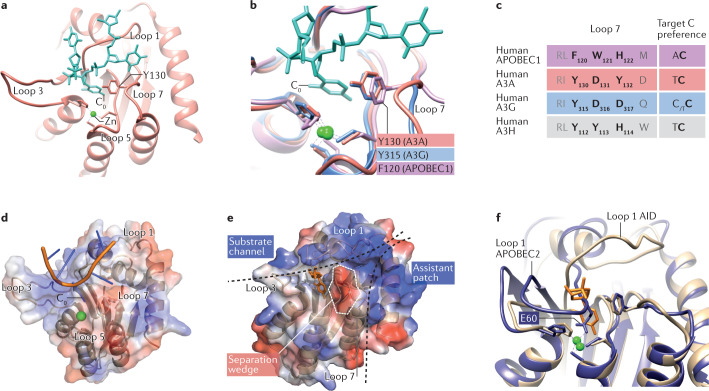
a | Co-crystal structure of APOBEC3A (A3A) bound to six-nucleotide single-stranded DNA (ssDNA; turquoise) (PDB:5SWW) (Table 2). Target deoxycytidine (C0) located at bottom of the substrate binding groove formed by loops 1, 3 and 7 and forms a π-stacking interaction with Y130 (PDB:5SWW) (Table 2). b | Overlapping crystal structures of APOBEC1 (purple) (PDB:6X91) (Table 2), A3A bound to ssDNA (pink) (PDB:5KEG) (Table 2) and A3G bound to ssDNA (blue) (PDB:6BUX) (Table 2). Residues F120 (APOBEC1), Y130 (A3A) and Y315 (A3G) form critical aromatic π-stacking interactions with target C (C0, from co-crystal structure of A3A bound to ssDNA; turquoise) (PDB:5SWW) (Table 2). c | Alignment of amino acids present in loop 7 for different APOBECs and target C preference motif for each. d | A3A binds U-shaped substrates, such as ssDNA (orange) (nucleobases represented as blue sticks) (PDB:5SWW) (Table 2). e | AID in co-crystal structure with dCMP ligand (PDB:5W0U) (Table 2) shown as a molecular surface. AID loops 1, 3 and 7 form positively charged (blue) bifurcated substrate binding surface, comprising ‘substrate channel’ (which hosts dCMP) and a second groove, termed the ‘assistant patch’. The two grooves are separated near the point of convergence by negatively charged residues in loop 7 (red) known as the ‘separation wedge’. f | Co-crystal structure AID (light brown) with a dCMP ligand (orange) (PDB:5W0U) (Table 2) overlaid with crystal structure of APOBEC2 (blue) (PDB:2NYT) (Table 2). Loop 1 of APOBEC2 obstructs substrate (orange) at the active site. Residue E60 in APOBEC2 forms a fourth point of coordination with zinc ion (Zn; green sphere). AID/APOBEC, activation-induced cytidine deaminase/apolipoprotein B mRNA-editing enzyme catalytic polypeptide-like. Part e is adapted from ref., CC BY 4.0 (https://creativecommons.org/licenses/by/4.0/).
Fig. 4
Fig. 4. The consequences of deamination for adaptive evolution.
a | APOBEC levels are upregulated in response to viral infection, and both single-stranded DNA (ssDNA) and single-stranded RNA (ssRNA) viral genomes can undergo APOBEC-mediated deamination resulting in mutations. When mutational load in the viral genome is so high that the genome cannot perform its function, the genome is degraded and viral particles are not produced; this process is known as viral restriction. However, mutations resulting from lower levels of deamination can become fixed in the viral genome after replication, increasing the probability of producing viral variants with altered characteristics (compared with the original strain). b | If AID/APOBEC-catalysed C-to-U deamination events are not repaired by the base excision repair pathway during replication, resulting C-to-T transitions can induce massive DNA damage and genome instability. Cell death can be triggered if accumulation of transitions leads to an excessive mutational load, resulting in tumour restriction. However, lower levels of mutation can fuel genome variability and tumour cellular heterogeneity that, upon selection, can result in adaptive evolution and cancer progression. AID/APOBEC, activation-induced cytidine deaminase/apolipoprotein B mRNA-editing enzyme catalytic polypeptide-like.
Fig. 5
Fig. 5. APOBEC-derived DNA and RNA base-editing tools.
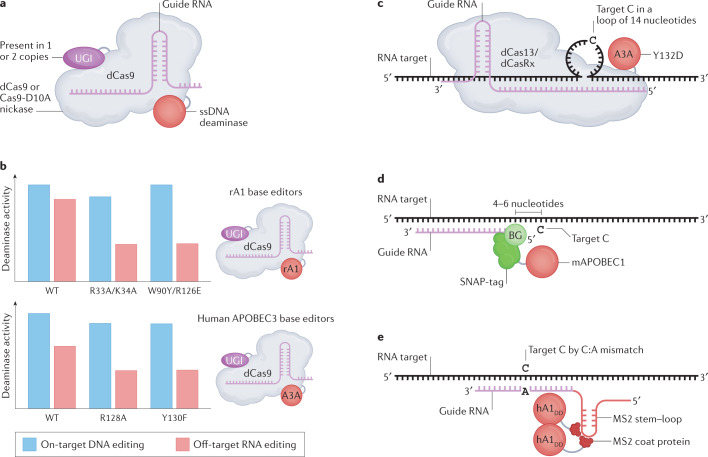
a | DNA-directed cytosine base editor (CBE) comprises catalytically dead Cas9 (dCas9), guide RNA (gRNA), single-stranded DNA (ssDNA) deaminase and uracil DNA glycosylase inhibitor (UGI). b | Quantification of on-target editing (on DNA) and off-target editing (on RNA), allowing quick visual understanding of features of each genome base editor. Several CBE variants illustrated, which differ with respect to the deaminase used (rat APOBEC1 (rA1) or human APOBEC3A (A3A)) and specific mutations within the deaminase. Note that amino acids identified in the human APOBEC1 structure as likely to be functionally important can inform base-editing work with rA1. ce | RNA-directed CBE tools based on APOBEC proteins. APOBEC variants are directed to a specific nucleotide in a transcript of interest via an antisense gRNA, design of which varies according to the editing system: RNA base editing by CURE (cytidine-specific C-to-U RNA Editor) — here, targeting mediated by gRNA that recruits a chimeric protein comprising either dCas13 or dCasRx and a Y132D variant of A3A to the RNA target — and gRNA creates a 14-nucleotide loop containing C to be edited (part c); RNA base editing with a SNAP-tagging system — mouse APOBEC1 (mAPOBEC1)-SNAP chimaera recruited to target RNA via covalent linkage to a benzylguanine (BG)-modified gRNA — and unlike other systems, C to be deaminated is positioned four to six nucleotides downstream of region bound by gRNA (part d); and RNA base editing with an MS2-tagging system — a human APOBEC1 deamination domain (hA1DD)–MS2 chimaera is recruited to a specific location on target RNA by binding MS2 coat proteins to MS2 stem–loop on gRNA — and in this system, C to be edited is specified by a C:A mismatch between target RNA and gRNA (part e). AID/APOBEC, activation-induced cytidine deaminase/apolipoprotein B mRNA-editing enzyme catalytic polypeptide-like; WT, wild type.

References

    1. Crick FH. On protein synthesis. Symposia Soc. Exp. Biol. 1958;12:138–163. - PubMed
    1. Blencowe BJ. Alternative splicing: new insights from global analyses. Cell. 2006;126:37–47. doi: 10.1016/j.cell.2006.06.023. - DOI - PubMed
    1. Di Giammartino DC, Nishida K, Manley JL. Mechanisms and consequences of alternative polyadenylation. Mol. Cell. 2011;43:853–866. doi: 10.1016/j.molcel.2011.08.017. - DOI - PMC - PubMed
    1. Ryvkin P, et al. HAMR: high-throughput annotation of modified ribonucleotides. RNA. 2013;19:1684–1692. doi: 10.1261/rna.036806.112. - DOI - PMC - PubMed
    1. Helm M, Motorin Y. Detecting RNA modifications in the epitranscriptome: predict and validate. Nat. Rev. Genet. 2017;18:275–291. doi: 10.1038/nrg.2016.169. - DOI - PubMed

Publication types