Review
. 2022 Oct;24(5):675-691.
doi: 10.1007/s11307-022-01714-4. Epub 2022 Mar 7.

The Need to Pair Molecular Monitoring Devices with Molecular Imaging to Personalize Health

Affiliations
Review

The Need to Pair Molecular Monitoring Devices with Molecular Imaging to Personalize Health

Zachary J Comeau et al. Mol Imaging Biol. 2022 Oct.

Abstract

By enabling the non-invasive monitoring and quantification of biomolecular processes, molecular imaging has dramatically improved our understanding of disease. In recent years, non-invasive access to the molecular drivers of health versus disease has emboldened the goal of precision health, which draws on concepts borrowed from process monitoring in engineering, wherein hundreds of sensors can be employed to develop a model which can be used to preventatively detect and diagnose problems. In translating this monitoring regime from inanimate machines to human beings, precision health posits that continual and on-the-spot monitoring are the next frontiers in molecular medicine. Early biomarker detection and clinical intervention improves individual outcomes and reduces the societal cost of treating chronic and late-stage diseases. However, in current clinical settings, methods of disease diagnoses and monitoring are typically intermittent, based on imprecise risk factors, or self-administered, making optimization of individual patient outcomes an ongoing challenge. Low-cost molecular monitoring devices capable of on-the-spot biomarker analysis at high frequencies, and even continuously, could alter this paradigm of therapy and disease prevention. When these devices are coupled with molecular imaging, they could work together to enable a complete picture of pathogenesis. To meet this need, an active area of research is the development of sensors capable of point-of-care diagnostic monitoring with an emphasis on clinical utility. However, a myriad of challenges must be met, foremost, an integration of the highly specialized molecular tools developed to understand and monitor the molecular causes of disease with clinically accessible techniques. Functioning on the principle of probe-analyte interactions yielding a transducible signal, probes enabling sensing and imaging significantly overlap in design considerations and targeting moieties, however differing in signal interpretation and readout. Integrating molecular sensors with molecular imaging can provide improved data on the personal biomarkers governing disease progression, furthering our understanding of pathogenesis, and providing a positive feedback loop toward identifying additional biomarkers and therapeutics. Coupling molecular imaging with molecular monitoring devices into the clinical paradigm is a key step toward achieving precision health.

Keywords: Molecular imaging; Molecular monitoring; Molecular sensing; Personalized medicine; Precision health; Sensor design.


Conflict of interest statement

The authors declare they have no conflict of interest.

Figures
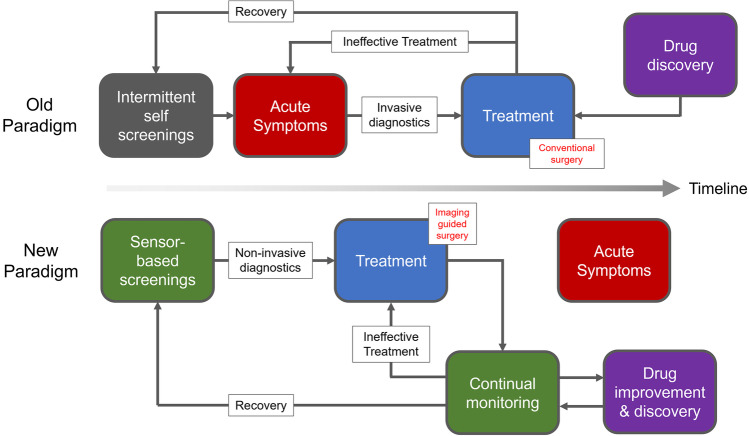
Fig. 1.
Fig. 1.
Reimagining the clinical paradigm with paired molecular sensing and imaging. Through early sensor-based screenings and increasing the clinical monitoring umbrella, acute symptoms can be bypassed, and the effectiveness of treatments can be rapidly assessed. Molecular imaging in turn enables non-invasive diagnoses and improves surgical outcomes through increased surgical precision. Drug development and discovery can also be streamlined with both molecular sensing and imaging as more data, more immediately, is available.
Fig. 2.
Fig. 2.
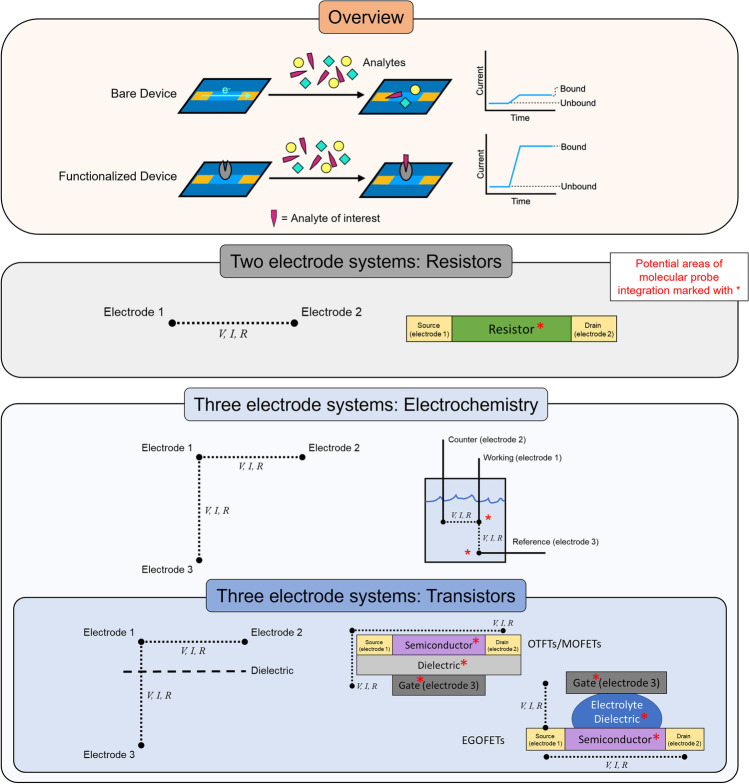
Electronic biosensor architypes and operation. Surface or electrode modifications with exposure to analytes induce altered electrical properties and with functionalization enabling selective responses. Increasing the number of electrodes increases design complexity; however, it also facilitates multiparametric measurements and complex operations such as electrochemical characterization and transistor operation. Molecular probes can be integrated into almost any components to accommodate a variety of sensor designs and implementations.
Fig. 3.
Fig. 3.
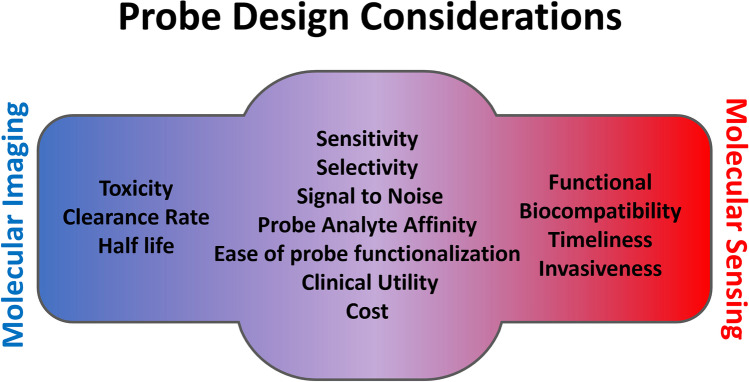
Shared design considerations of molecular imaging and molecular sensing probes. Probes for molecular imaging and molecular sensing share many of the same considerations as they pertain to analyte interaction and signal transduction and thus probes which work for one technique may be applicable to another. Molecular imaging and sensing instead slightly differ in relation to the practical aspects of each technique. Where imaging agents are typically injected into the subject, and thus toxicity, the rate of clearance, and half-life are major concerns, sensors are often outside the subject, interacting only partially with biofluids, and thus necessitate functional biocompatibility, timeliness of response, and minimizing the sampling invasiveness.
Fig. 4.
Fig. 4.
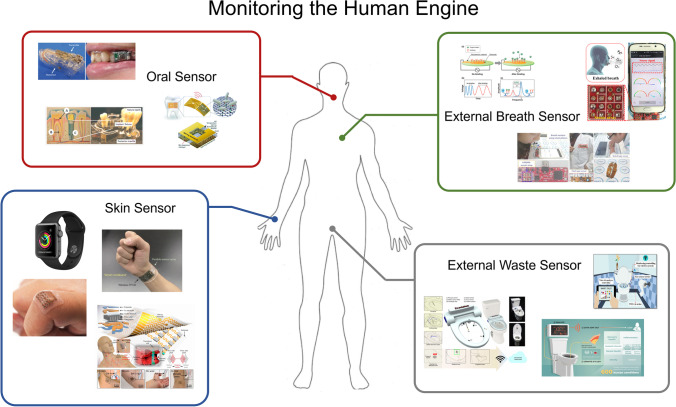
Monitoring the human engine. Examples of recent works to incorporating non-invasive technologies to molecularly monitor a battery of health metrics. While physiological monitoring has become ubiquitous there is a current need for monitoring devices to provide clinically actionable diagnostic data. Complex biomarker monitoring is possible with molecular imaging but still limited in capacity with molecular sensing. (a) Schematic image of a glucose biosensor with mouthguard support and oral implementation ( adapted from ref.146). (b) Proposed intra-oral dental implant system with an integrated three-electrode electrochemical biosensor (from ref.147). (c) Biotransferrable graphene wireless nanosensor (adapted from ref.148). (d) Apple Watch Series 3 with integrated heart rate and blood pressure sensors. (e) A wearable fully integrated sensor array on a subjects wrist for in-situ perspiration analysis (adapted from ref.149). (f, g) Stretchable ultrasonic devices and design schematic for monitoring the central blood pressure waveform (adapted from ref.150). (h) Function of a immuno-piezoelectric biosensor (adapted from ref.151). (i) Electrochemiresistive breath sensing with apoferritin encapsulated nanoparticles (from ref.152) (j) Real-time breath analysis via portable functionalized electrochemical sensing platforms (from ref.153). (k) A mountable toilet system for personalized health monitoring (from ref.154). (l) Real-time health monitoring through urine metabolomics (from ref.155). (m) Urine odor detection by electronic nose for smart toilet applications (from ref.156).
Fig. 5.
Fig. 5.
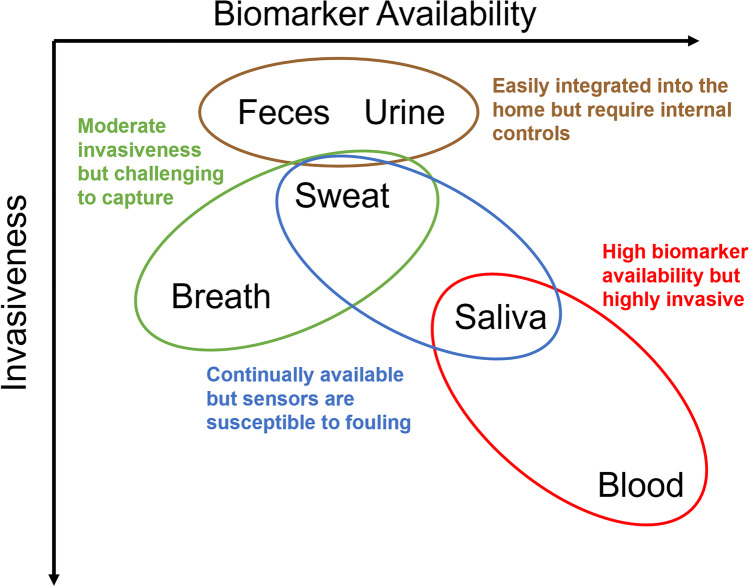
Advantages and disadvantages of commonly assayed biofluids. Biomarker availability is plotted against invasiveness. Ideally, molecular biosensors are as non-invasive as possible; however, biomarker availability for molecular sensing, and thus sampling considerations, is directly related to the routes by which it’s shed, processed, and excreted. Where molecular imaging considers probe delivery to compartments, with probe metabolism and excretion being tied to clearance rate, molecular sensing must instead consider biomarker metabolism and excretion, the relationship to biomarker availability, and the invasiveness by which the biofluid can be assayed.

References

    1. Gambhir, S. S., Ge, T. J., Vermesh, O. & Spitler, R. Toward achieving precision health. Sci. Transl. Med.10, (2018). - PMC - PubMed
    1. Gambhir, S. S., Ge, T. J., Vermesh, O., Spitler, R. & Gold, G. E. Continuous health monitoring: An opportunity for precision health. Sci. Transl. Med.13, (2021). - PubMed
    1. Collins FS, Varmus H. A New Initiative on Precision Medicine. N. Engl. J. Med. 2015;372:793–795. doi: 10.1056/NEJMp1500523. - DOI - PMC - PubMed
    1. Wang C, et al. Advanced Nanotechnology Leading the Way to Multimodal Imaging-Guided Precision Surgical Therapy. Adv. Mater. 2019;31:1904329. doi: 10.1002/adma.201904329. - DOI - PubMed
    1. Terris M. Evolution of Public Health and Preventive Medicine in the United States. Am. J. Public Health. 1975;65:161–169. doi: 10.2105/AJPH.65.2.161. - DOI - PMC - PubMed

Publication types

LinkOut - more resources