Review
. 2022 Mar;39(3):427-439.
doi: 10.1007/s11095-022-03185-2. Epub 2022 Mar 7.

"Focused Ultrasound-mediated Drug Delivery in Humans - a Path Towards Translation in Neurodegenerative Diseases"

Affiliations
Review

"Focused Ultrasound-mediated Drug Delivery in Humans - a Path Towards Translation in Neurodegenerative Diseases"

Joanna M Wasielewska et al. Pharm Res. 2022 Mar.

Abstract

The blood-brain barrier (BBB) has a major protective function in preventing the entry of harmful molecules into the brain, but is simultaneously limiting the delivery of drugs, restricting their potential clinical application in neurodegenerative diseases. Recent preclinical evidence demonstrates that following application of focused ultrasound with microbubbles (FUS+MB), the BBB becomes reversibly accessible to compounds that normally are brain-impermeable, suggesting FUS+MB as a promising new platform for delivery of therapeutic agents into the central nervous system. As a step towards translation, small cohort clinical studies were performed demonstrating safe BBB opening in Alzheimer's disease, Parkinson's disease and amyotrophic lateral sclerosis (ALS) patients following FUS+MB, however improved drug delivery has not yet been achieved in human. Simultaneously, rapid progress in the human induced pluripotent stem cell (hiPSC) modeling technology allowed for development of novel Alzheimer's disease patient-derived BBB in vitro model that reacts to FUS+MB with BBB opening and can be used to answer fundamental questions of human BBB responses to FUS+MB in health and disease. This review summarizes key features of the BBB that contribute to limited drug delivery, recapitulates recent advances in the FUS+MB mediated human BBB opening in vivo and in vitro in the context of neurodegenerative disorders, and highlights potential strategies for fast-track translation of the FUS+MB to improve bioavailability of drugs to the human brain. With safe and effective application, this innovative FUS+MB technology may open new avenues for therapeutic interventions in neurodegenerative diseases leading to improved clinical outcomes for patients.

Keywords: Blood-brain barrier; Drug delivery; Focused ultrasound; Human-induced pluripotent stem cell; Neurodegenerative disease.


Conflict of interest statement

Joanna M. Wasielewska and Anthony R. White declare that they have no conflict of interest.

Figures
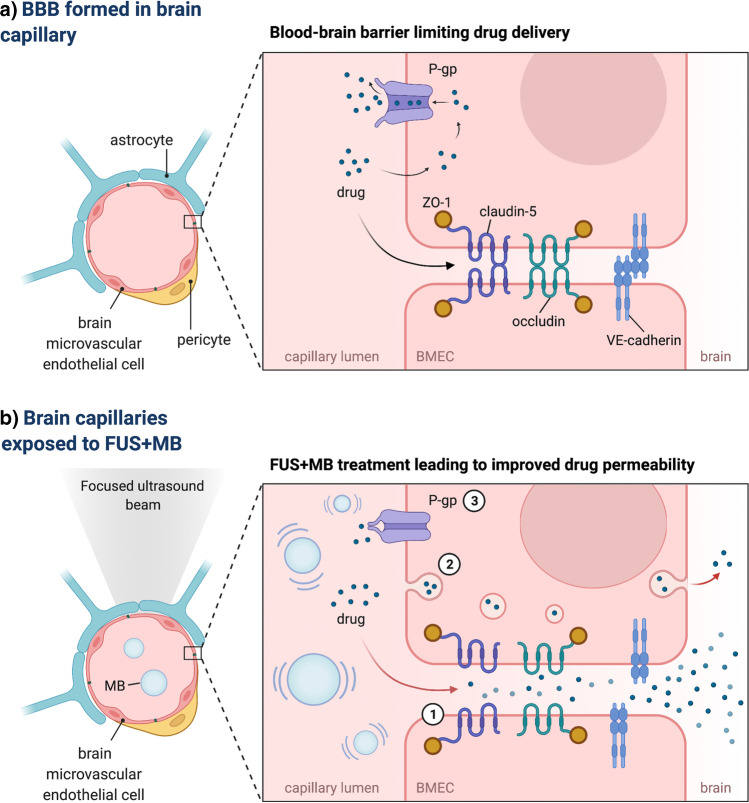
Fig. 1
Fig. 1
Proposed mechanisms of focused ultrasound and microbubble mediated drug delivery at the blood-brain barrier. (a) Physiologically, the blood-brain barrier (BBB) formed by brain microvascular endothelial cells (BMEC), pericytes and astrocytes restricts the permeability of delivered drugs from the blood into the brain. The presence of tight- and adherens junctions containing transmembrane adhesion proteins such as vascular endothelial (VE)-cadherin, occludin, claudin-5 and zonula occludens-1 (ZO-1) accessory protein prevents paracellular transport of most hydrophilic molecules. Efflux transporters as P-glycoprotein (P-gp) actively remove a wide range of drugs from the BMEC cytoplasm, including small (< 400 Da) lipophilic molecules that might otherwise passively diffuse across BMEC to brain parenchyma. Transcytosis of molecules through the BBB is largely limited, significantly impeding the entry of therapeutic agents into the brain. (b) Preclinical observations identify three proposed routes of focused ultrasound and microbubble (FUS+MB) mediated drug delivery at the BBB. (1) MB oscillating in the ultrasonic field produce mechanical forces on the of tight- and adherens junctions, leading to temporal junction opening and improved paracellular transport of delivered drug. (2) FUS+MB treatment causes increase in the number of intracellular vesicles and upregulation of endo- and transcytosis at BMEC suggesting stimulation of transcellular transport at the BBB. (3) Exposure to FUS+MB temporarily (48-72 h) suppresses expression of P-gp at BMEC, potentially limiting drug efflux at the BBB. [1, 28, 31, 32, 118, 119]. BBB-blood-brain barrier; BMEC- brain microvascular endothelial cell; FUS+MB- focused ultrasound and microbubble; P-gp- P-glycoprotein; ZO-1-zonnula occludens; VE-cadherin- vascular endothelial cadherin; Figure created with BioRender.com.
Fig. 2
Fig. 2
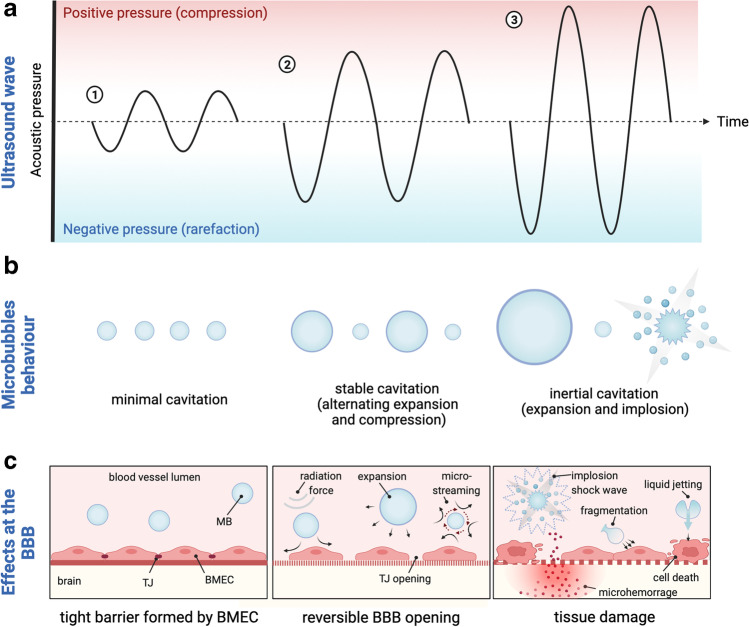
The interplay between focused ultrasound, microbubbles and cerebral vasculature. Physical interactions between ultrasonic wave (a) and microbubbles (MB) (b) determine the bioeffects at the blood-brain barrier (BBB) (c). When exposed to the ultrasound wave, MB decrease in diameter during the compression portion of the wave and increase during the rarefaction phase. (1) Ultrasound applied at insufficient acoustic pressure causes minimal volumetric oscillations of MB and the BBB remains closed. (2) Optimal ultrasound acoustic pressure induces stable MB contraction and expansion (stable cavitation) that exerts mechanical forces on brain microvascular endothelial cells (BMEC), leading to reversible BBB opening. Linearly cavitating MB generate the flow of liquid/blood around themselves (microstreaming) that in turn produces sheer stress on BMEC membrane, causing increased BBB permeability. Expanding MB create tension at tight junction (TJ) proteins leading to junction opening. Acoustic radiation force propels oscillating MB to the BMEC layer, further enhancing MB and BBB interactions. (3) At higher acoustic pressures, MB collapse violently, producing shock waves and micro-jets. This abrupt inertial cavitation generates strong mechanical stress at the BBB leading to permanent TJ disruption, irreversible BMEC membrane perforation, microhemorrhage and tissue necrosis. [, , , –35]. BBB-blood-brain barrier; BMEC- brain microvascular endothelial cell; MB-microbubble; TJ-tight junction; Figure created with BioRender.com.
Fig. 3
Fig. 3
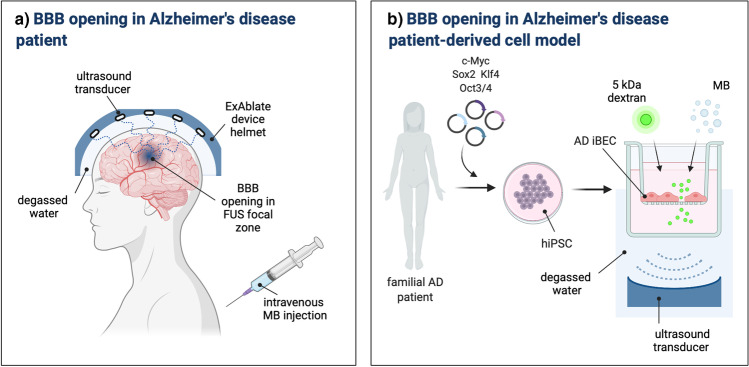
Schematic representation of blood-brain barrier opening in Alzheimer’s disease patient in vivo and patient-derived model in vitro. (a) Schematic of a magnetic resonance (MR)-guided ExAblate device used in the first successful blood-brain barrier (BBB) opening in Alzheimer’s disease (AD) patients. System consists of a hemispherical helmet lined with >1000 independent transducer elements delivering low frequency ultrasound treatment to the prescribed target. The helmet is positioned in the specialised MRI bed with stereotaxic frame and the space between patient’s head and the helmet filled with degassed water for acoustic coupling. Microbubble (MB) administration is carried out using repeated bolus injection or a continuous infusion. Reversible BBB opening occurs in the defined ultrasound focal zone. (b) Schematic of AD patient-derived human BBB opening in vitro. Somatic cells (e.g. fibroblasts or blood cells) are obtained from familial AD patients and reprogrammed to human induced pluripotent stem cells (hiPSC) by introduction of cocktail of reprogramming factors. hiPSC are used to generate brain endothelial-like cells (iBEC) and develop patient-derived in vitro AD BBB model. In vitro BBB is exposed to focused ultrasound and MB in the degassed water, leading to BBB opening and improved permeability of 5 kDa dextran. [44, 84]. AD-Alzheimer’s disease; BBB-blood-brain barrier; FUS-focused ultrasound; hiPSC-human induced pluripotent stem cell; iBEC- brain endothelial-like cells; kDa-kilodalton; MB-microbubble; Figure created with BioRender.com.

References

    1. Sweeney MD, Zhao Z, Montagne A, Nelson A, Zlokovic B. Blood-brain barrier: from physiology to disease and back. Physiological Reviews. 2019;99(1):21–78. - PMC - PubMed
    1. Wasielewska JM, Da Silva Chaves JC, White AR, Oikari LE. Modeling the Blood–Brain Barrier to Understand Drug Delivery in Alzheimer’s Disease. In: Huang X, editor. Alzheimer’s Disease: Drug Discovery. Brisbane (AU): Exon Publications; 2020 - PubMed
    1. Satchell SC, Braet F. Glomerular endothelial cell fenestrations: an integral component of the glomerular filtration barrier. Am J Physiol Renal Physiol. 2009;296(5):F947–F956. - PMC - PubMed
    1. Bauer H-C, Krizbai IA, Bauer H, Traweger A. “You Shall Not Pass”-tight junctions of the blood brain barrier. Front Neurosci. 2014;8:392–392. - PMC - PubMed
    1. Stewart PA. Endothelial vesicles in the blood-brain barrier: are they related to permeability? Cell Mol Neurobiol. 2000;20(2):149–163. - PMC - PubMed