. 2022 Apr;167(4):1089-1098.
doi: 10.1007/s00705-021-05356-9. Epub 2022 Mar 8.

Construction of full-length infectious clones of turnip mosaic virus isolates infecting Perilla frutescens and genetic analysis of recently emerged strains in Korea

Affiliations

Construction of full-length infectious clones of turnip mosaic virus isolates infecting Perilla frutescens and genetic analysis of recently emerged strains in Korea

Zheng-Xing Song et al. Arch Virol. 2022 Apr.

Abstract

Perilla is an annual herb with a unique aroma and taste that has been cultivated in Korea for hundreds of years. It has been widely cultivated in many Asian and European countries as a food and medicinal crop. Recently, several viruses have been reported to cause diseases in perilla in Korea, including turnip mosaic virus (TuMV), which is known as a brassica pathogen due to its significant damage to brassica crops. In this study, we determined the complete genome sequences of two new TuMV isolates originating from perilla in Korea. Full-length infectious cDNA clones of these two isolates were constructed, and their infectivity was tested by agroinfiltration of Nicotiana benthamiana and sap inoculation of Chinese cabbage and radish plants. In addition, we analyzed the phylogenetic relationship of six new Korean TuMV isolates to members of the four major groups. We also used RDP4 software to conduct recombination analysis of recent isolates from Korea, which provided new insight into the evolutionary relationships of Korean isolates of TuMV.


Conflict of interest statement

The authors declare that they have no conflict of interest.

Figures
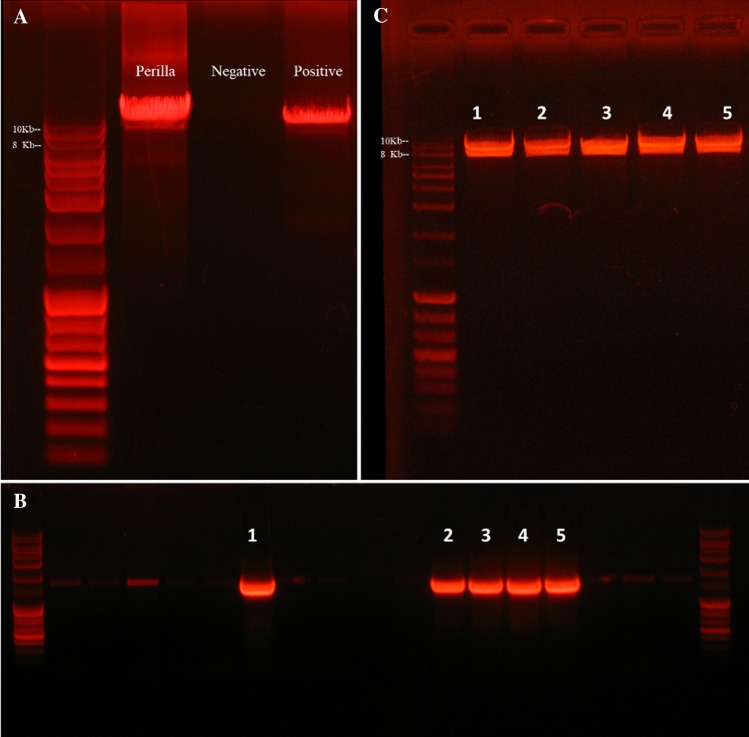
Fig. 1
Fig. 1
(A) Results of PCR amplification of the full-length grenome of TuMV from perilla, with negative and positive controls. cDNA from a TuMV isolate that had previously been amplified successfully served as a positive control. (B) Colony PCR results of screening for full-length TuMV clones. (C) Confirmation of the positive colonies by digestion with ApaI and XmaI.
Fig. 2
Fig. 2
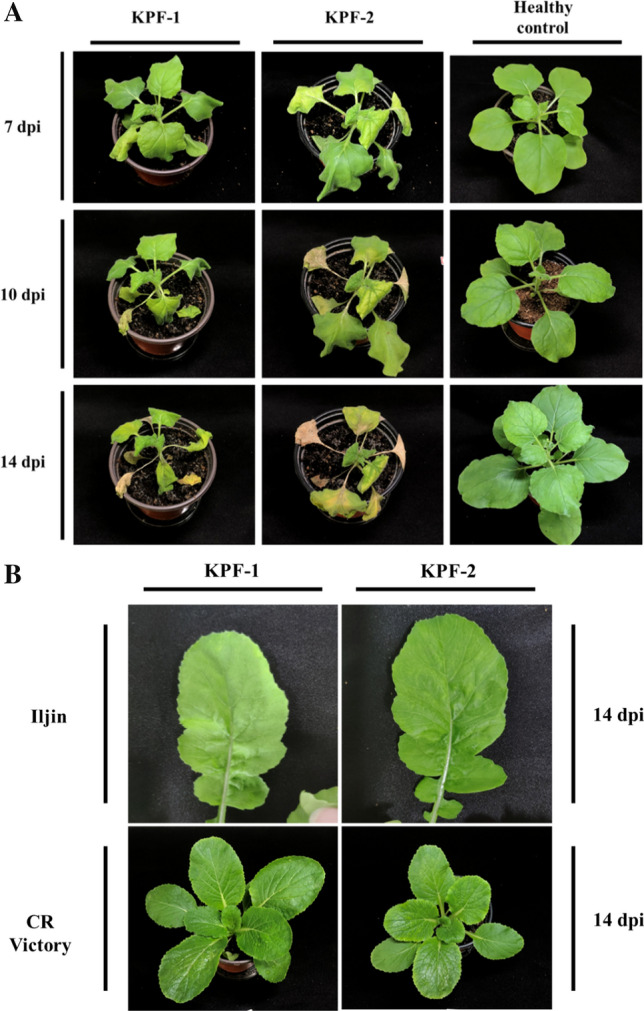
(A) Symptoms induced by the TuMV isolates KPF-1 and KPF-2 on Nicotiana benthamiana at 7, 10, and 14 dpi. (B) Symptoms induced by the isolates KPF-1 and KPF-2 on radish cv. Iljin and Chinese cabbage cv. CR Victory at 14 dpi
Fig. 3
Fig. 3
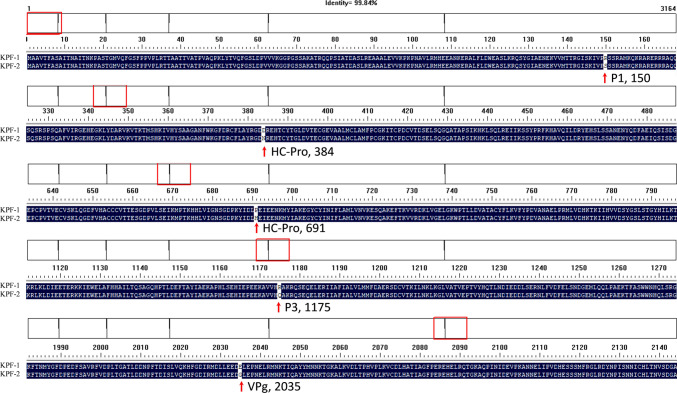
The positions of amino acid differences in the polyproteins of TuMV isolates KPF-1 and KPF-2
Fig. 4
Fig. 4
A phylogenetic tree constructed by the maximum-likelihood method with 1000 bootstrap replicates, using MEGA 7.0, based on the complete genome nucleotide sequence of TuMV isolates from around the world. The genome sequence of potato virus Y was used to root the tree. Labels show the isolate name or abbreviation/GenBank accession number/original host (Table 2). The labels of the new Korean isolates from perilla (KPF-1, KPF-2), radish (KRS-3, KRS-8), and Chinese cabbage (KBC-1, KBC-8) are shown in bold font on pink bars.
Fig. 5
Fig. 5
A phylogenetic tree constructed by the maximum-likelihood method with 1000 bootstrap replicates, using MEGA 7.0, based on the complete genome nucleotide sequence of Korean TuMV isolates. The genome sequence of potato virus Y was used to root the tree. Labels show the isolate name or abbreviation/GenBank accession number. For further details including the host plant, see Table 2. The labels of the new Korean isolates from perilla (KPF-1, KPF-2), radish (KRS-3, KRS-8), and Chinese cabbage (KBC-1, KBC-8) are shown in bold font.
Fig. 6
Fig. 6
Recombination events identified using RDP4, supported by all seven detection methods (see Table 4). Recombination events 1 and 3 were detected in isolate BE, and event 2 was detected in isolates HJY1, HJY2, and R007.

References

    1. Lee BH, Lee ST, Kim YS. Reference review for the scientific researches on perilla. RDA J Ind Crop Sci. 1998;40:80–112.
    1. Seo WH, Baek HH. Characteristic aroma-active compounds of Korean perilla (Perilla frutescens Britton) leaf. J Agric Food Chem. 2009;57:11537–11542. doi: 10.1021/jf902669d. - DOI - PubMed
    1. Dhyani A, Chopra R, Garg M. A review on nutritional value, functional properties and pharmacological application of Perilla (Perilla frutescens L.) Biomed Pharmacol J. 2019;12:649–660. doi: 10.13005/bpj/1685. - DOI
    1. Nitta M, Lee JK, Ohnishi O. Asian Perilla crops and their weedy forms: Their cultivation, utilization and genetic relationships. Econ Bot. 2003;57:245–253. doi: 10.1663/0013-0001(2003)057[0245:APCATW]2.0.CO;2. - DOI
    1. Nitta M, Lee JK, Kang CW, Katsuta M, Yasumoto S, Liu DJ, Nagamine T, Ohnishi O. The distribution of Perilla species. Genet Resour Crop Ev. 2005;52:797–804. doi: 10.1007/s10722-003-6017-5. - DOI

Supplementary concepts

LinkOut - more resources