


Effects of Ocean Warming on the Underexplored Members of the Coral Microbiome
- PMID: 35259253
- PMCID: PMC9801979
- DOI: 10.1093/icb/icac005
Effects of Ocean Warming on the Underexplored Members of the Coral Microbiome
Abstract
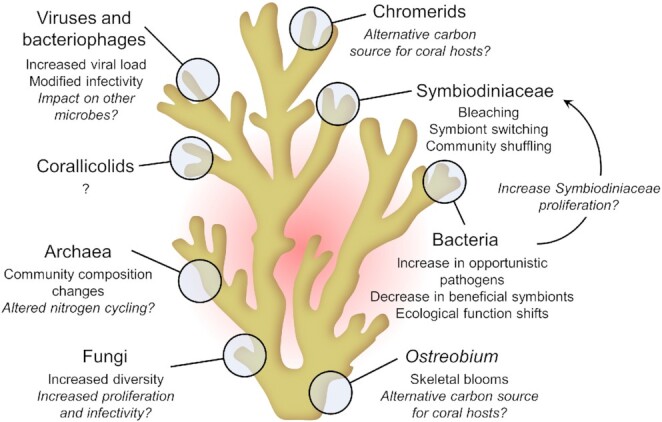
The climate crisis is one of the most significant threats to marine ecosystems. It is leading to severe increases in sea surface temperatures and in the frequency and magnitude of marine heatwaves. These changing conditions are directly impacting coral reef ecosystems, which are among the most biodiverse ecosystems on Earth. Coral-associated symbionts are particularly affected because summer heatwaves cause coral bleaching-the loss of endosymbiotic microalgae (Symbiodiniaceae) from coral tissues, leading to coral starvation and death. Coral-associated Symbiodiniaceae and bacteria have been extensively studied in the context of climate change, especially in terms of community diversity and dynamics. However, data on other microorganisms and their response to climate change are scarce. Here, we review current knowledge on how increasing temperatures affect understudied coral-associated microorganisms such as archaea, fungi, viruses, and protists other than Symbiodiniaceae, as well as microbe-microbe interactions. We show that the coral-microbe symbiosis equilibrium is at risk under current and predicted future climate change and argue that coral reef conservation initiatives should include microbe-focused approaches.
© The Author(s) 2022. Published by Oxford University Press on behalf of the Society for Integrative and Comparative Biology.
Figures
References
-
- Agostini S, Suzuki Y, Casareto BE, Nakano Y, Hidaka M, Badrun N.. 2009. Coral symbiotic complex: Hypothesis through vitamin B12 for a new evaluation. Galaxea, J Coral Reef Stud. 11:1–11.
-
- Ainsworth TD, Fordyce AJ, Camp EF.. 2017. The Other Microeukaryotes of the Coral Reef Microbiome. Trends Microbiol. 25:980–91. - PubMed
-
- Baker AC. 2003. Flexibility and Specificity in Coral-Algal Symbiosis: Diversity, Ecology, and Biogeography of Symbiodinium. Annu Rev Ecol Evol Syst. 34:661–89.
Publication types
MeSH terms
LinkOut - more resources
Full Text Sources
