


Positive signs on physical examination are not always indications for endotracheal tube intubation in patients with facial burn
- PMID: 35260094
- PMCID: PMC8903723
- DOI: 10.1186/s12873-022-00594-9
Positive signs on physical examination are not always indications for endotracheal tube intubation in patients with facial burn
Abstract
Background: After clinical evaluation in the emergency department (ED), facial burn patients are usually intubated to protect their airways. However, the possibility of unnecessary intubation or delayed intubation after admission exists. Objective criteria for the evaluation of inhalation injury and the need for airway protection in facial burn patients are needed.
Methods: Facial burn patients between January 2013 and May 2016 were reviewed. Patients who were and were not intubated in the ED were compared. All the intubated patients received routine bronchoscopy and laboratory tests to evaluate whether they had inhalation injuries. The patients with and without confirmed inhalation injuries were compared. Multivariate logistic regression analysis was used to identify the independent risk factors for inhalation injuries in the facial burn patients. The reasons for intubation in the patients without inhalation injuries were also investigated.
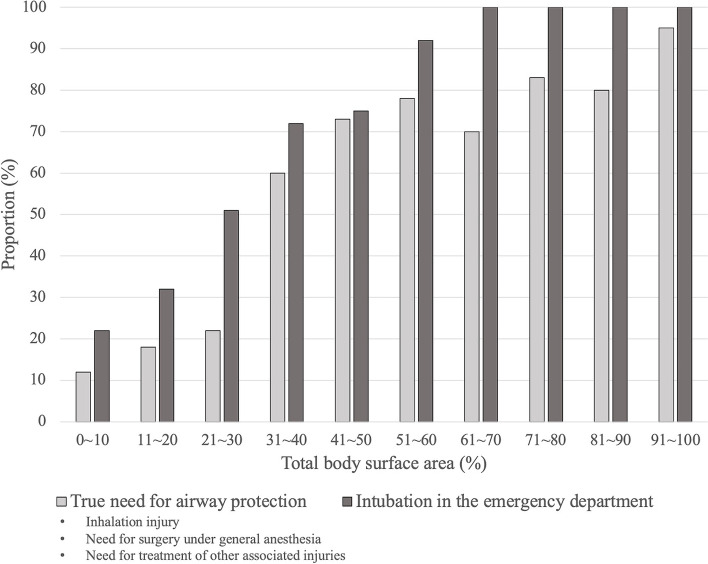
Results: During the study period, 121 patients were intubated in the ED among a total of 335 facial burn patients. Only 73 (60.3%) patients were later confirmed to have inhalation injuries on bronchoscopy. The comparison between the patients with and without inhalation injuries showed that shortness of breath (odds ratio = 3.376, p = 0.027) and high total body surface area (TBSA) (odds ratio = 1.038, p = 0.001) were independent risk factors for inhalation injury. Other physical signs (e.g., hoarseness, burned nostril hair, etc.), laboratory examinations and chest X-ray findings were not predictive of inhalation injury in facial burn patients. All the patients with a TBSA over 60% were intubated in the ED even if they did not have inhalation injuries.
Conclusions: In the management of facial burn patients, positive signs on conventional physical examinations may not always be predictive of inhalation injury and the need for endotracheal tube intubation in the ED. More attention should be given to facial burn patients with shortness of breath and a high TBSA. Airway protection is needed in facial burn patients without inhalation injuries because of their associated injuries and treatments.
Keywords: Endotracheal tube; Facial burn; Short of breath; TBSA.
© 2022. The Author(s).
Conflict of interest statement
No competing interests.
Figures

References
-
- Mock C, Peck M, Peden M, Krug E, editors. A WHO plan for burn prevention and care. Geneva: World Health Organisation; 2008.
MeSH terms
LinkOut - more resources
Full Text Sources
Medical
