


Declining trends in birth prevalence and severity of singletons with cerebral palsy of prenatal or perinatal origin in Australia: A population-based observational study
- PMID: 35261024
- PMCID: PMC9544021
- DOI: 10.1111/dmcn.15195
Declining trends in birth prevalence and severity of singletons with cerebral palsy of prenatal or perinatal origin in Australia: A population-based observational study
Abstract
Aim: To investigate temporal trends in birth prevalence, disability severity, and motor type for singletons with prenatal or perinatally acquired cerebral palsy (CP).
Method: Numerator data, number of children with CP born a singleton between 1995 and 2014, confirmed at 5 years of age, were drawn from three state registers with population-level ascertainment. Birth prevalence estimates and 95% confidence intervals (CI) were calculated per 1000 singleton live births for the three states combined, overall, by gestational age group, by dichotomized disability severity, and spastic laterality. Poisson regression models were used to analyse trends. Using data from all eight registers, trends in the proportional distribution of CP subtypes overall and stratified by gestational age were examined.
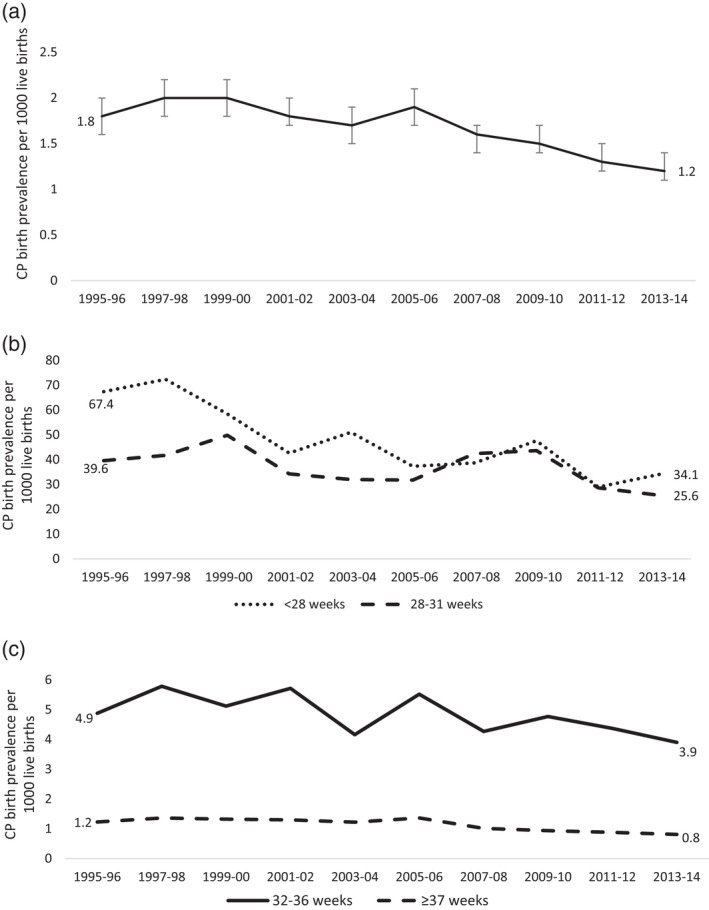
Results: Birth prevalence of CP declined from 1.8 (95% CI 1.6-2.0) in 1995 to 1996 to 1.2 (95% CI 1.1-1.4) in 2013 to 2014 (average 5% per 2-year epoch, p < 0.001). Declines in birth prevalence were observed across all gestational age groups with the largest decline in children born at <28 weeks (average 8% per epoch, p < 0.001). Prevalence of moderate-severe disability declined for children born at <28 and ≥37 weeks (average 11% and 7% per epoch respectively, p < 0.001). The proportions of bilateral spastic CP declined (p < 0.001) at <28 weeks (p = 0.014) and ≥37 weeks (p < 0.001). The proportion of children with dyskinesia increased (28-31 weeks: p = 0.021, 32-36 weeks: p = 0.001, and ≥37 weeks: p < 0.001).
Interpretation: Birth prevalence of CP and moderate-severe disability (<28 and ≥37 weeks) declined in Australian singletons between 1995 and 2014, reflecting changes in prenatal and perinatal care over time.
What this paper adds: Declines in birth prevalence of prenatal or perinatally acquired cerebral palsy were observed for singletons born in Australia between 1995 and 2014. These declines were evident across all gestational age groups. Declines in birth prevalence of moderate-severe disability were observed for children born at <28 weeks and ≥37 weeks.
© 2022 The Authors. Developmental Medicine & Child Neurology published by John Wiley & Sons Ltd on behalf of Mac Keith Press.
Figures

Comment in
-
Changing trends in cerebral palsy prevalence: an opportunity to consider etiological pathways.Dev Med Child Neurol. 2022 Sep;64(9):1054-1055. doi: 10.1111/dmcn.15223. Epub 2022 Mar 23. Dev Med Child Neurol. 2022. PMID: 35322400 Free PMC article.
References
-
- Rosenbaum P, Paneth N, Leviton A, Goldstein M, Bax M. A report: the definition and classification of cerebral palsy April 2006. Dev Med Child Neurol. 2007;49:8–14. - PubMed
-
- ACPR Group . Report of the Australian Cerebral Palsy Register Birth Years 1995‐2012; 2018. Available from: https://cpregister.com/wp‐content/uploads/2019/02/Report‐of‐the‐Australi... (Accessed 2nd December 2021).
-
- Khandaker G, Muhit M, Karim T, Smithers‐Sheedy H, Novak I, Jones C, Badawi N. Epidemiology of cerebral palsy in Bangladesh: a population‐based surveillance study. Dev Med Child Neurol. 2019;61(5):601–9. - PubMed
-
- Reid SM, Meehan E, McIntyre S, Goldsmith S, Badawi N, Reddihough DS. Temporal trends in cerebral palsy by impairment severity and birth gestation. Dev Med Child Neurol. 2016;58(Suppl 2):25–35. - PubMed
Publication types
MeSH terms
LinkOut - more resources
Full Text Sources
Medical
Miscellaneous
