


Machine learning techniques applied to mechanical fault diagnosis and fault prognosis in the context of real industrial manufacturing use-cases: a systematic literature review
- PMID: 35261480
- PMCID: PMC8894092
- DOI: 10.1007/s10489-022-03344-3
Machine learning techniques applied to mechanical fault diagnosis and fault prognosis in the context of real industrial manufacturing use-cases: a systematic literature review
Abstract
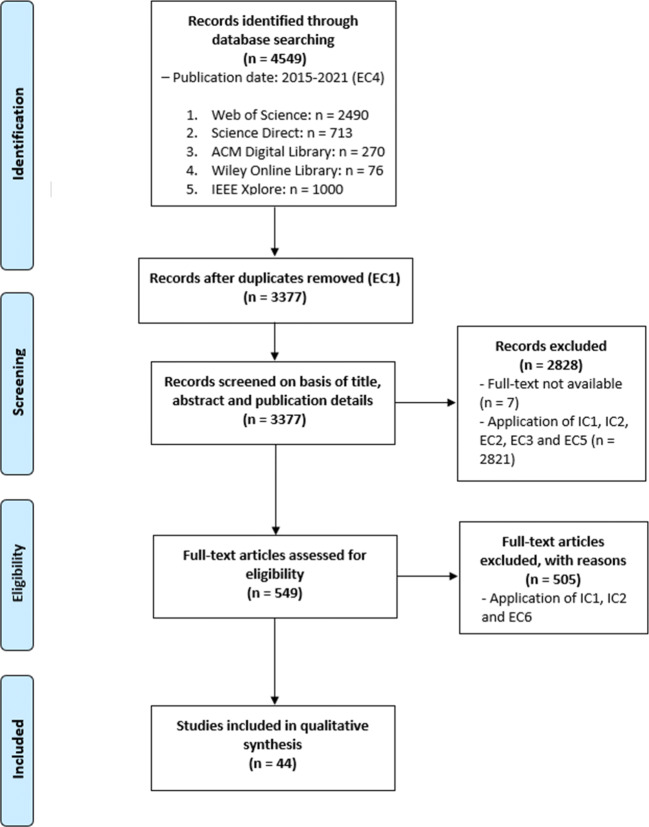
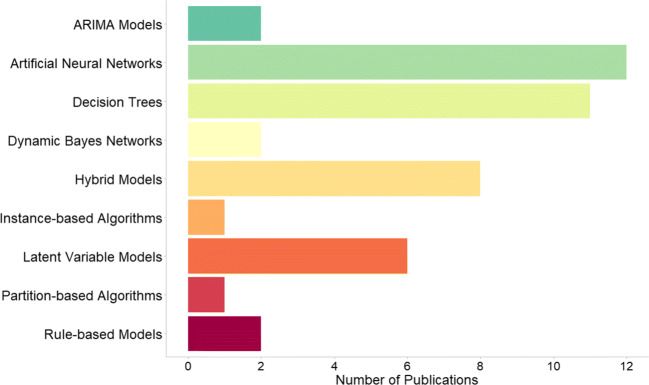
When put into practice in the real world, predictive maintenance presents a set of challenges for fault detection and prognosis that are often overlooked in studies validated with data from controlled experiments, or numeric simulations. For this reason, this study aims to review the recent advancements in mechanical fault diagnosis and fault prognosis in the manufacturing industry using machine learning methods. For this systematic review, we searched Web of Science, ACM Digital Library, Science Direct, Wiley Online Library, and IEEE Xplore between January 2015 and October 2021. Full-length studies that employed machine learning algorithms to perform mechanical fault detection or fault prognosis in manufacturing equipment and presented empirical results obtained from industrial case-studies were included, except for studies not written in English or published in sources other than peer-reviewed journals with JCR Impact Factor, conference proceedings and book chapters/sections. Of 4549 records, 44 primary studies were selected. In 37 of those studies, fault diagnosis and prognosis were performed using artificial neural networks (n = 12), decision tree methods (n = 11), hybrid models (n = 8), or latent variable models (n = 6), with one of the studies employing two different types of techniques independently. The remaining studies employed a variety of machine learning techniques, ranging from rule-based models to partition-based algorithms, and only two studies approached the problem using online learning methods. The main advantages of these algorithms include high performance, the ability to uncover complex nonlinear relationships and computational efficiency, while the most important limitation is the reduction in model performance in the presence of concept drift. This review shows that, although the number of studies performed in the manufacturing industry has been increasing in recent years, additional research is necessary to address the challenges presented by real-world scenarios.
Keywords: Fault detection; Fault prognosis; Industrial case-study; Machine learning; Manufacturing industry; Predictive maintenance.
© The Author(s), under exclusive licence to Springer Science+Business Media, LLC, part of Springer Nature 2022.
Conflict of interest statement
Conflict of InterestsThe authors declare that they have no conflict of interest.
Figures
References
-
- Aboelmaged MG. Predicting e-readiness at firm-level: An analysis of technological, organizational and environmental (TOE) effects on e-maintenance readiness in manufacturing firms. Int J Inf Manag. 2014;34(5):639–651. doi: 10.1016/j.ijinfomgt.2014.05.002. - DOI
-
- Holmberg K, Adgar A, Arnaiz A, Jantunen E, Mascolo J (2010). In: Holmberg K, Adgar A, Arnaiz A, Jantunen E, Mascolo J, Mekid S (eds) E-maintenance. Springer, London
-
- Muller A, Crespo Marquez A, Iung B. On the concept of e-maintenance: Review and current research. Reliab Eng Syst Saf. 2008;93(8):1165–1187. doi: 10.1016/j.ress.2007.08.006. - DOI
-
- Mobley R K (2001) Predictive Maintenance. In: Plant Engineer’s Handbook. Elsevier, pp 867–888
-
- Sullivan G, Pugh R, Melendez A P, Hunt WD (2010) Operations & maintenance best practices-a guide to achieving operational efficiency (release 3). Technical Report, Pacific Northwest National Lab.(PNNL), Richland
LinkOut - more resources
Full Text Sources
Other Literature Sources