


Eculizumab discontinuation in atypical haemolytic uraemic syndrome: TMA recurrence risk and renal outcomes
- PMID: 35261761
- PMCID: PMC8894930
- DOI: 10.1093/ckj/sfab005
Eculizumab discontinuation in atypical haemolytic uraemic syndrome: TMA recurrence risk and renal outcomes
Abstract
Background: Eculizumab modifies the course of disease in patients with atypical haemolytic uraemic syndrome (aHUS), but data evaluating whether eculizumab discontinuation is safe are limited.
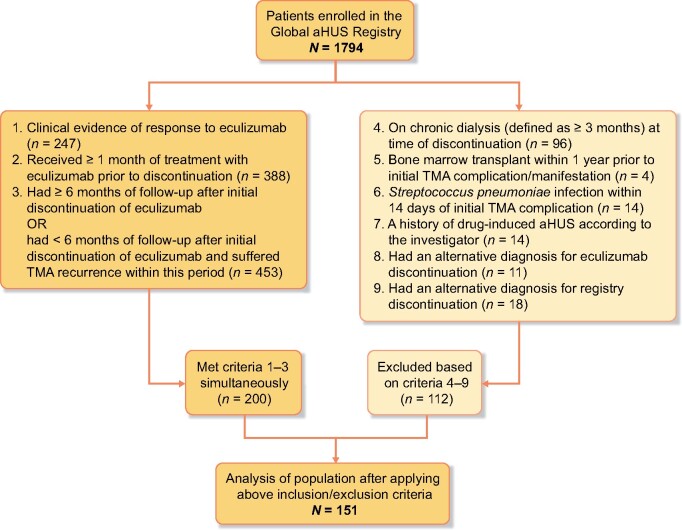
Methods: Patients enrolled in the Global aHUS Registry who received ≥1 month of eculizumab before discontinuing, demonstrated haematologic or renal response prior to discontinuation and had ≥6 months of follow-up were analysed. The primary endpoint was the proportion of patients suffering from thrombotic microangiopathy (TMA) recurrence after eculizumab discontinuation. Additional endpoints included: estimated glomerular filtration rate changes following eculizumab discontinuation to last available follow-up; number of TMA recurrences; time to TMA recurrence; proportion of patients restarting eculizumab; and changes in renal function.
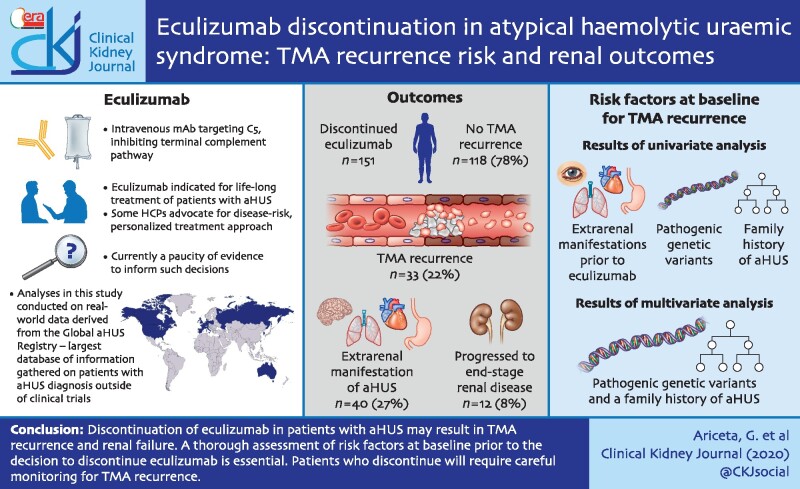
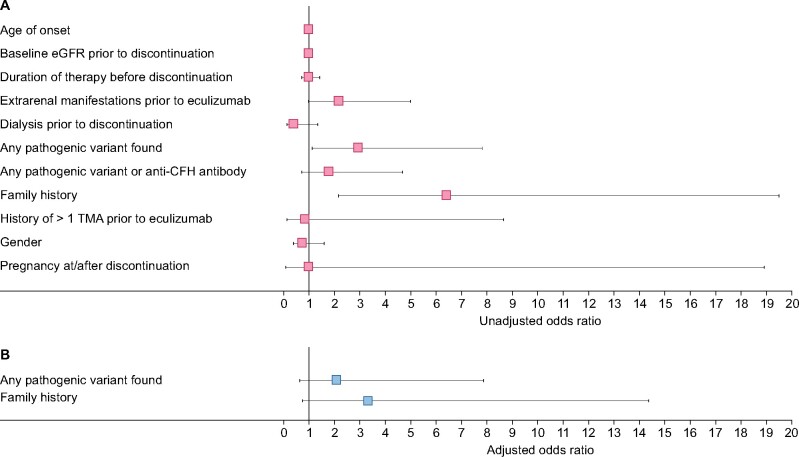
Results: We analysed 151 patients with clinically diagnosed aHUS who had evidence of haematologic or renal response to eculizumab, before discontinuing. Thirty-three (22%) experienced a TMA recurrence. Univariate analysis revealed that patients with an increased risk of TMA recurrence after discontinuing eculizumab were those with a history of extrarenal manifestations prior to initiating eculizumab, pathogenic variants or a family history of aHUS. Multivariate analysis showed an increased risk of TMA recurrence in patients with pathogenic variants and a family history of aHUS. Twelve (8%) patients progressed to end-stage renal disease after eculizumab discontinuation; seven (5%) patients eventually received a kidney transplant. Forty (27%) patients experienced an extrarenal manifestation of aHUS after eculizumab discontinuation.
Conclusions: Eculizumab discontinuation in patients with aHUS is not without risk, potentially leading to TMA recurrence and renal failure. A thorough assessment of risk factors prior to the decision to discontinue eculizumab is essential.
Keywords: GFR; anaemia; haemoglobin; thrombosis; thrombotic microangiopathy.
© The Author(s) 2021. Published by Oxford University Press on behalf of ERA-EDTA.
Figures
References
-
- EMA. EU/3/09/653. 2011. https://www.Ema.Europa.Eu/en/medicines/human/orphan-designations/eu309653 (22 January 2021, date last accessed)
-
- FDA. Eculizumab (soliris). 2011. http://wayback.Archive-it.Org/7993/20170113081126/ (22 January 2021, date last accessed)
LinkOut - more resources
Full Text Sources
