


Overexpression of mGDH in Gluconobacter oxydans to improve D-xylonic acid production from corn stover hydrolysate
- PMID: 35264166
- PMCID: PMC8905809
- DOI: 10.1186/s12934-022-01763-y
Overexpression of mGDH in Gluconobacter oxydans to improve D-xylonic acid production from corn stover hydrolysate
Abstract
Background: D-Xylonic acid is a versatile platform chemical with broad potential applications as a water reducer and disperser for cement and as a precursor for 1,4-butanediol and 1,2,4-tributantriol. Microbial production of D-xylonic acid with bacteria such as Gluconobacter oxydans from inexpensive lignocellulosic feedstock is generally regarded as one of the most promising and cost-effective methods for industrial production. However, high substrate concentrations and hydrolysate inhibitors reduce xylonic acid productivity.
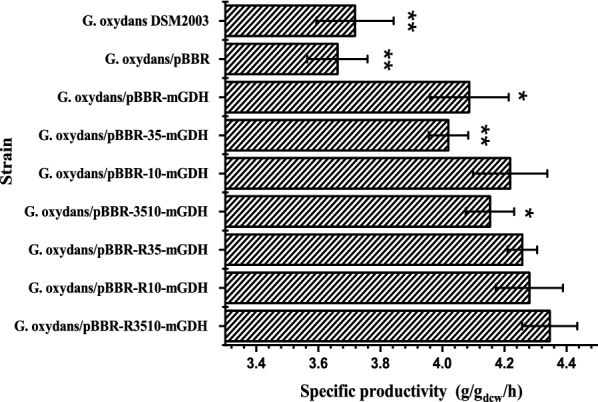
Results: The D-xylonic acid productivity of G. oxydans DSM2003 was improved by overexpressing the mGDH gene, which encodes membrane-bound glucose dehydrogenase. Using the mutated plasmids based on pBBR1MCS-5 in our previous work, the recombinant strain G. oxydans/pBBR-R3510-mGDH was obtained with a significant improvement in D-xylonic acid production and a strengthened tolerance to hydrolysate inhibitors. The fed-batch biotransformation of D-xylose by this recombinant strain reached a high titer (588.7 g/L), yield (99.4%), and volumetric productivity (8.66 g/L/h). Moreover, up to 246.4 g/L D-xylonic acid was produced directly from corn stover hydrolysate without detoxification at a yield of 98.9% and volumetric productivity of 11.2 g/L/h. In addition, G. oxydans/pBBR-R3510-mGDH exhibited a strong tolerance to typical inhibitors, i.e., formic acid, furfural, and 5-hydroxymethylfurfural.
Conclusion: Through overexpressing mgdh in G. oxydans, we obtained the recombinant strain G. oxydans/pBBR-R3510-mGDH, and it was capable of efficiently producing xylonic acid from corn stover hydrolysate under high inhibitor concentrations. The high D-xylonic acid productivity of G. oxydans/pBBR-R3510-mGDH made it an attractive choice for biotechnological production.
Keywords: D-xylonic acid; Gluconobacter oxydans; Lignocellulosic hydrolysate; Membrane-bound glucose dehydrogenase.
© 2022. The Author(s).
Conflict of interest statement
The authors declare that they have no competing of interests.
Figures


References
-
- Chun BW, Dair B, Macuch PJ, Wiebe D, Porteneuve C, Jeknavorian A. The development of cement and concrete additive: based on xylonic acid derived via bioconversion of xylose. Appl Biochem Biotechnol. 2006;129–132:645–658. - PubMed
-
- Zhang H, Liu G, Zhang J, Bao J. Fermentative production of high titer gluconic and xylonic acids from corn stover feedstock by Gluconobacter oxydans and techno-economic analysis. Bioresour Technol. 2016;219:123–131. - PubMed
-
- Zamora F, Bueno M, Molina I, Iribarren J, Muñoz-Guerra S, Muñoz S. Stereoregular copolyamides derived from d-xylose and l-arabinose. Macromolecules. 2000;33:2030–2038.
-
- Tai YS, Xiong M, Jambunathan P, Wang J, Wang J, Stapleton C, et al. Engineering nonphosphorylative metabolism to generate lignocellulose-derived products. Nat Chem Biol. 2016;12:247–253. - PubMed
-
- Niu W, Molefe MN, Frost JW. Microbial synthesis of the energetic material precursor 1,2,4-butanetriol. J Am Chem Soc. 2003;125:12998–12999. - PubMed
MeSH terms
Substances
Grants and funding
LinkOut - more resources
Full Text Sources
Molecular Biology Databases
