Review
. 2022 Mar 9;31(163):210251.
doi: 10.1183/16000617.0251-2021. Print 2022 Mar 31.

Interstitial lung disease in infancy and early childhood: a clinicopathological primer

Affiliations
Review

Interstitial lung disease in infancy and early childhood: a clinicopathological primer

Florian Peter Laenger et al. Eur Respir Rev. .

Abstract

Children's interstitial lung disease (chILD) encompasses a wide and heterogeneous spectrum of diseases substantially different from that of adults. Established classification systems divide chILD into conditions more prevalent in infancy and other conditions occurring at any age. This categorisation is based on a multidisciplinary approach including clinical, radiological, genetic and histological findings. The diagnostic evaluation may include lung biopsies if other diagnostic approaches failed to identify a precise chILD entity, or if severe or refractory respiratory distress of unknown cause is present. As the majority of children will be evaluated and diagnosed outside of specialist centres, this review summarises relevant clinical, genetic and histological findings of chILD to provide assistance in clinical assessment and rational diagnostics.


Conflict of interest statement

Conflict of interest: F.P. Laenger has nothing to disclose. Conflict of interest: N. Schwerk reports grants from FP7-305653-chILD-EU, during the conduct of the study; personal fees for consultancy service and scientific advice for Boehringer Ingelheim Pharma GmbH & Co. KG, outside the submitted work. Conflict of interest: J. Dingemann has nothing to disclose. Conflict of interest: T. Welte reports grants from the Bundesministerium für Bildung und Forschung, during the conduct of the study. Conflict of interest: B. Auber has nothing to disclose. Conflict of interest: S. Verleden has nothing to disclose. Conflict of interest: M. Ackermann has nothing to disclose. Conflict of interest: S.J. Mentzer has nothing to disclose. Conflict of interest: M. Griese reports grants and personal fees from Boehringer, and grants from the Bundesministerium für Bildung und Forschung, during the conduct of the study. Conflict of interest: D. Jonigk has nothing to disclose.

Figures

FIGURE 1
FIGURE 1
Diagnostic algorithm for the diagnosis of children's interstitial lung disease (chILD). A decision tree regarding the use of diagnostic procedures such as high-resolution computed tomography (HRCT), echocardiography, lavage and lung biopsy is shown. #: see flowchart in figure 2; : to exclude infection, or to diagnose pulmonary alveolar proteinosis, diffuse alveolar haemorrhage storage diseases or hypersensitivity pneumonitis.
FIGURE 2
FIGURE 2
Diagnostic algorithm for specific genetic testing in children's interstitial lung disease (chILD). A decision tree depicting the association of clinical symptoms and radiological findings with specific genetic alterations is shown. RDS: respiratory distress syndrome; PH: pulmonary hypertension; PDA: persistent ductus arteriosus; AP: absent patella; SPS: small patella syndrome; TA: tachypnoea; HO: hypoxaemia; HY: hypothyroidism; NS: neurological signs; FT: failure to thrive; PAP: pulmonary alveolar proteinosis; RSI: recurrent severe infections; POB: pulmonary obstruction; TP: thrombocytopenia; ID: immune dysregulation; DAH: diffuse alveolar haemorrhage; CT: computed tomography; GGO: ground-glass opacification; NN: nearly normal; CP: crazy paving; CD: consolidations; AT: air trapping; HI: hyperinflation; MRI: magnetic resonance imaging; PVH: periventricular heterotopia; RET: reticulation; IAC: intra-alveolar calcification; GOF: gain of function.
FIGURE 3
FIGURE 3
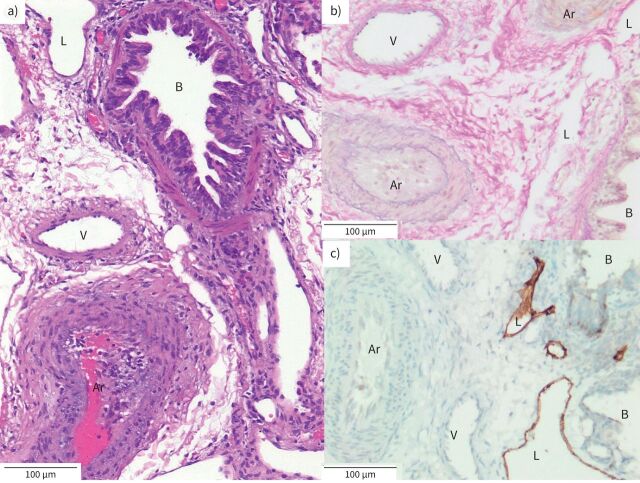
Lung biopsy of a mature neonate with alveolocapillary dysplasia with misalignment of pulmonary veins caused by FOXF1 mutation. a) The pathological vasculature shows a membranous bronchus (B) accompanied by a triad of a peribronchial artery (Ar), a vein (V) and tortuous as well as ectatic lymphatics (L) (haematoxylin/eosin). b) Trichrome staining highlights the preserved elastica externa and interna of the pulmonary artery (Ar) and allows better separation of ectatic veins (V) with one-layered elastica. c) Immunohistochemical staining for podoplanin allows better separation of the lymphatics (L) from the arterial (Ar) and venous (V) vessels.
FIGURE 4
FIGURE 4
Lung biopsy of a 6-month-old male with chronic neonatal lung disease and pulmonary interstitial glycogenosis (PIG) caused by pre-term delivery and mechanical ventilation. a) At low power, architectural distortion with variably sized alveoli and subpleurally accentuated alveolar distension can be seen (haematoxylin/eosin). b) The alveolar septa appear widened and hypercellular without inflammatory infiltrates (haematoxylin/eosin). c) On periodic acid–Schiff (PAS) staining, the cellular interstitium reveals PAS-positive immature stromal cells corresponding to PIG.
FIGURE 5
FIGURE 5
Lung biopsy from a 9-year-old male with alveolar simplification caused by FLNA mutation. a) Most striking is the massive and slightly variable enlargement of the alveolar spaces (A). Membranous bronchi (B) also appear dilated; the alveolar septa in the central parts of the lobuli show no widening or relevant inflammation (haematoxylin/eosin). b) The visceral pleura is thickened and fibrosed (P); the adjacent septa (S) are also broader and show a chronic inflammatory infiltrate (haematoxylin/eosin). c) The interstitium reveals a mixture of lymphocytes, plasma cells and occasional eosinophils. Focally, type 2 pneumocytes predominate the epithelial alveolar lining (Pz) (haematoxylin/eosin).
FIGURE 6
FIGURE 6
Lung explant from a 2-year-old male with chronic pneumonitis of infancy and desquamative interstitial pneumonia (DIP) caused by SFTPC mutation. a) At low power, a mixture of morphological patterns can be appreciated: widened and hypercellular septa encase alveoli with a DIP-like intra-alveolar accumulation of macrophages (M) and an alveolar proteinosis-like fluid deposition (F) (haematoxylin/eosin). b) The macrophages reveal a vacuolated cytoplasm; in the septal interstitium, immature stromal cells predominate with only sparse accompanying inflammatory cells. The epithelial lining shows type 2 cell hyperplasia (haematoxylin/eosin). c) On periodic acid–Schiff (PAS) staining, the cellular interstitium reveals sparse PAS-positive stromal cells; the alveoli again demonstrate a partial filling by macrophages (M) and exudate (F).
FIGURE 7
FIGURE 7
Lung biopsy of a 6-year-old male with chronic granulomatous disease caused by CYBB mutation. a) At low power, granulomas (G) of variable size with an accompanying inflammatory infiltrate are unevenly distributed in the parenchyma (haematoxylin/eosin). b) Multinuclear giant cells are surrounded by histiocytes and a wreath-like lymphocytic infiltrate (haematoxylin/eosin). c) Silver staining (Gomori) reveals fragmented fungal hyphae within the giant cells (Fu); Aspergillus niger could be demonstrated by molecular analysis.

References

    1. Langston C, Dishop MK. Diffuse lung disease in infancy: a proposed classification applied to 259 diagnostic biopsies. Pediatr Dev Pathol 2009; 12: 421–437. doi:10.2350/08-11-0559.1 - DOI - PubMed
    1. Bush A, Cunningham S, de Blic J, et al. . European protocols for the diagnosis and initial treatment of interstitial lung disease in children. Thorax 2015; 70: 1078–1084. doi:10.1136/thoraxjnl-2015-207349 - DOI - PubMed
    1. Griese M, Irnstetter A, Hengst M, et al. . Categorizing diffuse parenchymal lung disease in children. Orphanet J Rare Dis 2015; 10: 122. doi:10.1186/s13023-015-0339-1 - DOI - PMC - PubMed
    1. Griese M. Chronic interstitial lung disease in children. Eur Respir Rev 2018; 27: 170100. doi:10.1183/16000617.0100-2017 - DOI - PMC - PubMed
    1. American Thoracic Society/European Respiratory Society . American Thoracic Society/European Respiratory Society international multidisciplinary consensus classification of the idiopathic interstitial pneumonias. Am J Respir Crit Care Med 2002; 165: 277–304. doi:10.1164/ajrccm.165.2.ats01 - DOI - PubMed