


Drivers of and Barriers to Adherence to Neovascular Age-Related Macular Degeneration and Diabetic Macular Edema Treatment Management Plans: A Multi-National Qualitative Study
- PMID: 35264847
- PMCID: PMC8901255
- DOI: 10.2147/PPA.S347713
Drivers of and Barriers to Adherence to Neovascular Age-Related Macular Degeneration and Diabetic Macular Edema Treatment Management Plans: A Multi-National Qualitative Study
Abstract
Purpose: Neovascular age-related macular degeneration (nAMD) and diabetic macular edema (DME) patients treated with intravitreally injected anti-vascular endothelial growth factor (anti-VEGF) monotherapies achieve lower vision improvements compared with patients in clinical trials. This qualitative research study aimed to better understand the real-world anti-VEGF treatment experience from nAMD and DME patients', caregivers', and retina specialists' perspectives.
Methods: One-time, semi-structured, individual interviews were conducted with adult patients with nAMD or DME treated with anti-VEGF injections for ≥12 months, their caregivers, and experienced retina specialists. Interview transcripts were analyzed qualitatively using a thematic analysis approach.
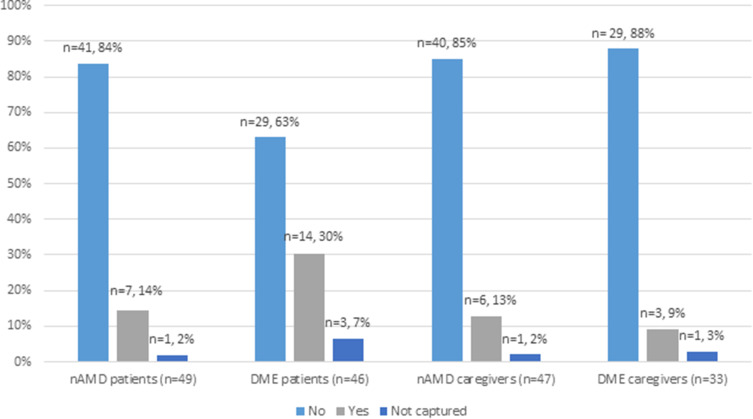
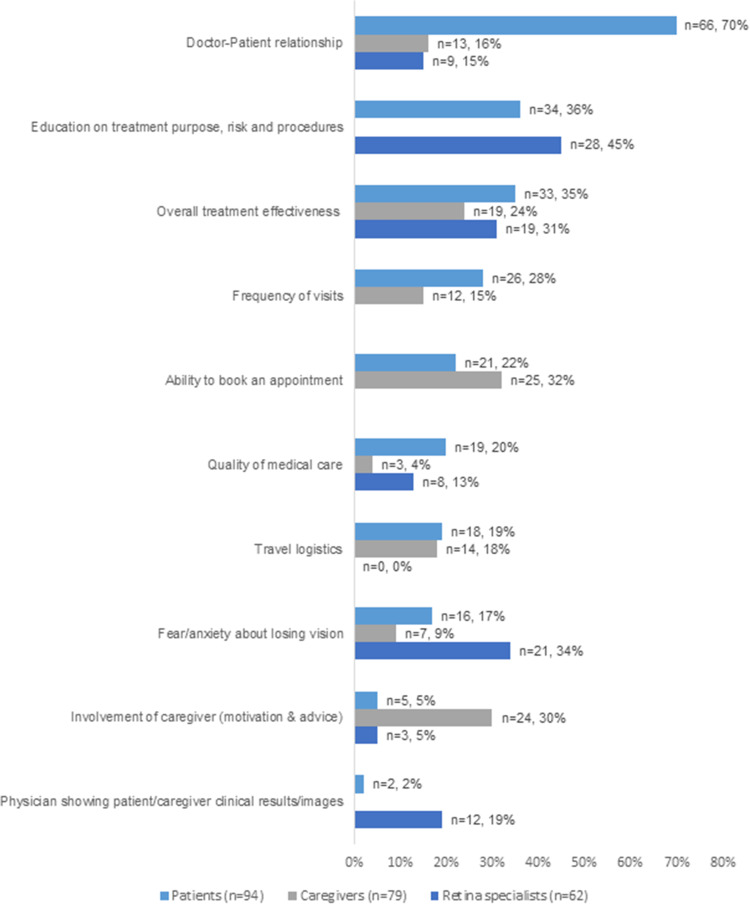
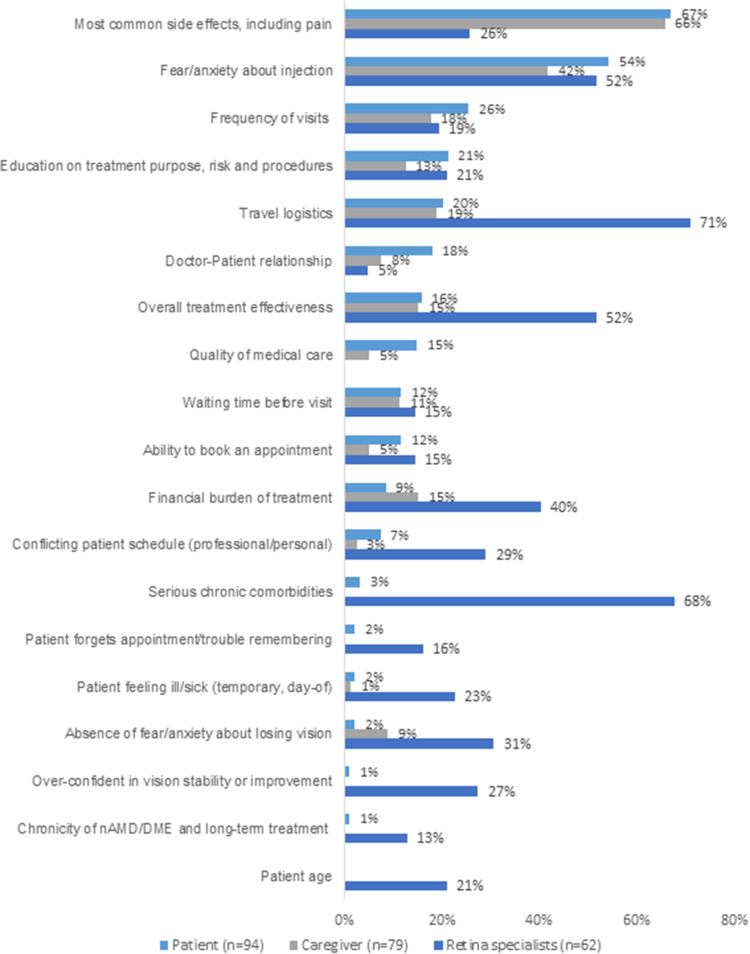
Results: A total of 49 nAMD and 46 DME patients, 47 nAMD and 33 DME caregivers, and 62 retina specialists were interviewed in the USA, Canada, France, Germany, Italy and Spain. Most (79%) patients and caregivers reported disruptions to their routine on the day before, the day of, or the day after anti-VEGF injection. Seven nAMD patients (14%) and 14 DME patients (30%) reported having missed an injection visit. The most frequently reported driver for adherence for patients was the doctor-patient relationship (n=66, 70%), whereas for caregivers, it was the ease of booking an appointment (n=25, 32%). Retina specialists reported patient education on the treatment (n=28, 45%) as the most important driver. Treatment barriers could be grouped into four categories: tolerability, clinical factors, logistical parameters and human factors. The most frequently reported barrier to adherence for patients and caregivers was related to side effects (pain/discomfort/irritation: n=63, 67% of patients; n=52, 66% of caregivers), whereas for retina specialists it was logistical parameters (travel logistics: n=44, 71%).
Conclusion: This study highlights the importance of the doctor-patient relationship and patient education as key drivers, and treatment tolerability and logistics as key barriers to treatment adherence. Improved doctor-patient relationship/communication and patient education together with new therapies offering convenience, long-acting effectiveness, and better tolerability may improve treatment adherence.
Keywords: adherence; diabetic macular edema; neovascular age-related macular degeneration; qualitative interviews; treatment experience.
© 2022 Giocanti-Aurégan et al.
Conflict of interest statement
SL, CEK, JL, and HBL, were full time employees of ICON plc at the time this work was conducted. AGA is consultant for and reports personal fees from AbbVie, Alcon, Allergan, Bayer, Horus, Novartis, and Roche. AGL is consultant for and report personal fees from Allergan, Bayer, Novartis, Roche, and Thea. TP reports consultant fees from Roche/Genentech, Inc., Bayer, Novartis, Alimera, Heidelberg, Oxurion, Apellis. BG and GCC are employees of Genentech, Inc. MM is an employee of F. Hoffmann-La Roche Ltd. NMH reports consulting fees from Adverum, Allergan, Annexon, Apellis, Bayer, Lineage Cell Therapeutics, Clearside Biosciences, Gemini, Genentech, Gyroscope, Katalyst Surgical, Nacuity, Notal Vision, Novartis, Polyactiva, Regeneron, Stealth Biosciences; has been a member of Speakers Bureau for Allergan, Genentech, Novartis, Regeneron, and Spark; conducted contracted research for Genentech, Gemini, Gyroscope, Notal Vision; and holds intellectual property/patents: Katalyst Surgical. The authors report no other conflicts of interest in this work.
Figures
References
-
- Holekamp NM. Review of neovascular age-related macular degeneration treatment options. Am J Manag Care. 2019;25(10 Suppl):S172–s181. - PubMed
LinkOut - more resources
Full Text Sources
