


Affect-Driven Learning of Robot Behaviour for Collaborative Human-Robot Interactions
- PMID: 35265672
- PMCID: PMC8898942
- DOI: 10.3389/frobt.2022.717193
Affect-Driven Learning of Robot Behaviour for Collaborative Human-Robot Interactions
Abstract
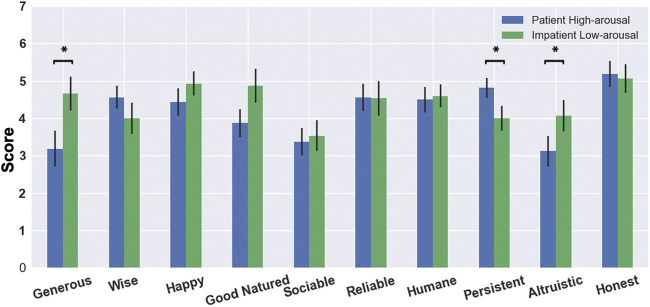
Collaborative interactions require social robots to share the users' perspective on the interactions and adapt to the dynamics of their affective behaviour. Yet, current approaches for affective behaviour generation in robots focus on instantaneous perception to generate a one-to-one mapping between observed human expressions and static robot actions. In this paper, we propose a novel framework for affect-driven behaviour generation in social robots. The framework consists of (i) a hybrid neural model for evaluating facial expressions and speech of the users, forming intrinsic affective representations in the robot, (ii) an Affective Core, that employs self-organising neural models to embed behavioural traits like patience and emotional actuation that modulate the robot's affective appraisal, and (iii) a Reinforcement Learning model that uses the robot's appraisal to learn interaction behaviour. We investigate the effect of modelling different affective core dispositions on the affective appraisal and use this affective appraisal as the motivation to generate robot behaviours. For evaluation, we conduct a user study (n = 31) where the NICO robot acts as a proposer in the Ultimatum Game. The effect of the robot's affective core on its negotiation strategy is witnessed by participants, who rank a patient robot with high emotional actuation higher on persistence, while an impatient robot with low emotional actuation is rated higher on its generosity and altruistic behaviour.
Keywords: core affect; human-robot interaction; multi-modal affect perception; neural networks; reinforcement learning.
Copyright © 2022 Churamani, Barros, Gunes and Wermter.
Conflict of interest statement
The authors declare that the research was conducted in the absence of any commercial or financial relationships that could be construed as a potential conflict of interest. The handling Editor is currently co-organizing a Research Topic with one of the authors PB and declared a past collaboration with one of the authors HG.
Figures


References
-
- Ahn H., Picard R. W. (2005). “Affective-cognitive Learning and Decision Making: A Motivational Reward Framework for Affective Agents,” in Affective Computing and Intelligent Interaction. Editors Tao J., Tan T., Picard R. (Berlin: Springer Berlin Heidelberg; ), 866–873. 10.1007/11573548_111 - DOI
-
- Barros P., Barakova E., Wermter S. (2020). Adapting the Interplay between Personalized and Generalized Affect Recognition Based on an Unsupervised Neural Framework. IEEE Trans. Affective Comput. 10.1109/taffc.2020.3002657 - DOI
-
- Barros P., Churamani N., Lakomkin E., Sequeira H., Sutherland A., Wermter S. (2018). “The OMG-Emotion Behavior Dataset,” in International Joint Conference on Neural Networks (IJCNN) (Rio de Janeiro, Brazil: IEEE; ), 1408–1414. 10.1109/ijcnn.2018.8489099 - DOI
LinkOut - more resources
Full Text Sources
