


Distinguishing between trait emotional intelligence and the five-factor model of personality: additive predictive validity of emotional intelligence for negative emotional states
- PMID: 35265757
- PMCID: PMC8899697
- DOI: 10.1016/j.heliyon.2022.e08882
Distinguishing between trait emotional intelligence and the five-factor model of personality: additive predictive validity of emotional intelligence for negative emotional states
Abstract
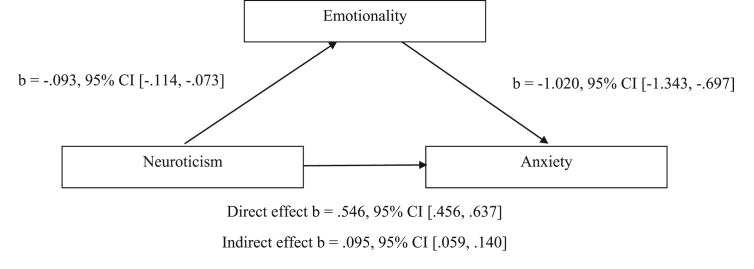
There is ongoing debate on the utility of trait emotional intelligence and whether it is distinguishable from the five-factor model of personality. In study 1, we investigated the incremental validity of trait emotional intelligence in predicting negative emotional states, after controlling for the five-factor model personality traits. The TEIQue, Mini-IPIP, and DASS-21 were administered to a community based Australian sample. Three significant predictive models emerged: (1) wellbeing, and neuroticism predicting depression; (2) emotionality, and neuroticism predicting anxiety; and (3) self-control, and neuroticism predicting stress. In Study 2, we further explored the relationship between TEIQue domains, neuroticism, and negative emotional states. Three partial mediation models were found: (1) wellbeing mediated the relationship between neuroticism and depression; (2) emotionality mediated the relationship between neuroticism and anxiety; and (3) self-control mediated the relationship between neuroticism and stress. The findings highlight that trait emotional intelligence is related to, and yet distinct from extraversion, conscientiousness, agreeableness, neuroticism, and openness. They also provide support for the incremental validity of the TEIQue domains in predicting depression, anxiety, and stress, beyond the five-factor model personality traits in a community based Australian sample, with the domains of trait emotional intelligence potentially operating as protective factors from pervasive negative moods.
Keywords: Anxiety; Depression; Emotional intelligence; Personality; Stress; TEIQue; Validity.
© 2022 The Authors. Published by Elsevier Ltd.
Conflict of interest statement
The authors declare no conflict of interest.
Figures


References
-
- Andrei F., Siegling A.B., Aloe A.M., Baldaro B., Petrides K.V. The incremental validity of the trait emotional intelligence questionnaire (TEIQue): a systematic review and meta-analysis. J. Pers. Assess. 2016;98(3):261–276. - PubMed
-
- Arteche A., Chamorro-Premuzic T., Furnham A., Crump J. The relationship of trait EI with personality, IQ and sex in a UK sample of employees. Int. J. Sel. Assess. 2008;16(4):421–426.
-
- Ashkanasy N.M., Daus C.S. Rumors of the death of emotional intelligence in organizational behavior are vastly exaggerated. J. Organ. Behav. 2005;26(4):441–452.
-
- Baldasaro R., Shanahan M., Bauer D. Psychometric properties of the mini-IPIP in a large, nationally representative sample of young adults. J. Pers. Assess. 2013;95(1):74–84. - PubMed
LinkOut - more resources
Full Text Sources
