. 2022 Jun;234(6):2111-2125.
doi: 10.1111/nph.18072. Epub 2022 Mar 28.

Habitat-adapted microbial communities mediate Sphagnum peatmoss resilience to warming

Affiliations

Habitat-adapted microbial communities mediate Sphagnum peatmoss resilience to warming

Alyssa A Carrell et al. New Phytol. 2022 Jun.

Abstract

Sphagnum peatmosses are fundamental members of peatland ecosystems, where they contribute to the uptake and long-term storage of atmospheric carbon. Warming threatens Sphagnum mosses and is known to alter the composition of their associated microbiome. Here, we use a microbiome transfer approach to test if microbiome thermal origin influences host plant thermotolerance. We leveraged an experimental whole-ecosystem warming study to collect field-grown Sphagnum, mechanically separate the associated microbiome and then transfer onto germ-free laboratory Sphagnum for temperature experiments. Host and microbiome dynamics were assessed with growth analysis, Chla fluorescence imaging, metagenomics, metatranscriptomics and 16S rDNA profiling. Microbiomes originating from warming field conditions imparted enhanced thermotolerance and growth recovery at elevated temperatures. Metagenome and metatranscriptome analyses revealed that warming altered microbial community structure in a manner that induced the plant heat shock response, especially the HSP70 family and jasmonic acid production. The heat shock response was induced even without warming treatment in the laboratory, suggesting that the warm-microbiome isolated from the field provided the host plant with thermal preconditioning. Our results demonstrate that microbes, which respond rapidly to temperature alterations, can play key roles in host plant growth response to rapidly changing environments.

Keywords: Sphagnum; climate change; heat tolerance; microbiome transfer; moss; peatland; symbiosis; synthetic communities.


Figures

Fig. 1
Fig. 1
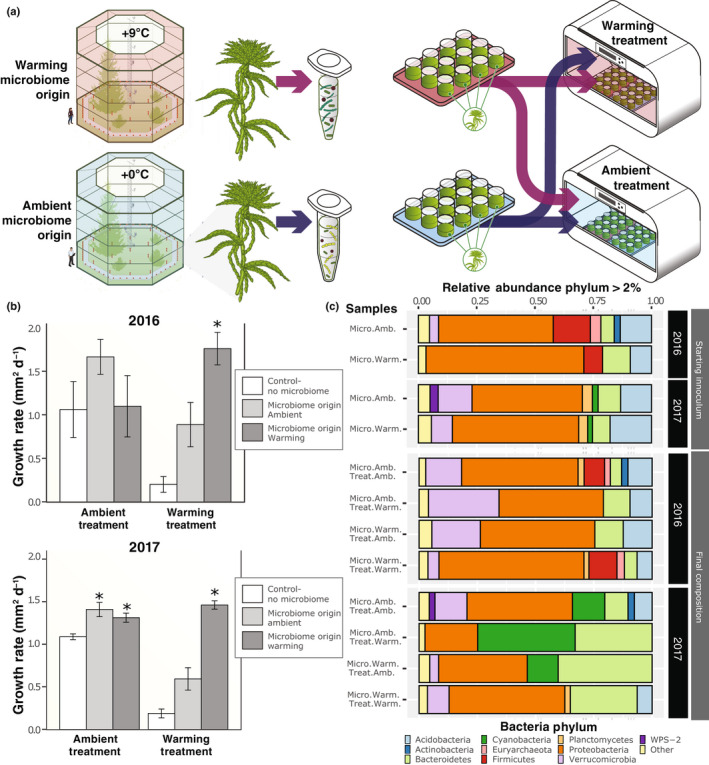
(a) Experimental approach and design: field‐collected donor moss microbiomes collected from ambient or warming conditions were transferred to germ‐free recipient moss (Sphangum angustifolium), and the resulting communities were then placed in an ambient or warm growth chamber. (b) Average moss growth rate under ambient or warming treatments, as a function of the thermal origin of the microbiome. Error bars represent standard error of the mean of n = 6 for 2016, n = 12 for 2017. (c) Relative abundance of microbiome phyla, determined by 16S rDNA amplicon sequencing of the starting field‐collected inoculum (n = 3 of each composite sample) from ambient or warming experimental plots, and the final compositions of experimental samples (n = 6 for each condition). An asterisk indicates statistical significance (P < 0.05) based on a Tukey’s HSD post hoc test of the percentage change of total growth between moss with a microbiome and moss without a microbiome within the same chamber.
Fig. 2
Fig. 2
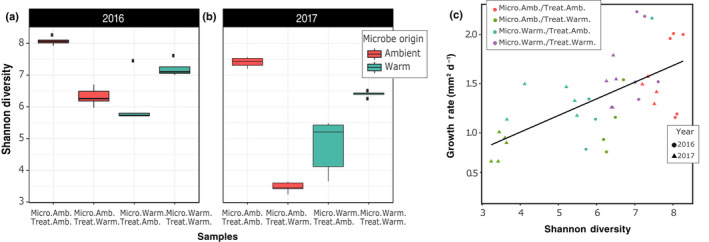
Microbial diversity change in response to habitat origin and experimental temperature. Shannon diversity index of the microbiome at the conclusion of the experiments in 2016 (a) and 2017 (b), based on 16S rDNA amplicon data for five replicates of each condition in each year. Microbiomes had lower Shannon diversity when the thermal origin and experimental treatment were mismatched (i.e. ambient origin in warming treatment or warming origin in ambient treatment) (ANOVA, P < 0.01). Lines within the boxplots represent median, 25th and 75th percentile values, while whiskers are defined by the largest value not greater than 1.5× the interquartile range (IQR) and the smallest value not less than 1.5× the IQR. (c) Sphagnum angustifolium growth rate was linearly correlated with microbiome Shannon diversity (Pearson correlation, r = 0.744, P = 0.003) at the conclusion of the experiment.
Fig. 3
Fig. 3
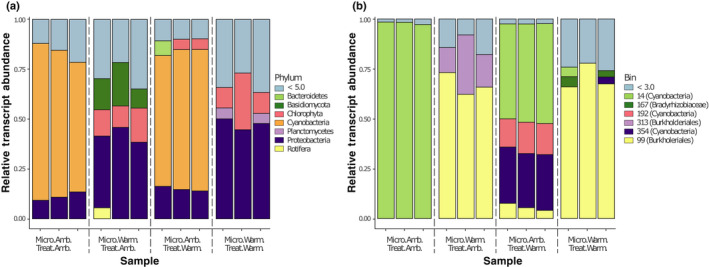
Microbial community transcriptional profile response to temperature treatment. Relative abundance of microbial transcripts mapping to metagenome contigs for (a) major phyla and (b) metagenome‐assembled genomes (MAGs). Each bar represents a metatranscriptome sample for the ambient‐microbiome (Micro. Amb.) or warming‐microbiome (Micro. Warm) under either the ambient (Treat. Amb.) or warming (Treat. Warm) treatment. Colors indicate (a) phyla or (b) MAGs; light blue represents (a) phyla with < 5% of mapped transcripts or (b) MAGs with < 3% of mapped transcripts.
Fig. 4
Fig. 4
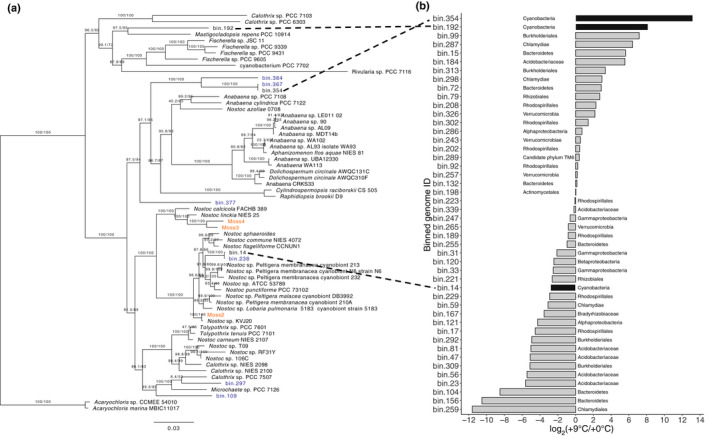
Bar chart representing Cyanobacteria log2(fold change) of counts per million reads mapping to metagenomic bins between ambient‐microbiome and warm‐microbiome metagenome samples. Phylogeny of selected Cyanobacteria and log2(fold change) of metagenomic bins. (a) Maximum‐likelihood phylogram where the numbers at nodes indicate UFBoot2 and Shimodaira–Hasegawa‐like approximate likelihood ratio support. Branch lengths indicate estimated substitutions per site. Metagenomic bin taxa labels are colored by source from either within peatland responses under changing environments (SPRUCE) (blue) or from Warshan et al. (2017) (orange). (b) Bar chart representing log2(fold change) of metagenomic bins between ambient‐microbiome and warm‐microbiome metagenomes. Black bars indicate cyanobacterial metagenome‐assembled genomes (MAGs) recovered in this work.
Fig. 5
Fig. 5
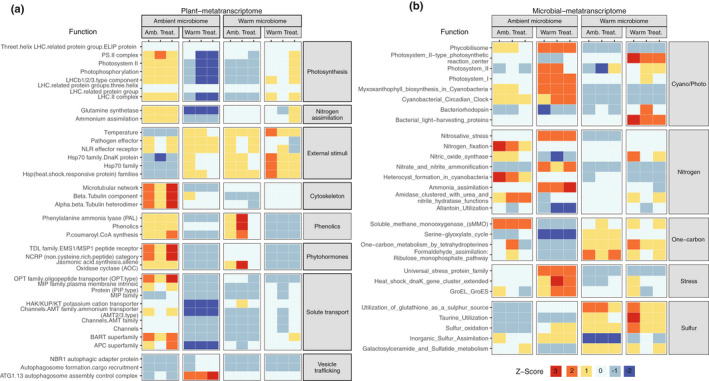
Plant and microbial ontology enrichment analysis. Heatmap of z‐scores for (a) Mapman4 ontology categories enriched in differentially expressed Sphagnum angustifolium genes and (b) differentially expressed SEED level 3 categories related to nitrogen, one‐carbon and sulfur metabolism; cyanobacterial/photosynthesis; and stress. Differential expression was defined as |log2(fold change) > 1| and corrected P < 0.05.

References

    1. Ali SZ, Sandhya V, Grover M, Kishore N, Rao LV, Venkateswarlu B. 2009. Pseudomonas sp. strain AKM‐P6 enhances tolerance of sorghum seedlings to elevated temperatures. Biology and Fertility of Soils 46: 45–55.
    1. Apprill A. 2020. The role of symbioses in the adaptation and stress responses of marine organisms. Annual Review of Marine Science 12: 291–314. - PubMed
    1. Baker DM, Freeman CJ, Wong JCY, Fogel ML, Knowlton N. 2018. Climate change promotes parasitism in a coral symbiosis. ISME Journal 12: 921–930. - PMC - PubMed
    1. Basilier K. 1979. Moss‐associated nitrogen fixation in some mire and coniferous forest environments around Uppsala, Sweden. Lindbergia 5: 84–88.
    1. Basilier K. 1980. Fixation and uptake of nitrogen in sphagnum blue‐green algal associations. Oikos 34: 239–242.

Publication types

LinkOut - more resources