. 2022 Mar 1:2022:baac008.
doi: 10.1093/database/baac008.

PlasticDB: a database of microorganisms and proteins linked to plastic biodegradation

Affiliations

PlasticDB: a database of microorganisms and proteins linked to plastic biodegradation

Victor Gambarini et al. Database (Oxford). .

Abstract

The number of publications reporting putative plastic-degrading microbes and proteins is continuously increasing, necessitating the compilation of these data and the development of tools to facilitate their analysis. We developed the PlasticDB web application to address this need, which comprises a database of microorganisms and proteins reported to biodegrade plastics. Associated metadata, such as the techniques utilized to assess biodegradation, the environmental source of microbial isolate and presumed thermophilic traits are also reported. Proteins in the database are categorized according to the plastic type they are reported to degrade. Each protein structure has been predicted in silico and can be visualized or downloaded for further investigation. In addition to standard database functionalities, such as searching, filtering and retrieving database records, we implemented several analytical tools that accept inputs, including gene, genome, metagenome, transcriptomes, metatranscriptomes and taxa table data. Users can now analyze their datasets for the presence of putative plastic-degrading species and potential plastic-degrading proteins and pathways from those species. Database URL:http://plasticdb.org.


Figures

Figure 1.
Figure 1.
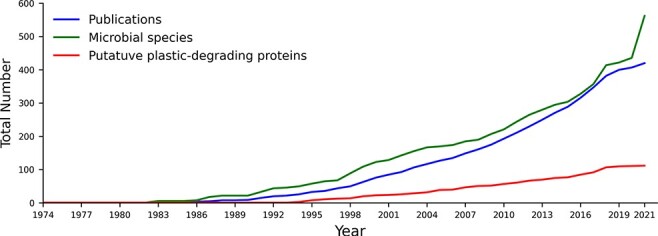
The cumulative number of publications, microbial species and proteins reported to degrade plastics between 1974 and August 2021. All included data fit our criteria for putative plastics degradation, as outlined in the methods.
Figure 2.
Figure 2.
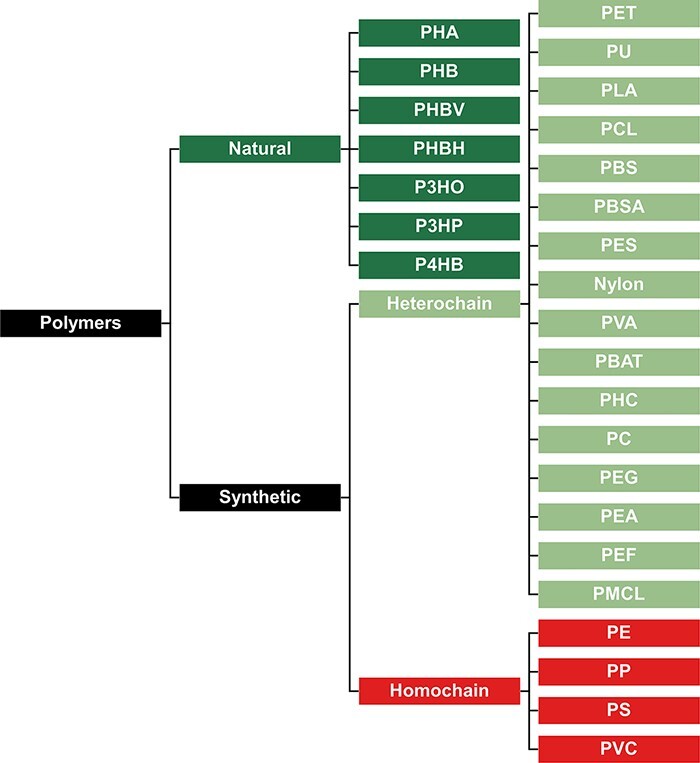
Classification of polymers to represent their presumed biodegradation potential. Natural polymers are more biodegradable, synthetic heterochain polymers have an intermediate biodegradability, and synthetic homochain polymers are the least biodegradable.
Figure 3.
Figure 3.
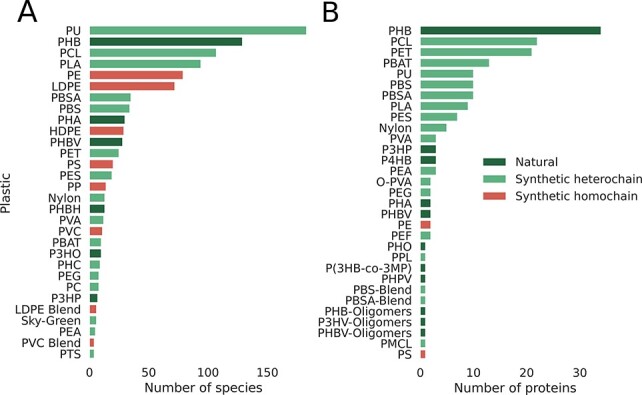
Database statistics per plastic, emphasizing the smaller number of reports for synthetic homochain polymers (those composed of only C–C backbones). A) Number of microbial species reported to degrade plastics. B) Number of proteins reported to break down plastics categorized by plastic type.
Figure 4.
Figure 4.
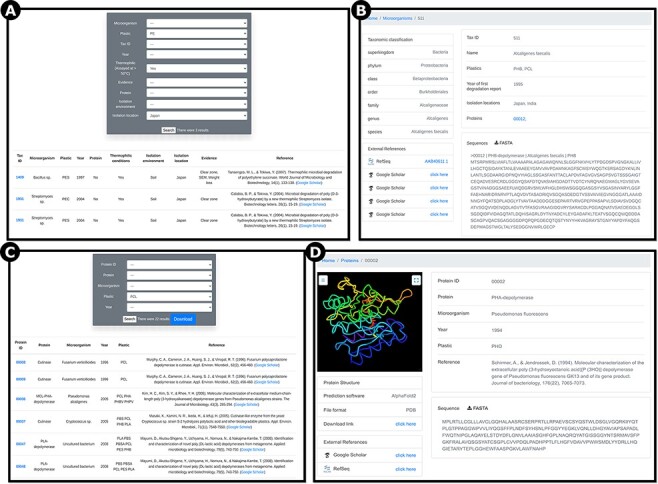
Screenshots of example pages showing information on reported plastic-degrading microorganisms and proteins. A) ‘Microorganisms’ page showing search results filtered for polyethylene (PE), thermophilic organisms, and isolation location in Japan; B) ‘Microorganisms’ page outputs showing Alcaligenes faecalis, a bacterium reported to degrade PHB and PCL; C) ‘Proteins’ page showing 22 results for the plastic type polycaprolactone (PCL). D) ‘Proteins’ page showing Pseudomonas fluorescens PHA-depolymerase, reported to break down polyhydroxyoctanoate (PHO; RefSeq ID AAA64538.1). Users can visualize the predicted protein structure, download the prediction in PDB file format and download the sequence in FASTA file format.
Figure 5.
Figure 5.
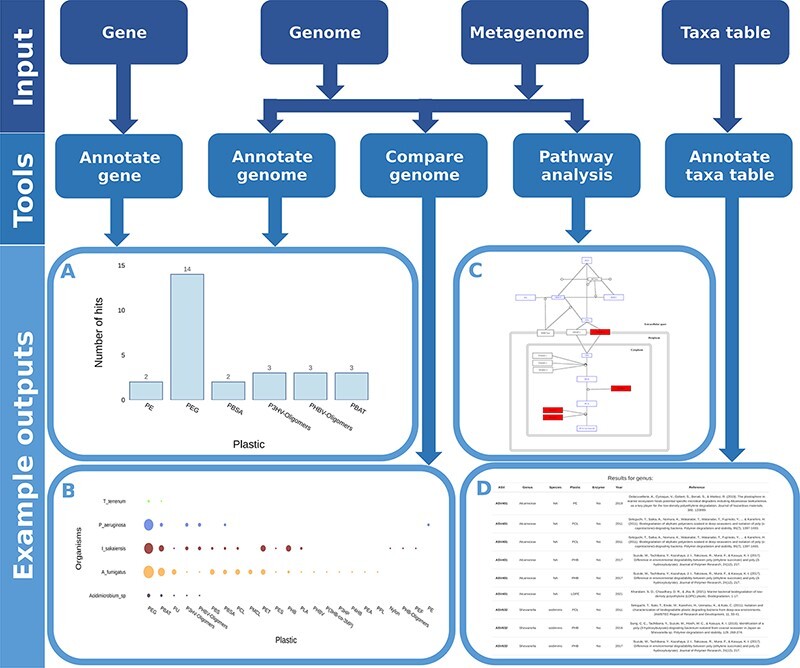
Flow chart showing all possible inputs, respective tools and example outputs for each data type. A) The Ideonella sakaiensis genome was used as an input for the ‘Annotate Genome’ tool, showing the number of input proteins that matched database proteins, grouped by plastic type. B) Comparison of plastic biodegradation potential for the genomes of Ideonella sakaiensis,  Agaricus bisporus,  P. aeruginosa and Aspergillus fumigatus. C) The P. aeruginosa genome was also used as the input for the ‘Pathway Analysis’ tool. Open blue rectangles represent substrates, solid red rectangles represent proteins in the pathway present in the P. aeruginosa genome, and open black rectangles represent proteins not present in the genome. D) An example output table generated by the ‘Annotate Taxa Table’ tool using amplicon sequencing data as the input. All figures are available at higher resolution in the supplementary material.
Figure 6.
Figure 6.
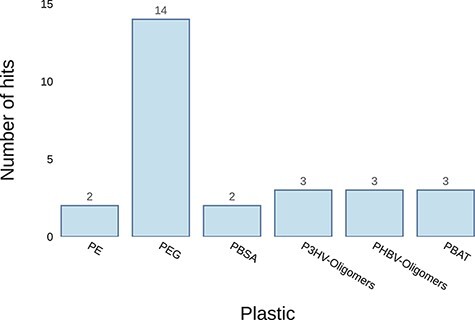
Example graph output from the ‘Annotate Genome’ tool. It plots the number of results returned for putative plastic-degrading proteins per plastic type. The input datum was the genome of Pseudomonas aeruginosa.
Figure 7.
Figure 7.
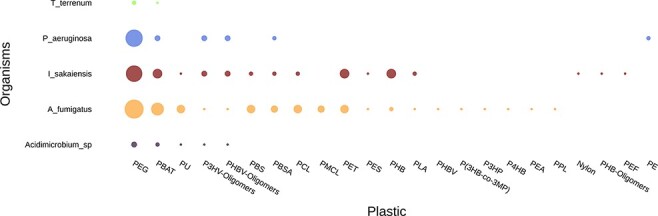
Example graph output from the ‘Compare Genome’ tool. The tool plots the number of hits for putative plastic-degrading proteins per plastic type for each dataset. The size of the dots represents the number of hits found in each genome for each plastic. The input data were the genomes of Thermobaculum terrenum,  Pseudomonas aeruginosa,  Ideonella sakaiensis,  Aspergillus fumigatus and Acidimicrobium sp.
Figure 8.
Figure 8.
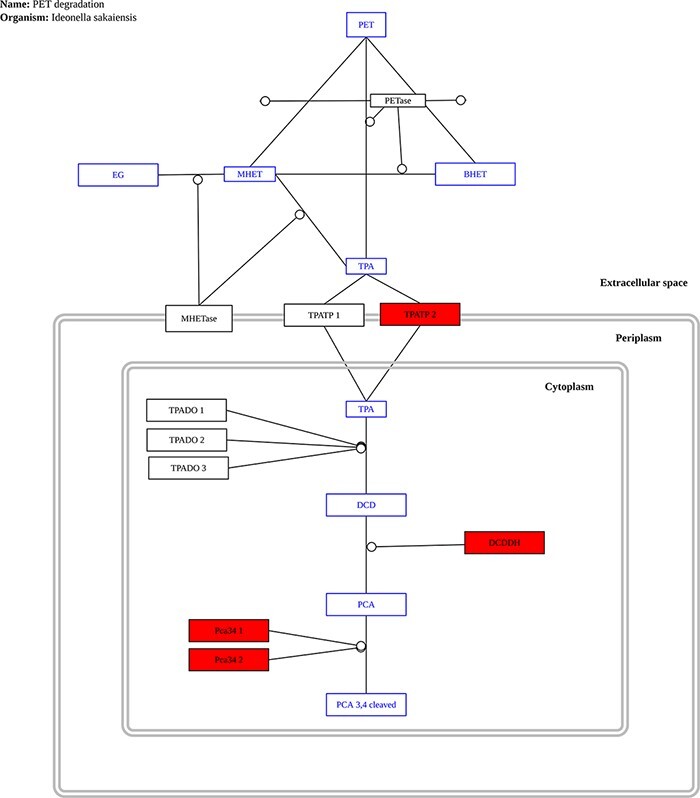
Example graph output from the ‘Pathway Analysis’ tool. Black rectangles represent proteins, blue rectangles represent substrates and red rectangles represent proteins present in the genome or metagenome being investigated, in this case, the genome of the bacterium P. aeruginosa.
Figure 9.
Figure 9.
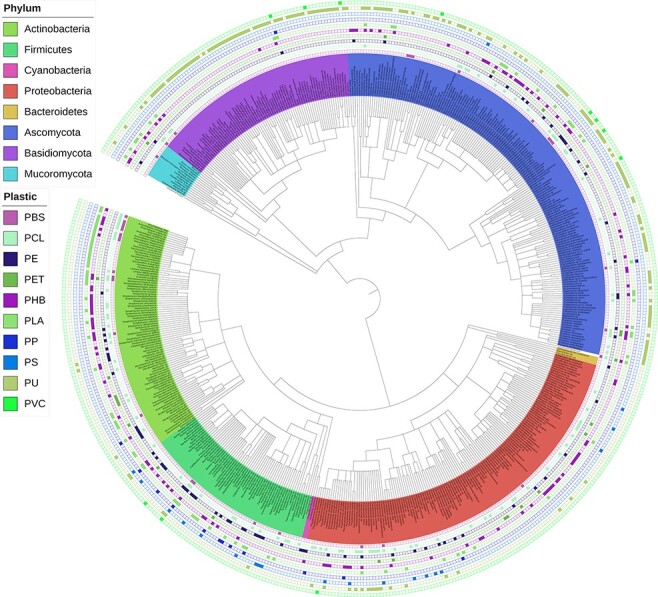
Interactive phylogenetic tree showing all microbes in the database and their respective plastic degradation reports. This figure is updated regularly with new reports of microbial degradation. Available at plasticdb.org/interactive_tree.

References

    1. Sauter D.W., Taoufik M. and Boisson C. (2017) Polyolefins, a success story. Polymers, 9, 185. - PMC - PubMed
    1. Siddiqui J. and Pandey G. (2013) A review of plastic waste management strategies. Int. Res. J. Environ. Sci., 2, 84–88.
    1. Geyer R., Jambeck J.R. and Law K.L. (2017) Production, use, and fate of all plastics ever made. Sci. Adv., 3, e1700782. - PMC - PubMed
    1. Lebreton L. and Andrady A. (2019) Future scenarios of global plastic waste generation and disposal. Palgrave Commun., 5, 1–11.
    1. Zantis L.J., Carroll E.L., Nelms S.E. et al. (2021) Marine mammals and microplastics: a systematic review and call for standardisation. Environ. Pollut., 269, 116142. - PubMed

Publication types