Review
. 2022 Feb 24;14(5):1176.
doi: 10.3390/cancers14051176.

Current Understanding of Hypoxia in Glioblastoma Multiforme and Its Response to Immunotherapy

Affiliations
Review

Current Understanding of Hypoxia in Glioblastoma Multiforme and Its Response to Immunotherapy

Jang Hyun Park et al. Cancers (Basel). .

Abstract

Hypoxia is a hallmark of glioblastoma multiforme (GBM), the most aggressive cancer of the central nervous system, and is associated with multiple aspects of tumor pathogenesis. For example, hypoxia induces resistance to conventional cancer therapies and inhibits antitumor immune responses. Thus, targeting hypoxia is an attractive strategy for GBM therapy. However, traditional studies on hypoxia have largely excluded the immune system. Recently, the critical role of the immune system in the defense against multiple tumors has become apparent, leading to the development of effective immunotherapies targeting numerous cancer types. Critically, however, GBM is classified as a "cold tumor" due to poor immune responses. Thus, to improve GBM responsiveness against immunotherapies, an improved understanding of both immune function in GBM and the role of hypoxia in mediating immune responses within the GBM microenvironment is needed. In this review, we discuss the role of hypoxia in GBM from a clinical, pathological, and immunological perspective.

Keywords: antitumor immunity; glioblastoma multiforme (GBM); hypoxia; immunotherapy.


Conflict of interest statement

The authors declare no conflict of interest.

Figures
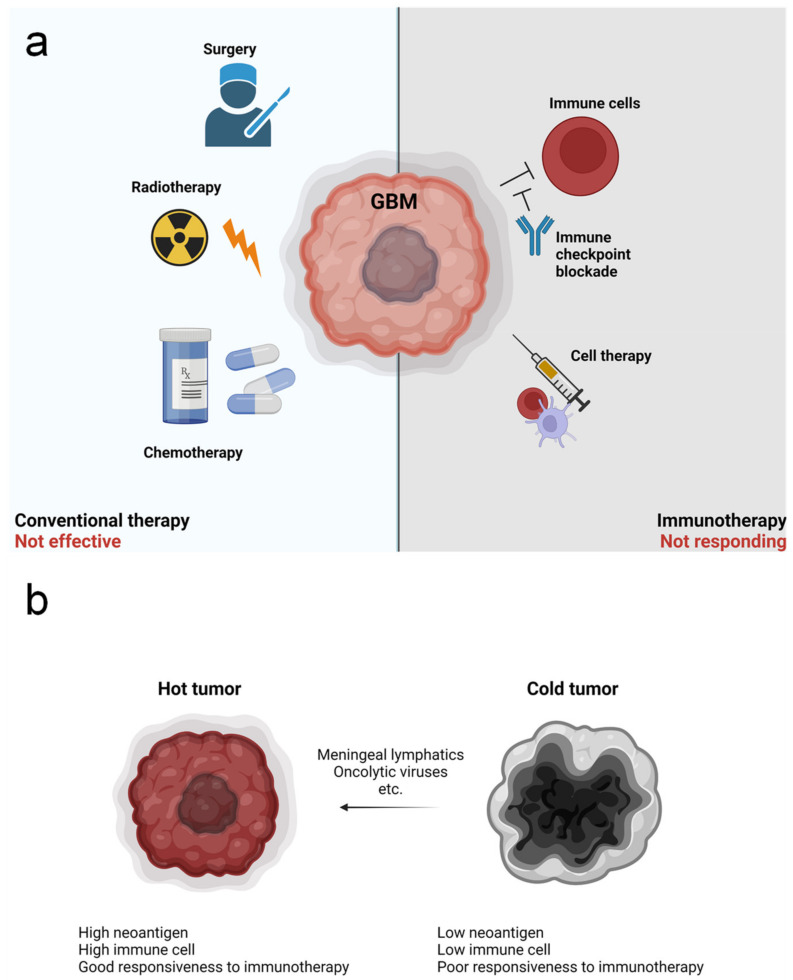
Figure 1
Figure 1
Therapeutic approaches for glioblastoma multiforme (GBM) and hurdles to treatment. (a) There are multiple strategies to care for GBM patients. Conventional GBM therapy involves surgery, followed by radiotherapy and concomitant chemotherapy. However, this is not fully effective. Recently, immunotherapies have been developed and shown promising results for other tumors. Immune checkpoint blockade approaches for inhibiting immunosuppression, and cell therapies, such as dendritic cell (DC) vaccines, are now being tested for GBM. However, responsiveness to these therapies is poor. (b) Tumors can be classified as “hot” or “cold”. Hot tumor shows high levels of neoantigens, increased infiltration of immune cells, and better responsiveness to therapies relative to cold tumors. Thus, several approaches for converting cold tumors into hot tumors, such as by manipulating lymphatics or through the use of oncolytic viruses, are being studied.
Figure 2
Figure 2
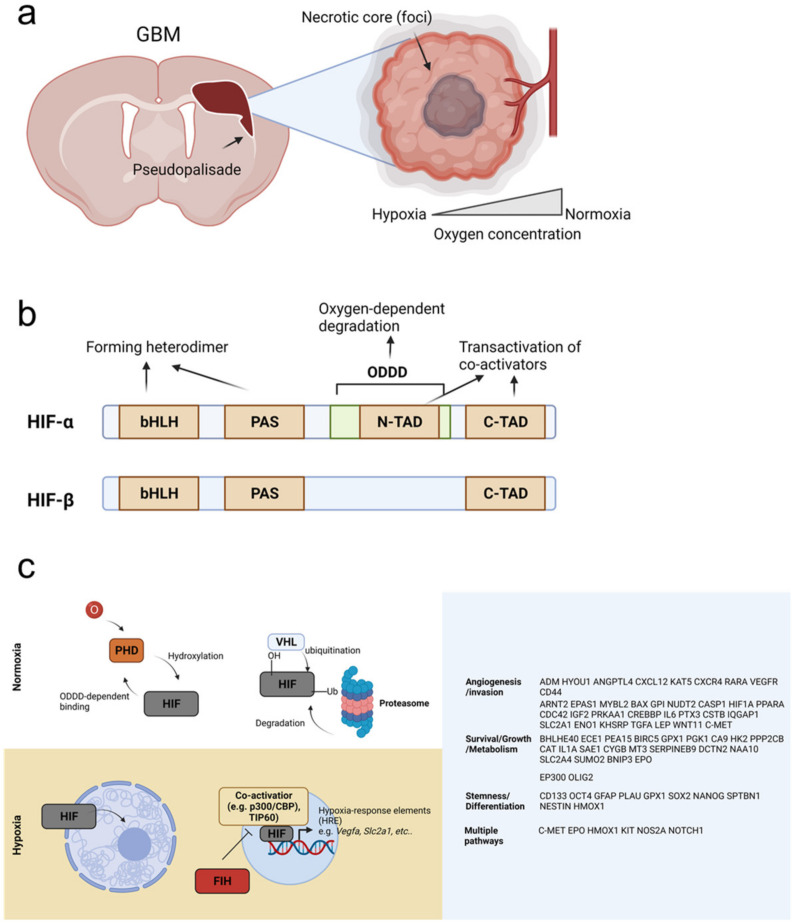
Responses to hypoxia in GBM tumors. (a) GBM tissue shows aggressive invasiveness and pseudopalisades. Oxygen is supplied by blood vessels, and thus, tumor cells located far from vessels become hypoxic due to poor oxygen diffusion, forming necrotic core (foci). Tumor cells that escape from hypoxia form pseudopalisades. (b) Hypoxia-inducible factor (HIF)-α and HIF-β have basic helix–loop–helix (bHLH), Per–Arnt–Sim (PAS), and C-terminal (C-TAD) domains. The bHLH and PAS domain are responsible for forming the heterodimer, and the C-TAD domain promotes transactivation of co-activators. HIFα also has an N-terminal (N-TAD) domain and an oxygen-dependent degradation domain (ODDD), which mediate its oxygen-dependent degradation via the ubiquitin–proteasome pathway. The N-TAD also participates in transactivation of co-activators. (c) Under normoxia, oxygen-dependent prolyl hydroxylase (PHD) enzyme is active and binds to HIF in an ODDD-dependent manner. PHD hydroxylates HIF, which allows von Hippel–Lindau (VHL) to bind and recruit E3 ubiquitinase. This enzyme ubiquitinates HIF, targeting it for binding and degradation by the proteasome. In contrast, under hypoxia, HIF is stable and translocates into the nucleus, where it binds to co-activators, such as p300/CBP or TIP60, and turns on expression of hypoxia-response element (HRE) genes. HIF can regulate multiple cellular processes via activation of these HRE genes. HIF-suppressors, including factor-inhibiting HIF (FIH), function to inhibit binding between HIF and its co-activators and block HRE activation.
Figure 3
Figure 3
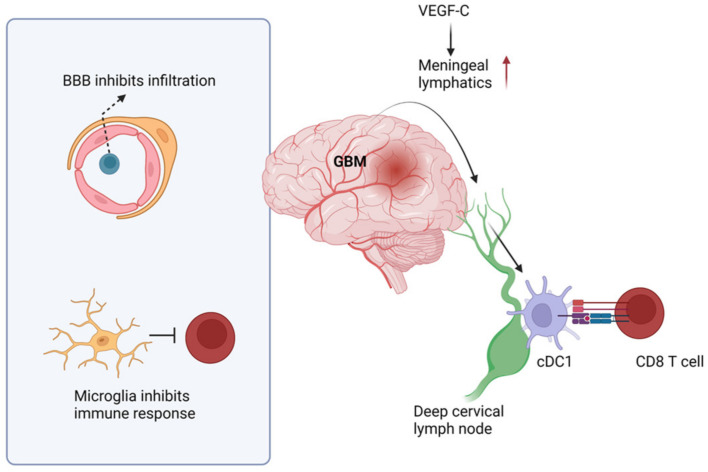
Immune responses in the GBM. GBM antigens are drained by meningeal lymphatics, and classical DC-1s (cDC1s) present antigen to CD8+ T cells in the deep cervical lymph node. However, due to the strong blood–brain barrier (BBB), immune cell infiltration into the parenchyma is limited. In addition, the predominant microglia suppress immune responses. However, enhancing lymphatics via VEGF-C treatment has shown promising results to improve survival in animal models.
Figure 4
Figure 4
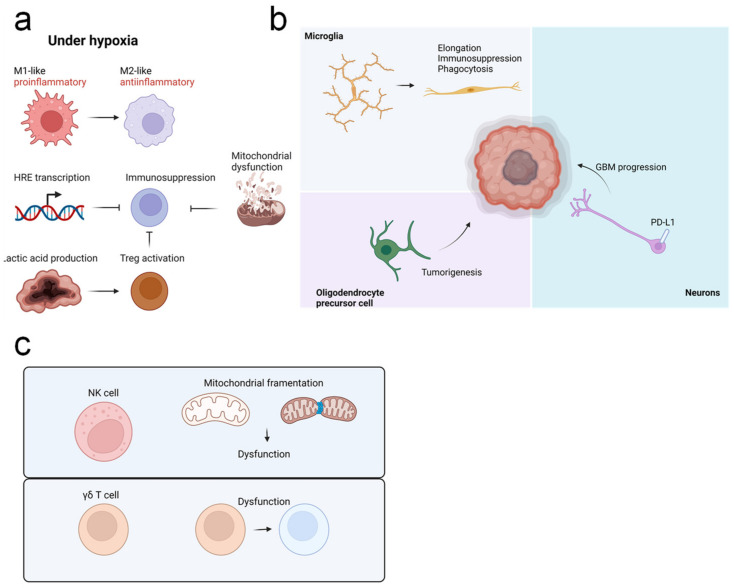
The effect of hypoxia on anti-GBM immune responses. (a) Under hypoxia, macrophages preferentially show an immunosuppressive M2-like phenotype, rather than an inflammatory M1-like phenotype. Tumor-infiltrating lymphocytes are suppressed in response to activation of HRE genes and mitochondrial dysfunction, and accumulation of lactic acid supports stability and function of regulatory T cells (Tregs), to further suppress inhibit responses. (b) Microglia in the tumor area show an elongated phenotype; these cells are immunosuppressive, with enhanced phagocytosis ability. Oligodendrocyte precursor cells are thought to be a precursor for GBM cells. Connection with neurons also supports GBM progression, whereas PD-L1 expression from neurons is associated with improved prognosis of GBM patients. (c) Hypoxia inhibits functions of natural killer (NK) cells and γδ T cells and promotes dysfunction of NK cell mitochondria.

References

    1. Vadlakonda L., Dash A., Pasupuleti M., Anil Kumar K., Reddanna P. Did we get pasteur, warburg, and crabtree on a right note? Front. Oncol. 2013;3:186. doi: 10.3389/fonc.2013.00186. - DOI - PMC - PubMed
    1. Boedtkjer E., Pedersen S.F. The Acidic Tumor Microenvironment as a Driver of Cancer. Annu. Rev. Physiol. 2020;82:103–126. doi: 10.1146/annurev-physiol-021119-034627. - DOI - PubMed
    1. Giaccia A.J., Simon M.C., Johnson R. The biology of hypoxia: The role of oxygen sensing in development, normal function, and disease. Genes Dev. 2004;18:2183–2194. doi: 10.1101/gad.1243304. - DOI - PMC - PubMed
    1. Epstein T., Gatenby R.A., Brown J.S. The Warburg effect as an adaptation of cancer cells to rapid fluctuations in energy demand. PLoS ONE. 2017;12:e0185085. doi: 10.1371/journal.pone.0185085. - DOI - PMC - PubMed
    1. Harris A.L. Hypoxia—A key regulatory factor in tumour growth. Nat. Rev. Cancer. 2002;2:38–47. doi: 10.1038/nrc704. - DOI - PubMed

LinkOut - more resources