. 2022 Feb 26;14(5):942.
doi: 10.3390/polym14050942.

Star-Branched Polyamides as the Matrix in Thermoplastic Composites

Affiliations

Star-Branched Polyamides as the Matrix in Thermoplastic Composites

Karina C Núñez Carrero et al. Polymers (Basel). .

Abstract

The aim of this study is the preparation of star-shaped branched polyamides (sPA6) with low melt viscosity, but also with improved mechanical properties by reactive extrusion. This configuration has been obtained by grafting a tri-functional, three-armed molecule: 5-aminoisophthalic-acid, used as a linking agent (LA). The balance between the fluidity, polarity and mechanical properties of sPA6s is the reason why these materials have been investigated for the impregnation of fabrics in the manufacture of thermoplastic composites. For these impregnation processes, the low viscosity of the melt has allowed the processing parameters (temperature, pressure and time) to be reduced, and its new microstructure has allowed the mechanical properties of virgin thermoplastic resins to be maintained. A significant improvement in the ultrasonic welding processes of the composites was also found when an energy director based on these materials was applied at the interface. In this work, an exhaustive microstructural characterization of the obtained sPAs is presented and related to the final properties of the composites obtained by film stacking.

Keywords: easy-processing material; star-branched polyamide; thermoplastic composite; ultrasonic welding.


Conflict of interest statement

The authors declare no conflict of interest.

Figures

Figure 1
Figure 1
(a) Representation of the synthesis process of 3-arm star-type polyamides. (b) Choosing the main experimental parameters conditioning the fluidity and mechanical properties of sPA6 by DoE.
Figure 2
Figure 2
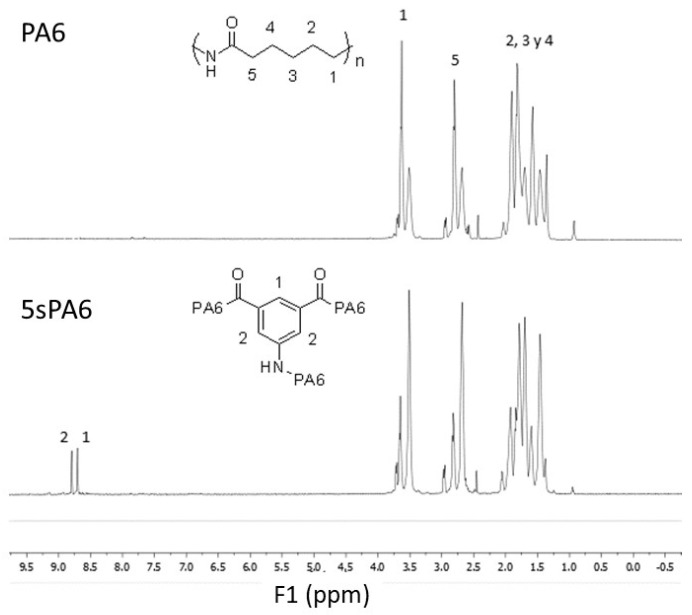
1H spectra of the raw PA6 and the star-branched polyamide 5sPA6.
Figure 3
Figure 3
WAXS curves of the star-branched polyamides.
Figure 4
Figure 4
(Left) SEC curves of the star-branched polyamides. (Right) Polydispersity of the peaks for the bimodal distribution of the star-branched polyamides.
Figure 5
Figure 5
DSC thermograms of the star-branched polyamides’ (left) melting and (right) crystallization curves.
Figure 6
Figure 6
MFI values and viscosity molecular weight (Mz) of the star-branched polymers versus the content of 5-aminoisophthalic acid.
Figure 7
Figure 7
Apparent viscosity of the samples by capillary rheometry versus shear rate: (left) 240 °C and (right) 260 °C.
Figure 8
Figure 8
Spiral specimens for PA6 (left) and star polyamides modified with 2.5% (center) and 5% (right) 5-aminophthalic acid.
Figure 9
Figure 9
Pressures required to advance 1 mm in the spiral mold of sPA6 with different amounts of LA.
Figure 10
Figure 10
Specific mechanical properties of modified polyamides (sPA6) under different preparation approaches as a function of the 5-aminoisophthalic acid content: (a) Young’s modulus, (b) elongation at break, (c) Charpy impact test and (d) heat-distortion temperature.
Figure 11
Figure 11
Images of the forming process: film manufacturing of 2.5sPA6, lamination sequence, pre-consolidation and final specimen after compaction.
Figure 12
Figure 12
Results obtained from the characterization of composites of PA6 and 2.5sPA6 by film stacking at 240 and 260 °C: (a)Young’s modulus, (b) tensile stress and (c) Charpy impact test.
Figure 13
Figure 13
Welding process. (a) Milling of 2.5sPA6 and raw PA6 composite specimens, (b) deposition of 2.5sPA6 as an energy director on the specimens by FFF, (c) ultrasonic welding with cylindrical sonotrode and (d) mechanical test to evaluate weld strength.

References

    1. Yao S.S., Jin F.L., Rhee K.Y., Hui D., Park S.J. Recent advances in carbon-fiber-reinforced thermoplastic composites: A review. Compos. Part B Eng. 2018;142:241–250. doi: 10.1016/j.compositesb.2017.12.007. - DOI
    1. Bhudolia S.K., Gohel G., Leong K.F. Advances in Ultrasonic Welding of Thermoplastic Composites: A Review. Materials. 2020;13:1284. doi: 10.3390/ma13061284. - DOI - PMC - PubMed
    1. Banik N. A review on the use of thermoplastic composites and their effects in induction welding method. Mater. Today Proc. 2018;5:20239–20249. doi: 10.1016/j.matpr.2018.06.395. - DOI
    1. Martin I., Saenz del Castillo D., Fernandez A., Güemes A. Advanced Thermoplastic Composite Manufacturing by In-Situ Consolidation: A Review. J. Compos. Sci. 2020;4:149. doi: 10.3390/jcs4040149. - DOI
    1. Ageyeva T., Sibikin I., Kovács J.G. A Review of Thermoplastic Resin Transfer Molding: Process Modeling and Simulation. Polymers. 2019;11:1555. doi: 10.3390/polym11101555. - DOI - PMC - PubMed

LinkOut - more resources