


Spectroscopic Ellipsometry and Quartz Crystal Microbalance with Dissipation for the Assessment of Polymer Layers and for the Application in Biosensing
- PMID: 35267879
- PMCID: PMC8915094
- DOI: 10.3390/polym14051056
Spectroscopic Ellipsometry and Quartz Crystal Microbalance with Dissipation for the Assessment of Polymer Layers and for the Application in Biosensing
Abstract
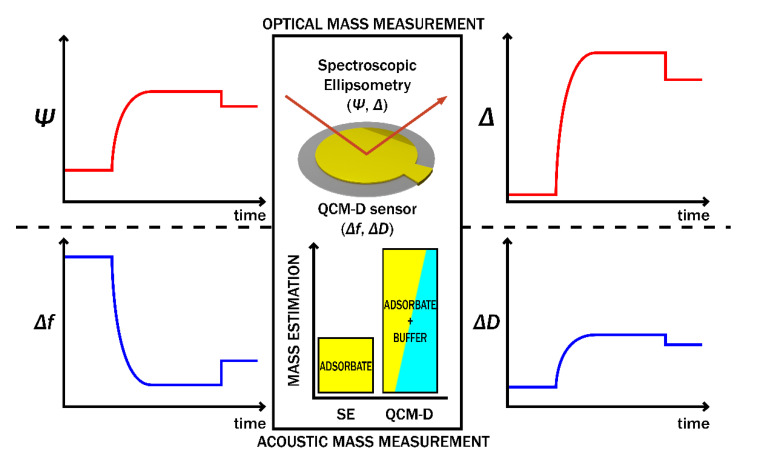
Polymers represent materials that are applied in almost all areas of modern life, therefore, the characterization of polymer layers using different methods is of great importance. In this review, the main attention is dedicated to the non-invasive and label-free optical and acoustic methods, namely spectroscopic ellipsometry (SE) and quartz crystal microbalance with dissipation (QCM-D). The specific advantages of these techniques applied for in situ monitoring of polymer layer formation and characterization, biomolecule immobilization, and registration of specific interactions were summarized and discussed. In addition, the exceptional benefits and future perspectives of combined spectroscopic ellipsometry and QCM-D (SE/QCM-D) in one measurement are overviewed. Recent advances in the discussed area allow us to conclude that especially significant breakthroughs are foreseen in the complementary application of both QCM-D and SE techniques for the investigation of polymer structure and assessment of the interaction between biomolecules such as antigens and antibodies, receptors and ligands, and complementary DNA strands.
Keywords: application for biosensing; biosensors; characterization of polymer layers; conducting polymers; immunosensors; molecularly imprinted polymers (MIPs); quartz crystal microbalance with dissipation (QCM-D); spectroscopic ellipsometry.
Conflict of interest statement
The authors declare no conflict of interest.
Figures
References
-
- Popov A., Brasiunas B., Damaskaite A., Plikusiene I., Ramanavicius A., Ramanaviciene A. Electrodeposited Gold Nanostructures for the Enhancement of Electrochromic Properties of PANI–PEDOT Film Deposited on Transparent Electrode. Polymers. 2020;12:2778. doi: 10.3390/polym12122778. - DOI - PMC - PubMed
-
- German N., Popov A., Ramanaviciene A., Ramanavicius A. Evaluation of enzymatic formation of polyaniline nanoparticles. Polymer. 2017;115:211–216. doi: 10.1016/j.polymer.2017.03.028. - DOI
Publication types
LinkOut - more resources
Full Text Sources
Other Literature Sources
