. 2022 Feb 24;14(5):959.
doi: 10.3390/nu14050959.

Dietary Intake and Sources of Added Sugars in Various Food Environments in Costa Rican Adolescents

Affiliations

Dietary Intake and Sources of Added Sugars in Various Food Environments in Costa Rican Adolescents

Rafael Monge-Rojas et al. Nutrients. .

Abstract

Consumption of added sugars, especially from sugar-sweetened beverages (SSBs), has been associated with several negative health outcomes during adolescence. This study aimed to identify dietary intake and food sources of added sugars in the home, school, and neighborhood environments of Costa Rican adolescents. Dietary intake of added sugars was determined using 3-day food records in a cross-sectional study of 818 adolescents aged 12 to 19 and enrolled in rural and urban schools in the province of San José. On average, 90% of adolescents consumed more than 10% of their total energy intake from added sugars. Furthermore, 74.0% of added sugars were provided at home, 17.4% at school, and 8.6% in the neighborhood. Added sugars were primarily provided by frescos (29.4%), fruit-flavored still drinks (22.9%), and sugar-sweetened carbonated beverages (12.3%), for a total contribution of 64.6%. Our findings suggest that Costa Rican adolescents have a plethora of added sugar sources in all food environments where they socialize. However, it is relevant for public health to consider the home and school environments as fundamental units of interventions aimed at reducing added sugars in the adolescent diet. Frescos prepared at home and school and fruit-flavored still drinks must be the focus of these interventions.

Keywords: Costa Rica; added sugar; adolescents; home environment; neighborhood environment; school environment.


Conflict of interest statement

The authors declare no conflict of interest. The funder had no role in the design of the study, collection, analyses, or interpretation of data, writing of the manuscript, or the decision to publish the results.

Figures
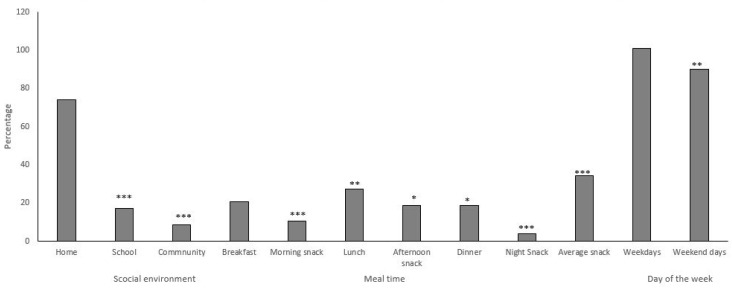
Figure 1
Figure 1
Proportion of added sugars consumed by Costa Rican adolescents in different social environments and mealtimes. Values shown as %. Significant differences determined from chi-squared test shown as * p < 0.05, ** p < 0.01, *** p < 0.0001, as compared to the reference group (home environment, breakfast and weekdays).
Figure 2
Figure 2
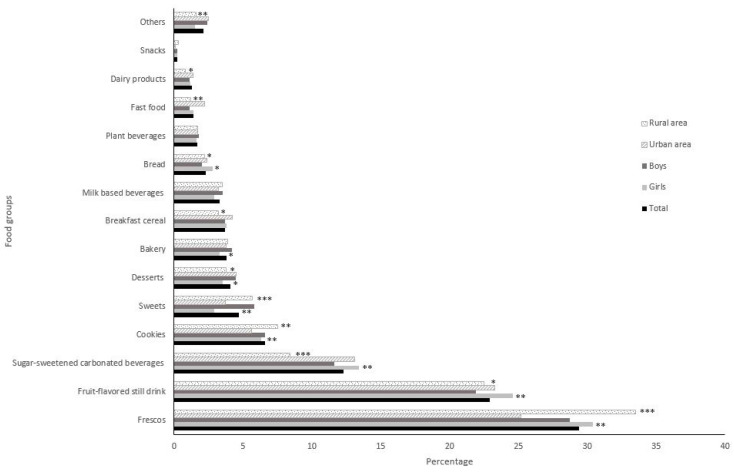
Food sources of added sugars in the Costa Rican adolescent diet, stratified by sex and area. Values shown as %. Significant differences determined from chi-squared test shown as * p < 0.05, ** p < 0.01, *** p < 0.0001, as compared to the reference group (boys and urban area). Fresco is a traditional Costa Rican home-made beverage made by blending pieces of fresh fruit or fresh fruit juice, sugar, and water. Fruit-flavored still drink includes fruit-flavored still waters, iced teas and hydration drinks. Sugar-sweetened carbonated beverages includes Coke, Pepsi, Sprite, and other sodas. Cookies includes all home-made and prepackaged cookies. Sweets includes all sugar confectionery items. Milk based beverages Includes industrialized ready-to-drink flavored milk drinks. Plant beverages includes all type of plant-based milk beverages (cereals, legumes, nuts, seeds, and pseudo cereals). Fast foods includes traditional Costa Rican fast foods (e.g., empanadas, arreglados, tacos ticos) and foods sold in international restaurant chains such as McDonald’s, Burger King, KFC and others. Snacks includes sweet extruded and puffed corn snacks.
Figure 3
Figure 3
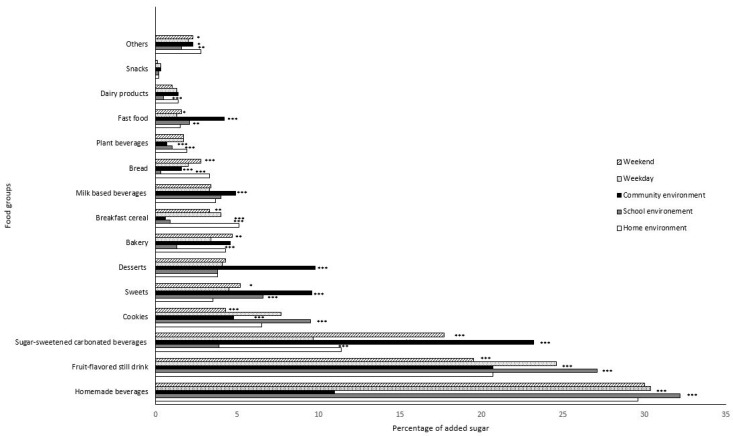
Food sources of added sugars in the Costa Rican adolescents’ diet, stratified by social environment and day of the week. Values shown as %. Significant differences determined from chi-squared test shown as * p < 0.05, ** p < 0.01, *** p < 0.0001, as compared to the referent group (home environment and weekdays). Fresco is a traditional Costa Rican home-made beverage made by blending pieces of fresh fruit or fresh fruit juice, sugar, and water. Fruit-flavored still drink includes fruit-flavored still waters, iced teas and hydration drinks. Sugar-sweetened carbonated beverages includes Coke, Pepsi, Sprite, and other sodas. Cookies includes all home-made and prepackaged cookies. Sweets includes all sugar confectionery items. Milk based beverages includes industrialized ready-to-drink flavored milk drinks. Plant beverages includes all type of plant-based milk beverages (cereals, legumes, nuts, seeds, and pseudo cereals). Fast foods includes traditional Costa Rican fast foods (e.g., empanadas, arreglados, tacos ticos) and foods sold in international restaurant chains such as McDonald’s, Burger King, KFC and others. Snacks includes sweet extruded and puffed corn snacks.

References

    1. Vos M.B., Kaar J.L., Welsh J.A., Van Horn L.V., Feig D.I., Anderson C.A., Patel M.J., Crus Munos J., Krebs N.F., Xanthakos S.A., et al. Added sugars and cardiovascular disease risk in children: A scientific statement from the American Heart Association. Circulation. 2017;135:e1017–e1034. doi: 10.1161/CIR.0000000000000439. - DOI - PMC - PubMed
    1. Ambrosini G.L., Oddy W.H., Huang R.C., Mori T.A., Beilin L.J., Jebb S.A. Prospective associations between sugar-sweetened beverage intakes and cardiometabolic risk factors in adolescents. Am. J. Clin. Nutr. 2013;98:327–334. doi: 10.3945/ajcn.112.051383. - DOI - PMC - PubMed
    1. Jiménez-Aguilar A., Flores M., Shamah-Levy T. Sugar-sweetened beverages consumption and BMI in Mexican adolescents: Mexican National Health and Nutrition Survey 2006. [(accessed on 13 January 2022)];Salud Pública México. 2009 51:S604–S612. doi: 10.1590/S0036-36342009001000015. Available online: http://www.scielo.org.mx/scielo.php?pid=S0036-36342009001000015&script=s.... - DOI - PubMed
    1. Malik V.S., Pan A., Willett W.C., Hu F.B. Sugar-sweetened beverages and weight gain in children and adults: A systematic review and meta-analysis. Am. J. Clin. Nutr. 2013;98:1084–1102. doi: 10.3945/ajcn.113.058362. - DOI - PMC - PubMed
    1. Magriplis E., Michas G., Petridi E., Chrousos G.P., Roma E., Benetou V., Cholopoulos N., Micha R., Panagiotakos D., Zampelas A. Dietary sugar intake and its association with obesity in children and adolescents. Children. 2021;8:676. doi: 10.3390/children8080676. - DOI - PMC - PubMed

LinkOut - more resources