. 2022 Mar 6;27(5):1721.
doi: 10.3390/molecules27051721.

Inhibition of the Quorum Sensing System, Elastase Production and Biofilm Formation in Pseudomonas aeruginosa by Psammaplin A and Bisaprasin

Affiliations

Inhibition of the Quorum Sensing System, Elastase Production and Biofilm Formation in Pseudomonas aeruginosa by Psammaplin A and Bisaprasin

Emmanuel T Oluwabusola et al. Molecules. .

Abstract

Natural products derived from marine sponges have exhibited bioactivity and, in some cases, serve as potent quorum sensing inhibitory agents that prevent biofilm formation and attenuate virulence factor expression by pathogenic microorganisms. In this study, the inhibitory activity of the psammaplin-type compounds, psammaplin A (1) and bisaprasin (2), isolated from the marine sponge, Aplysinellarhax, are evaluated in quorum sensing inhibitory assays based on the Pseudomonas aeruginosa PAO1 lasB-gfp(ASV) and rhlA-gfp(ASV) biosensor strains. The results indicate that psammaplin A (1) showed moderate inhibition on lasB-gfp expression, but significantly inhibited the QS-gene promoter, rhlA-gfp, with IC50 values at 14.02 μM and 4.99 μM, respectively. In contrast, bisaprasin (2) displayed significant florescence inhibition in both biosensors, PAO1 lasB-gfp and rhlA-gfp, with IC50 values at 3.53 μM and 2.41 μM, respectively. Preliminary analysis suggested the importance of the bromotyrosine and oxime functionalities for QSI activity in these molecules. In addition, psammaplin A and bisaprasin downregulated elastase expression as determined by the standard enzymatic elastase assay, although greater reduction in elastase production was observed with 1 at 50 μM and 100 μM. Furthermore, the study revealed that bisaprasin (2) reduced biofilm formation in P. aeruginosa.

Keywords: Pseudomonas aeruginosa; elastase inhibitor; inhibitor of biofilm formation; marine natural products; marine sponge; psammaplin; quorum sensing inhibitor.


Conflict of interest statement

The authors declare no conflict of interest.

Figures
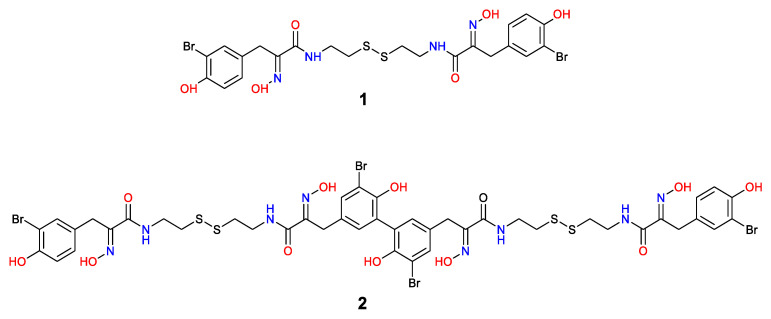
Figure 1
Figure 1
Structures of psammaplin A (1) and bisaprasin (2).
Figure 2
Figure 2
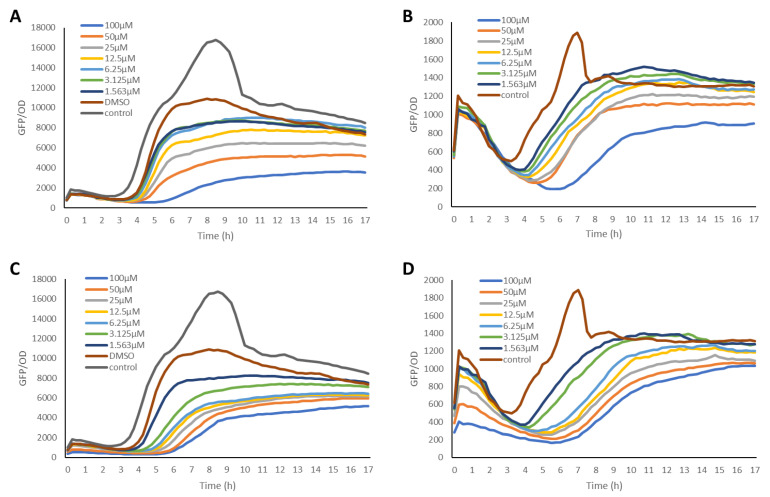
Dose–response curves of psammaplin A (1) incubated with P. aeruginosa PAO1 lasB-gfp(ASV) (A) and rhlA-gfp(ASV) (B) strains, while (C,D) are the dose–response curves of bisaprasin (2) incubated with P. aeruginosa PAO1 lasB-gfp(ASV) and rhlA-gfp(ASV) strains, respectively.
Figure 3
Figure 3
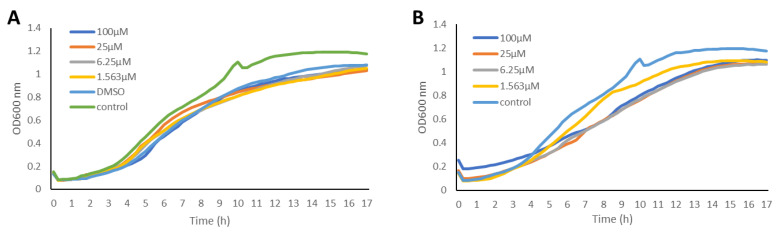
The growth curve (OD600) of the biosensor strain PAO1 lasB-gfp(ASV) incubated with psammaplin A (1) (A) and bisaprasin (2) (B) at four different concentrations ranging from 1.563 μM to 100 μM.
Figure 4
Figure 4
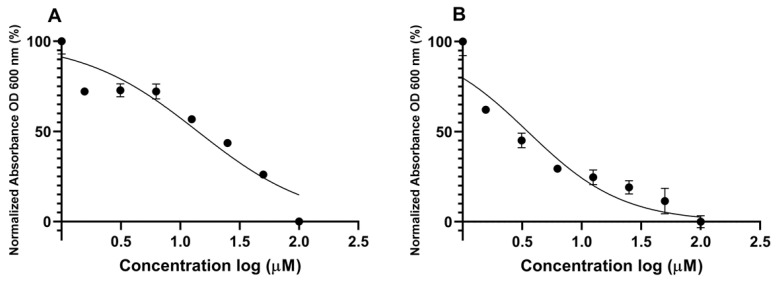
Log IC50 curves of psammaplin A (1) (A) and bisaprasin (2) (B) incubated with P. aeruginosa PAO1 lasB-gfp(ASV).
Figure 5
Figure 5
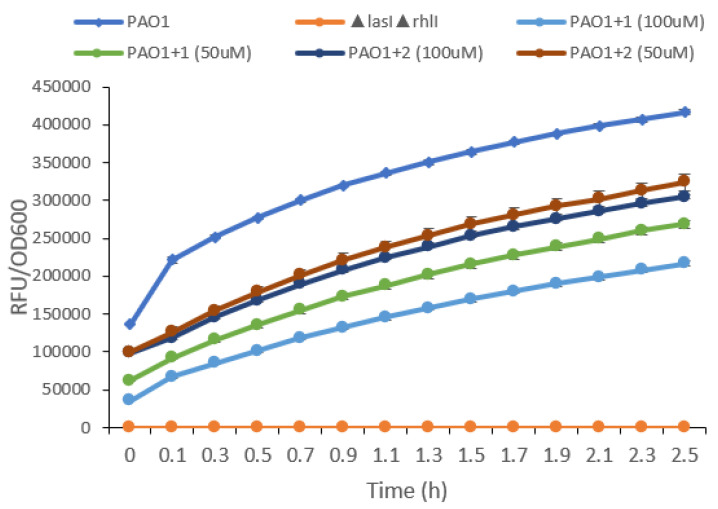
Effects of psammaplin A (1) and bisaprasin (2) on the elastase activities of P. aeruginosa cultures. The elastase activity of P. aeruginosa culture supernatants was measured using the EnzChekElastase assay kit (Invitrogen). Fluorescence was recorded every 6 min for 2.5 h by using a Tecan Infinite 200 Pro plate reader (excitation at 490 nm, emission at 520 nm). The P. aeruginosa PAO1 ΔlasIΔrhlI strain and DMSO served as controls.
Figure 6
Figure 6
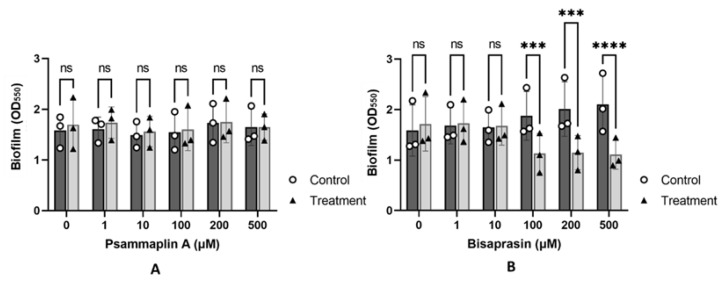
(A,B) show the effects of 0–500 µM of psammaplin A (1) and bisaprasin (2) on P. aeruginosa PAO1 biofilm formation, respectively. Each data point represents the average of two technical replicates. Error bars indicate the standard deviation of the mean. p-values were derived from multiple comparisons between control and treatment groups following two-way ANOVA, with ***—<0.001, ****—<0.0001. ns= not significant.

References

    1. Aminov R.A. Brief history of the antibiotic era: Lessons learned and challenges for the future. Front. Microbiol. 2010;1:134. doi: 10.3389/fmicb.2010.00134. - DOI - PMC - PubMed
    1. Rice L. Federal funding for the study of antimicrobial resistance in nosocomial pathogens: No ESKAPE. J. Infect. Dis. 2008;197:1079–1081. doi: 10.1086/533452. - DOI - PubMed
    1. Yadav G., Thakuria B., Madan M., Agwan V., Pandey A. Linezolid and vancomycin-resistant Enterococci: A therapeutic problem. J. Clin. Diagn. Res. 2017;11:GC07–GC11. doi: 10.7860/JCDR/2017/27260.10474. - DOI - PMC - PubMed
    1. Markwart R., Willrich N., Haller S., Noll I., Koppe U., Werner G., Eckmanns T., Reuss A. The rise in vancomycin-resistant Enterococcus faecium in Germany: Data from the German antimicrobial resistance surveillance (ARS) Antimicrob. Resist. Infect. Control. 2019;8:147. doi: 10.1186/s13756-019-0594-3. - DOI - PMC - PubMed
    1. Chan L., Basuino L., Diep B., Hamilton S., Chatterjee S.S., Chambers H. Ceftobiprole- and ceftaroline-resistant methicillin-resistant Staphylococcus aureus. Antimicrob. Agents Chemother. 2015;59:2960–2963. doi: 10.1128/AAC.05004-14. - DOI - PMC - PubMed

LinkOut - more resources