Review
. 2022 Feb 24;23(5):2519.
doi: 10.3390/ijms23052519.

Drug-Resistant Stem Cells: Novel Approach for Colon Cancer Therapy

Affiliations
Review

Drug-Resistant Stem Cells: Novel Approach for Colon Cancer Therapy

Nitin Telang. Int J Mol Sci. .

Abstract

Background: Next to breast cancer, advanced stage metastatic colon cancer represents a major cause for mortality in women. Germline or somatic mutations in tumor suppressor genes or in DNA mismatch repair genes represent risk factors for genetic predisposition of colon cancer that are also detectable in sporadic colon cancer. Conventional chemotherapy for colon cancer includes combination of 5-fluoro-uracil with oxaliplatin and irinotecan or targeted therapy with non-steroid anti-inflammatory drugs and selective cyclooxygenase-2 inhibitors. Major limitations of these therapeutic interventions are associated with systemic toxicity, acquired tumor resistance and the emergence of drug resistant stem cells that favor initiation, progression and metastasis of therapy-resistant disease. These limitations emphasize an unmet need to identify tumor stem cell selective testable alternatives. Drug-resistant stem cell models facilitate the identification of new testable alternatives from natural phytochemicals and herbal formulations. The goal of this review is to provide an overview relevant to the current status of conventional/targeted therapy, the role of cancer stem cells and the status of testable alternatives for therapy-resistant colon cancer. Experimental models: Hyper-proliferative and tumorigenic cell lines from genetically predisposed colonic tissues of female mice represent experimental models. Chemotherapeutic agents select drug-resistant phenotypes that exhibit upregulated expressions of cellular and molecular stem cell markers. Mechanistically distinct natural phytochemicals effectively inhibit stem cell growth and downregulate the expressions of stem cell markers.

Conclusions: The present review discusses the status of colon cancer therapy and inherent limitations, cancer stem cell biology, potential lead compounds and their advantages over chemotherapy. The present experimental approaches will facilitate the identification of pharmacological and naturally-occurring agents as lead compounds for stem cell targeted therapy of colon cancer.

Keywords: colon cancer; drug-resistant stem cells; natural products.


Conflict of interest statement

The author declares that there are no conflict of interest.

Figures
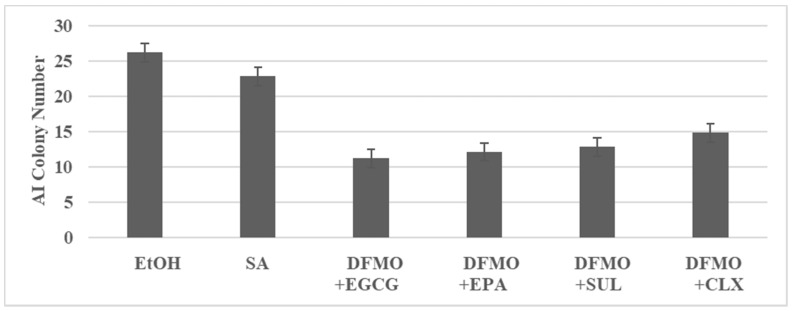
Figure 1
Figure 1
Combinatorial effects of test agents in 850 MIN COL model. AI colony number is determined at day 14 after seeding 100 cells. Data presented as mean ± SD, n = 12 per treatment group, and analyzed by ANOVA with Dunnett’s multiple comparison test (α = 0.05). EtOH, ethanol; SA, single agent; DFMO, difluoromethyl ornithine; EGCG, epigallocatechin gallate; EPA, eicosapentaenoic acid; SUL, sulindac; CLX, celecoxib; ANOVA, analysis of variance. Data summarized from [24].
Figure 2
Figure 2
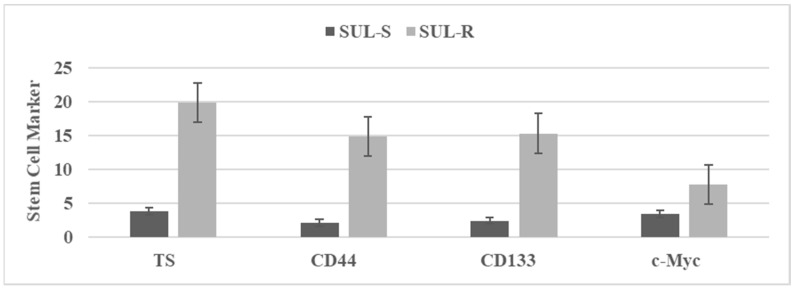
The status of stem cell markers in sulindac resistant (SUL-R) 850 MIN COL phenotype. Figure 2. TS: Tumor spheroid number determined at day 14 after seeding 100 cells. Mean ± SD, n = 3 per treatment group. CD44, CD133, c-Myc. RFU determined at day four after seeding 1.0 × 10⁵ cells. Data presented as mean ± SD, n = 3 per treatment group, and analyzed by paired Student’s t-test. SUL-S, sulindac sensitive; SUL-R, sulindac resistant; CD, cluster of differentiation; c-Myc, cellular Myc; RFU, relative fluorescent unit.
Figure 3
Figure 3
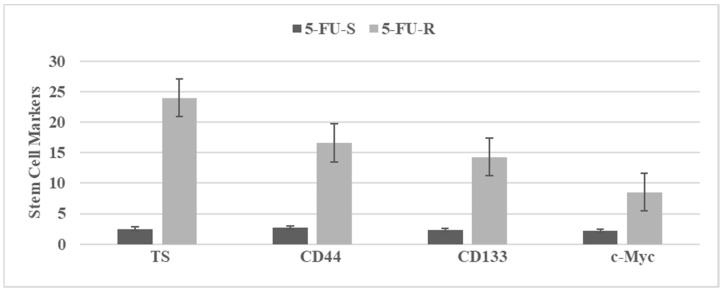
The status of stem cell markers in 5-fluoro-uracil resistant (5-FU-R) Mlh1/1638N COL phenotype. Figure 3. TS: tumor spheroid number determined at day 14 after seeding 100 cells. Data expressed as Mean ± SD, n = 3 per treatment group. CD44, CD133 c-Myc. RFU determined at day four after seeding 1.0 × 10⁵ cells. Data expressed as Mean ± SD, n = 3 per treatment group. Data analyzed by paired Student’s t-test. 5-FU-S, 5-fluoro-uracil sensitive; 5-FU-R, 5-fluoro-uracil resistant; CD, cluster of differentiation; c-Myc, cellular Myc; RFU, relative fluorescent unit. Data summarized from [22].
Figure 4
Figure 4
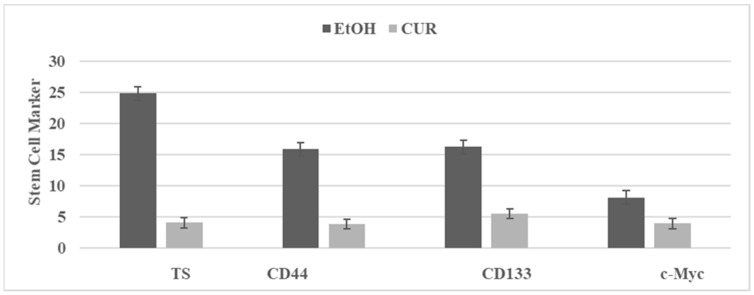
Effect of curcumin on stem cell markers in SU-R 850 MIN COL phenotype. TS: Tumor spheroid number determined at day 14 after seeding of 100 cells. Mean ± SD, n = 3 per treatment group. CD44, CD133, c-Myc. RFU determined at day four after seeding 1.0 × 10⁵ cells. EtOH, ethanol; CUR, curcumin; CD, cluster of differentiation; c-Myc, cellular Myc; RFU, relative fluorescent unit.
Figure 5
Figure 5
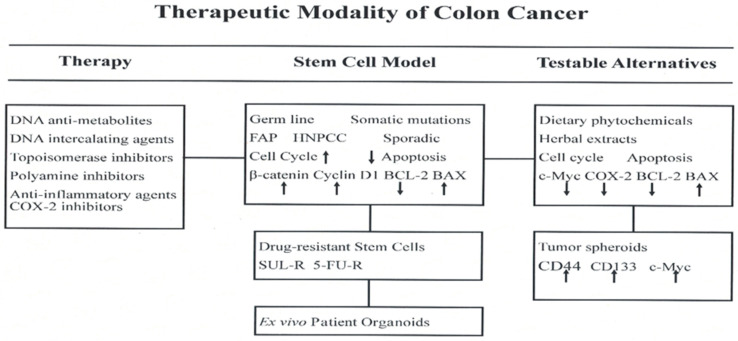
COX-2, cyclo-oxygenase-2; FAP, familial adenomatous polyposis; HNPCC, hereditary non-polyposis colon cancer; c-Myc, cellular myc; SUL-R, sulindac resistant; 5-FU-R, 5-fluoro-uracil resistant; BCL-2, B cell lymphoma-2; BAX, BCL-2 associated X protein; CD, cluster of differentiation.

References

    1. American Cancer Society-Facts and Figures-2021. American Cancer Society; Atlanta, GA, USA: 2021.
    1. Williams C., Di Leo A., Niv Y., Gustafsson J.Å. Estrogen receptor-β as a target for colorectal cancer prevention. Cancer Lett. 2016;372:48–56. doi: 10.1016/j.canlet.2015.12.009. - DOI - PMC - PubMed
    1. Filho R.P.S., Junior S.A., Begnami M.D., Ferreira F.O., Nakagawa W.T. Estrogen receptor β as a prognostic marker of tumor progression in colorectal cancer with familial adenomatous polyps and sporadic polyps. Path. Oncol. Res. 2018;24:533–540. doi: 10.1007/s12253-017-0268-5. - DOI - PubMed
    1. Cho N.L., Javid S.H., Carothers A.M., Redston M., Bertagnolli M.M. Estrogen receptor α and β are inhibitory modifiers of Apc-dependent tumorigenesis in the proximal colon of Min/+ mice. Cancer Res. 2007;67:2366–2372. doi: 10.1158/0008-5472.CAN-06-3026. - DOI - PubMed
    1. Saleiro D., Murillo G., Lubahn D.B., Kopelovich L., Korach K.S., Mehta R.G. Enhanced induction of mucin-depleted foci in estrogen receptor-β knockout mice. Cancer Prev. Res. (Phila.) 2010;3:1198–1204. doi: 10.1158/1940-6207.CAPR-10-0044. - DOI - PMC - PubMed