


The Tiny Companion Matters: The Important Role of Protons in Active Transports in Plants
- PMID: 35269965
- PMCID: PMC8911182
- DOI: 10.3390/ijms23052824
The Tiny Companion Matters: The Important Role of Protons in Active Transports in Plants
Abstract
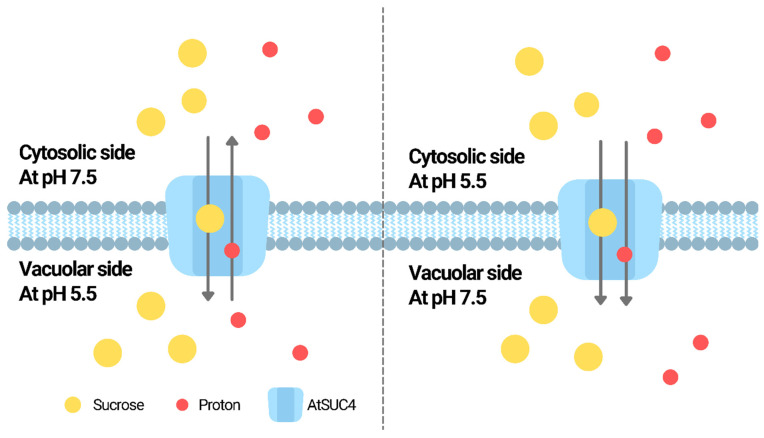
In plants, the translocation of molecules, such as ions, metabolites, and hormones, between different subcellular compartments or different cells is achieved by transmembrane transporters, which play important roles in growth, development, and adaptation to the environment. To facilitate transport in a specific direction, active transporters that can translocate their substrates against the concentration gradient are needed. Examples of major active transporters in plants include ATP-binding cassette (ABC) transporters, multidrug and toxic compound extrusion (MATE) transporters, monosaccharide transporters (MSTs), sucrose transporters (SUTs), and amino acid transporters. Transport via ABC transporters is driven by ATP. The electrochemical gradient across the membrane energizes these secondary transporters. The pH in each cell and subcellular compartment is tightly regulated and yet highly dynamic, especially when under stress. Here, the effects of cellular and subcellular pH on the activities of ABC transporters, MATE transporters, MSTs, SUTs, and amino acid transporters will be discussed to enhance our understanding of their mechanics. The relation of the altered transporter activities to various biological processes of plants will also be addressed. Although most molecular transport research has focused on the substrate, the role of protons, the tiny counterparts of the substrate, should also not be ignored.
Keywords: ATP-binding cassette (ABC) transporter; amino acid transporter; cellular pH; detoxification; monosaccharide transporter (MST); multidrug and toxic compound extrusion (MATE) transporter; nutrient transport; proton gradient; stress adaptation; sucrose transporter (SUT).
Conflict of interest statement
Authors declare no conflict of interest.
Figures
References
-
- Wilkinson S. PH as a stress signal. Plant Growth Regul. 1999;29:87–99. doi: 10.1023/A:1006203715640. - DOI
Publication types
MeSH terms
Substances
Grants and funding
LinkOut - more resources
Full Text Sources
