


First Survey of the Vascular and Cryptogam Flora on Bulgaria's Ancient Mounds
- PMID: 35270175
- PMCID: PMC8912620
- DOI: 10.3390/plants11050705
First Survey of the Vascular and Cryptogam Flora on Bulgaria's Ancient Mounds
Abstract
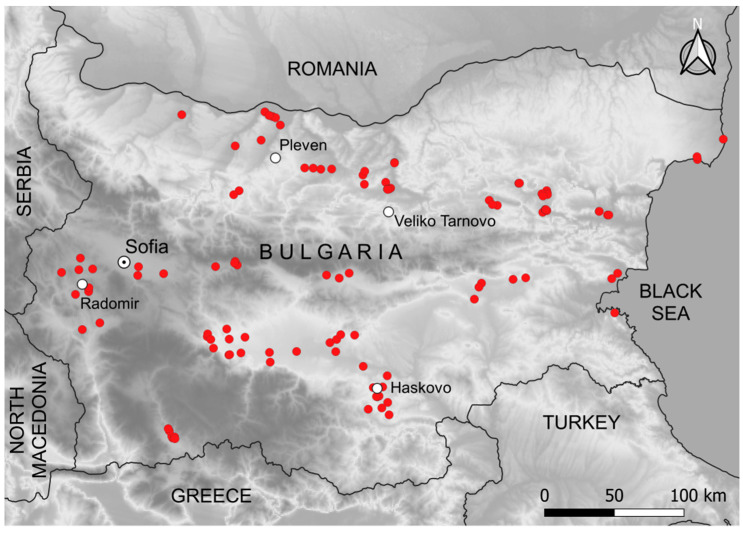
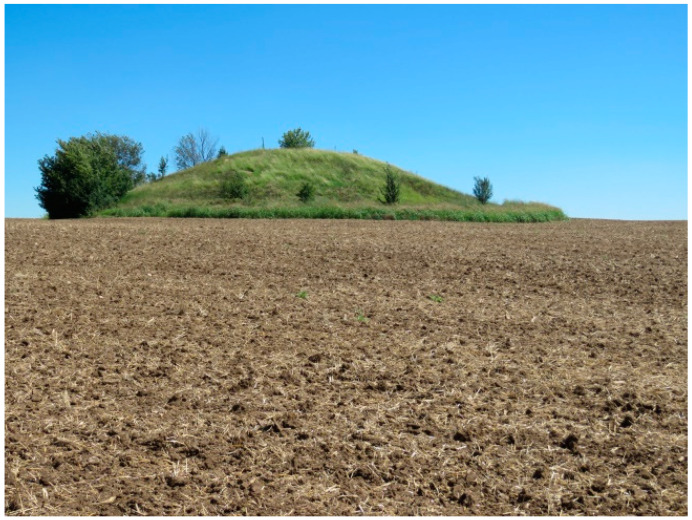
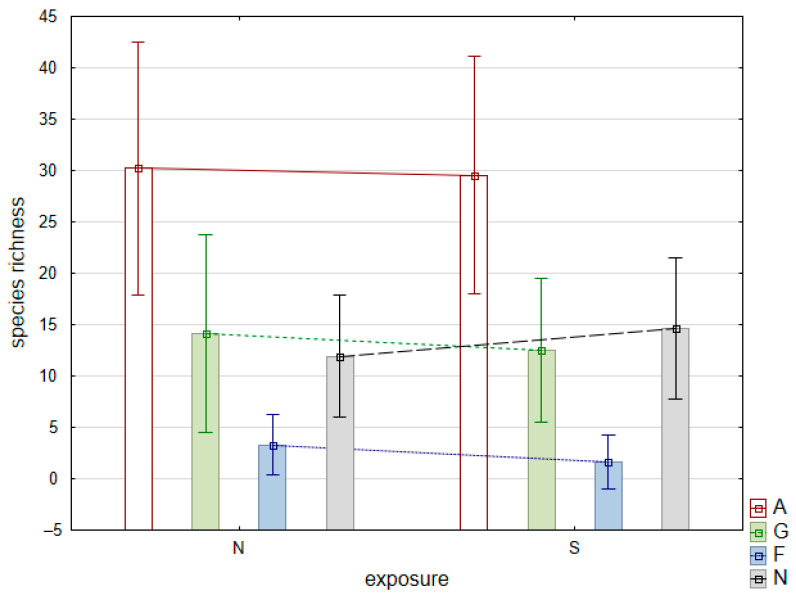
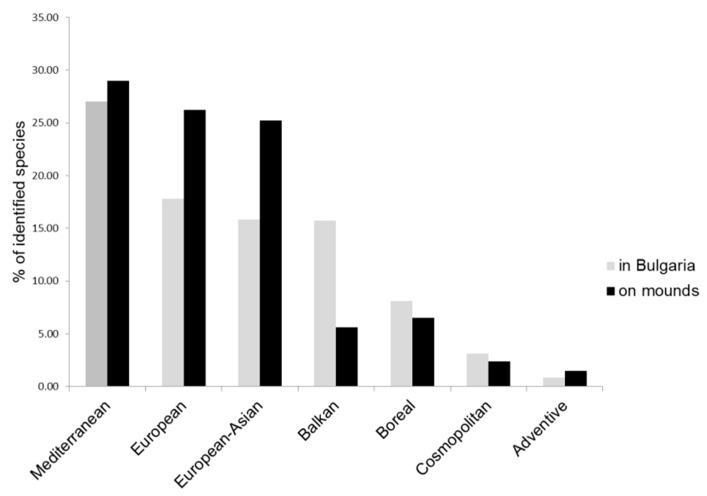
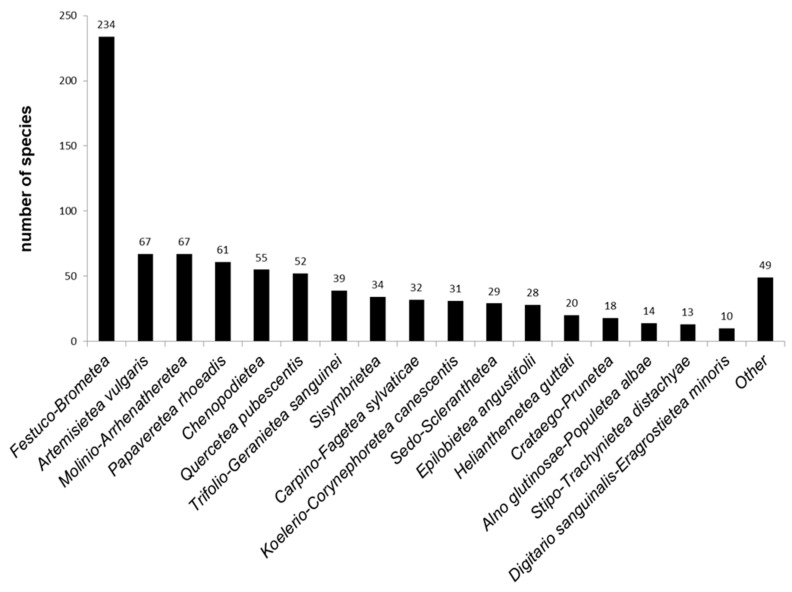
This work represents the first study of the floristic diversity on Bulgaria's ancient mounds. The objective of this research was to assess the importance of the mounds for the preservation of the native vascular and cryptogam flora. Our sampling design included 111 ancient mounds distributed throughout the country. We recorded a total of 1059 vascular plants, 58 bryophytes and 61 lichen taxa. Despite their small area, the mounds were shown to preserve nearly a quarter of the Bulgarian flora. The vegetation cover on the mounds included 61% perennials indicating a long-term persistence and stability. The majority (98%) of the established vascular plants were native species. Although the conservation significance of the vascular plant species were not common, we recorded 2 critically endangered, 9 endangered and 14 Balkan endemics during the present study. The lichen Arthopyrenia salicis was recorded for the first time in Bulgaria and a new locality of the rare bryophyte Ceratodon conicus was discovered. The established compositional difference between plots from the northern and southern slopes of the mounds (88.95%) is a testament to the high local habitat diversity. The prevalence of species characteristic for Festuco-Brometea suggests that the mounds preserve fragments of native grasslands and steppes. The variation in cover of agricultural and other human modified areas in the mounds' immediate surroundings did not substantially affect their species richness. We argue that the ancient mounds should be taken into consideration in future green space planning.
Keywords: bryophytes; generalist plants; grassland specialists; historical monuments; invasive alien plants; kurgans; lichens; native plants.
Conflict of interest statement
The authors declare no conflict of interest. The funders had no role in the design of the study; in the collection, analyses, or interpretation of data; in the writing of the manuscript, or in the decision to publish the results.
Figures
References
-
- Sudnik-Wójcikowska B., Moysiyenko I.I. Kurhany na “Dzikich Polach”—Dziedzictwo Kultury i Ostoja Ukraińskiego Stepu [Kurgans in the “Wild Field”—A Cultural Heritage and Refugium of the Ukrainian Steppe] Wydawnictwa Uniwersytetu Warszawskiego; Warsaw, Poland: 2012.
-
- Deák B. Nature and Culture: The Role of Ancient Burial Mounds in the Conservation of Eurasian Steppe Vegetation. Centre for Ecological Research; Tihany, Hungary: 2020. p. 172.
-
- Deák B., Tóthmérész B., Valkó O., Sudnik-Wójcikowska B., Moysiyenko I., Bragina T., Apostolova I., Dembicz I., Bykov N., Török P. Cultural monuments and nature conservation: A review of the role of kurgans in the conservation and restoration of steppe vegetation. Biodivers. Conserv. 2016;25:2473–2490. doi: 10.1007/s10531-016-1081-2. - DOI
-
- Apostolova I., Palpurina S., Sopotlieva D., Terziyska T., Velev N., Vassilev K., Nekhrizov G., Tsvetkova N. Ancient Burial Mounds-Stepping Stones for Semi-Natural Habitats in Agricultural Landscape. Ecol. Balk. 2020;12:43–52.
-
- Kitov G. The Thracian tumuli. Thracia. 1993;10:39–80.
Grants and funding
LinkOut - more resources
Full Text Sources
