


Prevalence and Predictors of Osteoporosis and Osteopenia in Postmenopausal Women of Punjab, India
- PMID: 35270692
- PMCID: PMC8910053
- DOI: 10.3390/ijerph19052999
Prevalence and Predictors of Osteoporosis and Osteopenia in Postmenopausal Women of Punjab, India
Abstract
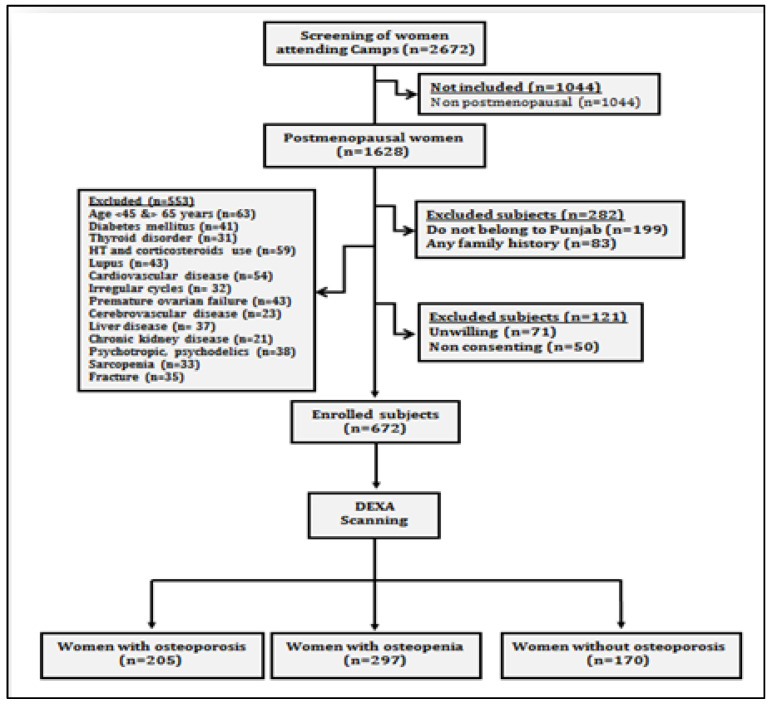
The prevalence and predictors of osteoporosis and osteopenia remain to be examined in the postmenopausal women of Punjab, India. The present cross-sectional study screened 1628 postmenopausal women during September 2019 to March 2020. Osteoporosis and osteopenia were confirmed on the basis of T-scores using dual energy X-ray absorptiometry (DXA) at the hip (femoral neck) and lumbar spine regions (L1−L4 vertebrae). The prevalence of osteoporosis and osteopenia was observed to be 30.50% and 44.20%, respectively, in postmenopausal women of Punjab. In univariable and multivariable regression analysis, variables independently influencing the risk of osteoporosis and osteopenia were: higher systolic blood pressure (95%CI: 1.22−3.11 & 1.08−2.49), triglyceride levels (95%CI: 1.21−3.10 & 1.42−2.51), poor sleep quality (95%CI: 1.91−2.47 & 1.76−3.47) and C-reactive protein levels (95%CI: 2.18−3.56 & 1.03−2.18). Years since menopause >10 years was observed to be an independent predictor for the risk of osteopenia but not for osteoporosis. Higher body mass index (>30 kg·m−2) was observed to be a significant protective factor against the risk of osteoporosis (95%CI: 0.26−0.68) and osteopenia (95%CI: 0.19−0.52). The higher prevalence rates of osteoporosis and osteopenia in postmenopausal women of Punjab are alarming, which solicits awareness and earlier testing of those women who are approaching menopause.
Keywords: independent predictors; osteopenia; postmenopausal women; prevalence of osteoporosis.
Conflict of interest statement
No potential conflicts of interest are reported by the authors.
Figures
References
-
- Weaver C.M., Gordon C.M., Janz K.F., Kalkwarf H.J., Lappe J.M., Lewis R., O’Karma M., Wallace T.C., Zemel B.S. The National Osteoporosis Foundation’s position statement on peak bone mass development and lifestyle factors: A systematic review and implementation recommendations. Osteoporos. Int. 2016;27:1281–1386. doi: 10.1007/s00198-015-3440-3. - DOI - PMC - PubMed
Publication types
MeSH terms
LinkOut - more resources
Full Text Sources
Medical
Research Materials
