


Facilitators and barriers for clinical implementation of a 30-minute point-of-care test for Neisseria gonorrhoeae and Chlamydia trachomatis into clinical care: A qualitative study within sexual health services in England
- PMID: 35271658
- PMCID: PMC8912210
- DOI: 10.1371/journal.pone.0265173
Facilitators and barriers for clinical implementation of a 30-minute point-of-care test for Neisseria gonorrhoeae and Chlamydia trachomatis into clinical care: A qualitative study within sexual health services in England
Abstract
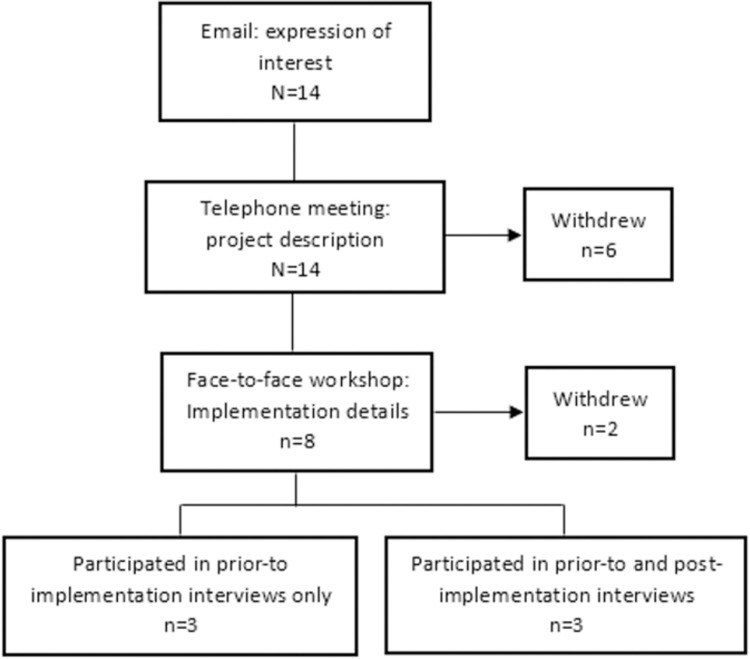
Point-of-care tests (POCTs) to diagnose sexually transmitted infections (STIs) have potential to positively impact patient management and patient perceptions of clinical services. Yet there remains a disconnect between development of new technologies and their implementation into clinical care. With the advent of new STI POCTs arriving to the global market, guidance for their successful adoption and implementation into clinical services is urgently needed. We conducted qualitative in-depth interviews with professionals prior to and post-implementation of a Chlamydia trachomatis/Neisseria gonorrhoeae POCT into clinical services in England to define key stakeholder roles and explore the process of POCT integration. Participants self-identified themselves as key stakeholders in the STI POCT adoption and/or implementation processes. Data consisted of interview transcripts, which were analysed thematically using NVIVO 11. Six sexual health services were included in the study; three of which have implemented POCTs. We conducted 40 total interviews: 31 prior to POCT implementation and 9 follow-up post-implementation. Post-implementation data showed that implementation plans required little or no change during service evaluation. Lead clinicians and managers self-identified as key stakeholders for the decision to purchase, while nurses self-identified as "change champions" for implementation. Many identified senior clinical staff as those most likely to introduce and drive change. However, participants stressed the importance of engaging all clinical staff in implementation. While the accuracy of the POCT, its positive impact on patient management and the ease of its integration within existing pathways were considered essential, costs of purchasing and utilising the technology were identified as central to the decision to purchase. Our study shows that key decision-makers for adoption and implementation require STI POCTs to have laboratory-comparable accuracy and be affordable for purchase and ongoing use. Further, successful integration of POCTs into sexual health services relies on supportive interpersonal relationships between all levels of staff.
Conflict of interest statement
The authors have read the journal’s policy and have the following competing interests to declare: At the time this research was being conducted, all authors were employed by the Applied Diagnostic Research and Evaluation Unit (ADREU) at St George’s University of London; ADREU has received funding from Abbott (https://www.abbott.com/), binx health (https://mybinxhealth.com/), Cepheid (https://www.cepheid.com/), SpeedDx (https://plexpcr.com/), Mologic (https://mologic.co.uk/), Revolugen (https://revolugen.co.uk/), and Sekisui (https://sekisuidiagnostics.com/), for the research and evaluation of their diagnostics. The present study was funded by a collaborative grant (ref: no. 90174-463338; awarded to STS, SSF, EMHE) between binx health and St George’s University of London. This does not alter our adherence to PLOS ONE policies on sharing data and materials. There are no patents, products in development or marketed products associated with this research to declare.
Figures
References
-
- Adams EJ, Ehrlich A, Turner KME, Shah K, Macleod J, Goldenberg S, et al.. Mapping patient pathways and estimating resource use for point of care versus standard testing and treatment of chlamydia and gonorrhoea in genitourinary medicine clinics in the UK. BMJ Open. 2014;4(7). doi: 10.1136/bmjopen-2014-005322 - DOI - PMC - PubMed
Publication types
MeSH terms
Associated data
LinkOut - more resources
Full Text Sources
Medical
