. 2022 May 19;139(20):3009-3017.
doi: 10.1182/blood.2022015860.

HLA-DQ heterodimers in hematopoietic cell transplantation

Affiliations

HLA-DQ heterodimers in hematopoietic cell transplantation

Effie W Petersdorf et al. Blood. .

Abstract

HLA-DQ heterodimers increase the susceptibility to autoimmune diseases, but their role in hematopoietic cell transplantation is unknown. We tested the hypothesis that outcome after HLA-matched and HLA-DQ-mismatched hematopoietic cell transplantation is influenced by HLA-DQ heterodimers. Heterodimers were defined in 5164 HLA-matched and 520 HLA-DQ-mismatched patients and their transplant donors according to well-established crystallographic criteria. Group 1 (G1) heterodimers are any DQA1*02/03/04/05/06α paired with any DQB1*02/03/04β. Group 2 (G2) heterodimers are DQA1*01α paired with any DQB1*05/06β. Multivariable models identified significantly higher relapse risk in G1G2 and G2G2 compared with G1G1 HLA-matched patients with malignant disease; risk increased with an increasing number of G2 molecules. In HLA-DQ-mismatched transplantation for malignant diseases, matching or mismatching for G2 increased relapse risk. G2 lowered disease-free survival after both HLA-matched and HLA-DQ-mismatched transplantation. A paradigm based on HLA-DQ heterodimers provides a functional definition of the hematopoietic cell transplantation barrier and a means to lower risks for future patients.


Figures

None
Graphical abstract
Figure 1.
Figure 1.
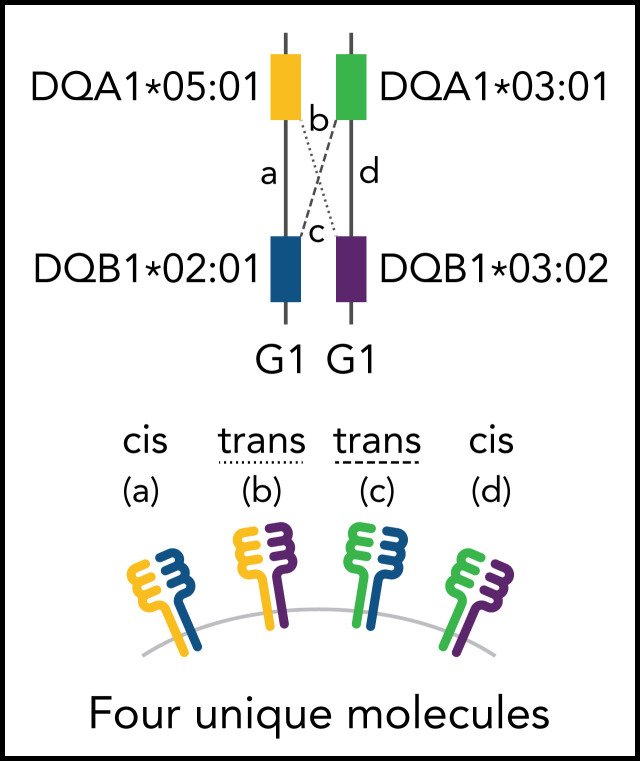
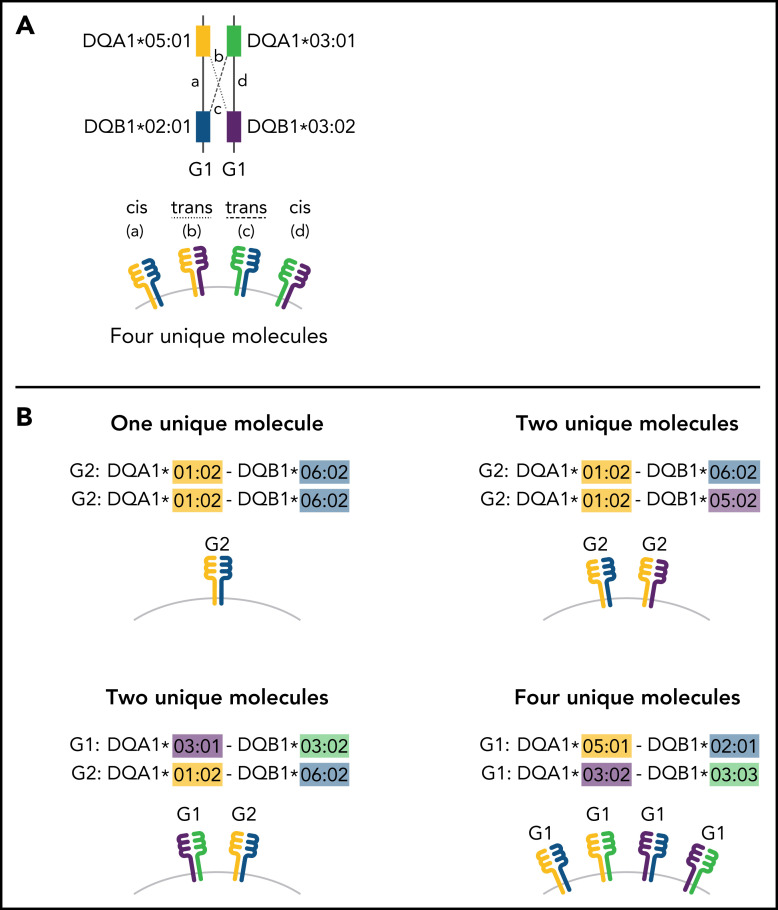
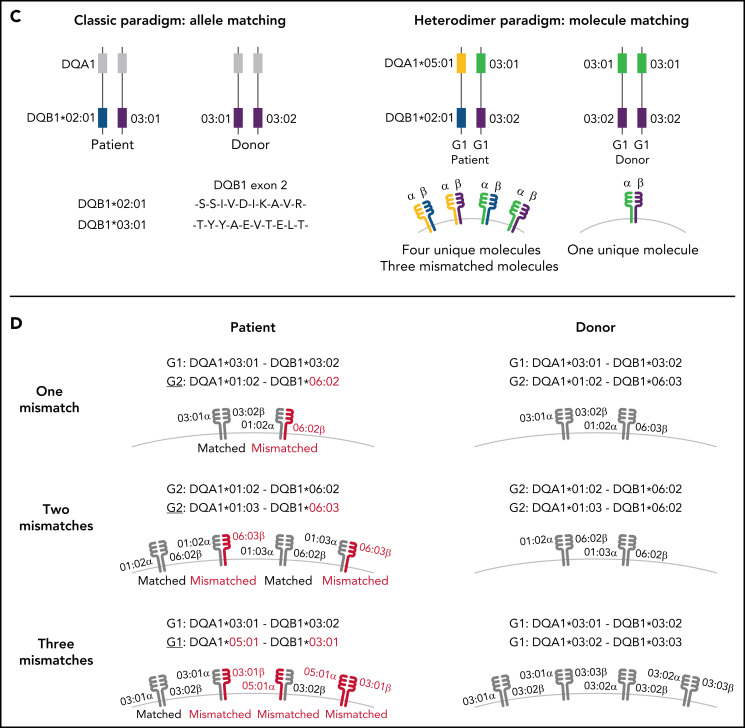
Schema for HLA-DQ heterodimers. (A) HLA-DQ molecules are heterodimers composed of an α-chain protein encoded by the HLA-DQA1 allele and a β-chain protein encoded by the HLA-DQB1 allele that are coinherited on the same parental haplotype (a and d cis heterodimers). Cis encoded parental DQA1-DQB1 haplotypes define the genotype of the individual: G1G1, G1G2, and G2G2. In addition to cis heterodimer molecules, trans-heterodimer molecules (b and c) are formed by the α-chain from 1 parent with the β chain of the other parent. Stable trans-dimerization occurs between G1α (DQA1*02/03/04/05/06) and G1β (DQB1*02/03/04) and between G2α (DQA1*01) and G2β (DQB1*05/06) but not between G1α and G2β or G2α and G1β. (B) Individuals may encode up to 4 unique HLA-DQ molecules depending on DQA1-DQB1 homozygosity and G1G1, G1G2, and G2G2 genotype. G1G1 and G2G2 individuals can form trans-dimers between the DQα from 1 haplotype with the DQβ of the opposing haplotype, generating up to 4 unique molecules. Trans-dimerization cannot occur between G1α and G2β or between G2α and G1β chains; hence, G1G2 individuals have 2 unique molecules each defined by the cis-encoded parental DQA1-DQB1 haplotypes. (C) The classic paradigm for HLA-DQB1 exon 2 allele matching (left) is based on donor compatibility for amino acid residues of the parentally inherited β chains. HLA-DQB1 exon 2 matching does not interrogate HLA-DQA1 (gray) and current donor selection criteria do not include HLA-DQA1. The heterodimer model (right) incorporates sequence information from the α-chain product of DQA1 and the β-chain product of DQB1. The heterodimer paradigm describes the total number of unique molecules, the number of mismatched molecules, and the specific α- and β-protein sequences of a given molecule. (D) Transplantation from donors with 1 HLA-DQB1 allele mismatch may result in 1, 2, or 3 mismatched HLA-DQ molecules in the patient depending on homozygosity of HLA-DQA1 and DQB1 alleles in the patient and the donor and G1G1, G1G2, and G2G2 genotype. The mismatch is denoted in red.
Figure 1.
Figure 1.
Schema for HLA-DQ heterodimers. (A) HLA-DQ molecules are heterodimers composed of an α-chain protein encoded by the HLA-DQA1 allele and a β-chain protein encoded by the HLA-DQB1 allele that are coinherited on the same parental haplotype (a and d cis heterodimers). Cis encoded parental DQA1-DQB1 haplotypes define the genotype of the individual: G1G1, G1G2, and G2G2. In addition to cis heterodimer molecules, trans-heterodimer molecules (b and c) are formed by the α-chain from 1 parent with the β chain of the other parent. Stable trans-dimerization occurs between G1α (DQA1*02/03/04/05/06) and G1β (DQB1*02/03/04) and between G2α (DQA1*01) and G2β (DQB1*05/06) but not between G1α and G2β or G2α and G1β. (B) Individuals may encode up to 4 unique HLA-DQ molecules depending on DQA1-DQB1 homozygosity and G1G1, G1G2, and G2G2 genotype. G1G1 and G2G2 individuals can form trans-dimers between the DQα from 1 haplotype with the DQβ of the opposing haplotype, generating up to 4 unique molecules. Trans-dimerization cannot occur between G1α and G2β or between G2α and G1β chains; hence, G1G2 individuals have 2 unique molecules each defined by the cis-encoded parental DQA1-DQB1 haplotypes. (C) The classic paradigm for HLA-DQB1 exon 2 allele matching (left) is based on donor compatibility for amino acid residues of the parentally inherited β chains. HLA-DQB1 exon 2 matching does not interrogate HLA-DQA1 (gray) and current donor selection criteria do not include HLA-DQA1. The heterodimer model (right) incorporates sequence information from the α-chain product of DQA1 and the β-chain product of DQB1. The heterodimer paradigm describes the total number of unique molecules, the number of mismatched molecules, and the specific α- and β-protein sequences of a given molecule. (D) Transplantation from donors with 1 HLA-DQB1 allele mismatch may result in 1, 2, or 3 mismatched HLA-DQ molecules in the patient depending on homozygosity of HLA-DQA1 and DQB1 alleles in the patient and the donor and G1G1, G1G2, and G2G2 genotype. The mismatch is denoted in red.
Figure 2.
Figure 2.
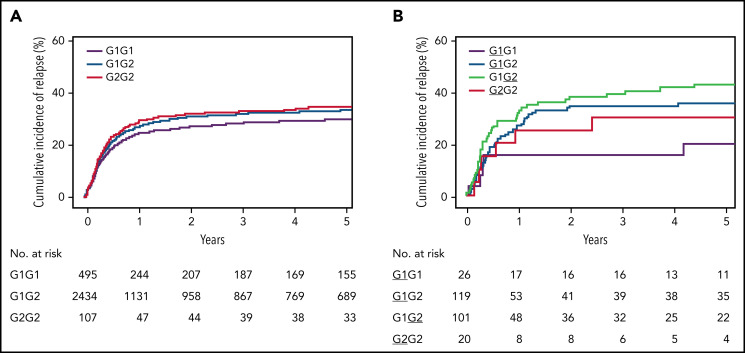
Cumulative incidence of relapse. (A) Probability of relapse in 3208 HLA-10/10-matched patients with 2 unique HLA-DQ molecules according to genotype. (B) Probability of relapse in 324 patients with 1 mismatched HLA-DQ molecule, according to patient genotype and mismatched molecule. The mismatches are underlined.

Comment in

References

    1. van Rood JJ, van Leeuwen A, Keuning JJ, van Oud Alblas AB. The serological recognition of the human MLC determinants using a modified cytotoxicity technique. Tissue Antigens. 1975;5(2):73-79. - PubMed
    1. Bodmer JG. Ia Serology. In: Bodmer WF, Batchelor JR, Bodmer, JG, eds. Histocompatibility Testing 1977. Copenhagen, Denmark: Munksgaard, 1978:351-357.
    1. Duquesnoy RJ, Marrari M, Annen K. Identification of an HLA-DR-associated system of B-cell alloantigens. Transplant Proc. 1979;11(4):1757-1760. - PubMed
    1. Terasaki PI, Park MS, Bernoco D, et al. Overview of the 1980 International Histocompatibility Workshop. In: Terasaki PI, ed. Histocompatibility Testing 1980. Los Angeles, CA: UCLA Tissue Typing Laboratory, 1980.
    1. McDevitt HO, Bodmer WF. HL-A, immune-response genes, and disease. Lancet. 1974;303(7869):1269-1275. - PubMed

Publication types