Review
. 2022 Apr 1;139(4):645-659.
doi: 10.1097/AOG.0000000000004710. Epub 2022 Mar 10.

Health Disparities in Uterine Cancer: Report From the Uterine Cancer Evidence Review Conference

Affiliations
Review

Health Disparities in Uterine Cancer: Report From the Uterine Cancer Evidence Review Conference

Sara Whetstone et al. Obstet Gynecol. .

Abstract

The Centers for Disease Control and Prevention recognized the need for educational materials for clinicians on the prevention and early diagnosis of gynecologic cancers. The American College of Obstetricians and Gynecologists convened a panel of experts in evidence review from the Society for Academic Specialists in General Obstetrics and Gynecology and content experts from the Society of Gynecologic Oncology to review relevant literature, best practices, and existing practice guidelines for the development of evidence-based educational materials for women's health care clinicians about uterine cancer. This article is the evidence summary of the literature review of health disparities and inequities related to uterine cancer. Substantive knowledge gaps are noted and summarized to provide guidance for future research.


Figures

Fig. 1.
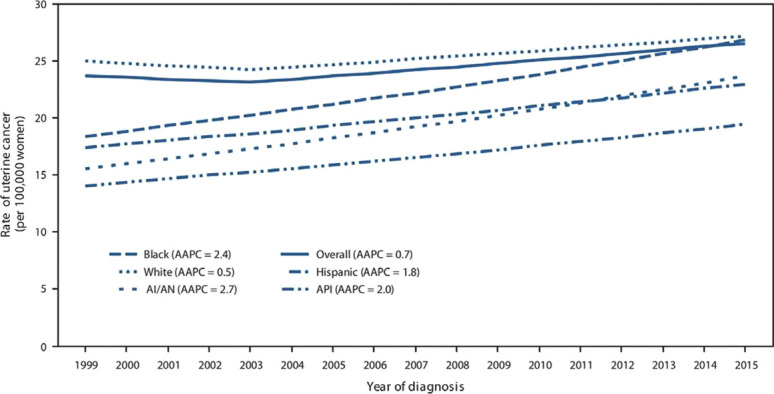
Fig. 1.. Trends* in age-adjusted uterine cancer incidence rates by racial and ethnic group§—United States, 1999–2015. Reprinted from Henley SJ, Miller JW, Dowling NF, et al. Uterine cancer and mortality—United States, 1999–2016. MMWR, 2018;67 (48):1333–1338. The sources of the figure cited in Henley SJ et al are CDC's National Program of Cancer Registries and the National Cancer Institute's Surveillance, Epidemiology, and End Results program. *Trends were measured with average annual percent change (AAPC) in rates and were considered to increase or decrease if P<.05; otherwise, rates were considered stable. AAPC is the weighted average of the annual percent change over the period 1999–2015 using a Joinpoint regression model (up to 2 joinpoints). Per 100,000 women, age-adjusted to the 2000 U.S. standard population. Uterine cancers were defined as microscopically confirmed cancers of the corpus uteri (International Classification of Diseases for Oncology, Third Edition [ICD-O-3] site codes C54.0–C54.3, C54.8, C54.9) and uterus, not otherwise specified (C55.9), excluding cases that were identified by autopsy or death certificate only. §Mutually exclusive racial/ethnic groups are based on information about race and ethnicity that was collected separately and combined for this report. White, Black, American Indian/Alaska Native (AI/AN), and Asian/Pacific Islander (API) race categories are all non-Hispanic. Hispanic persons can be any race. Cancer incidence compiled from cancer registries that meet the data quality criteria for each year during the period 1999–2015, covering 98% of the U.S. population.
Fig. 2.
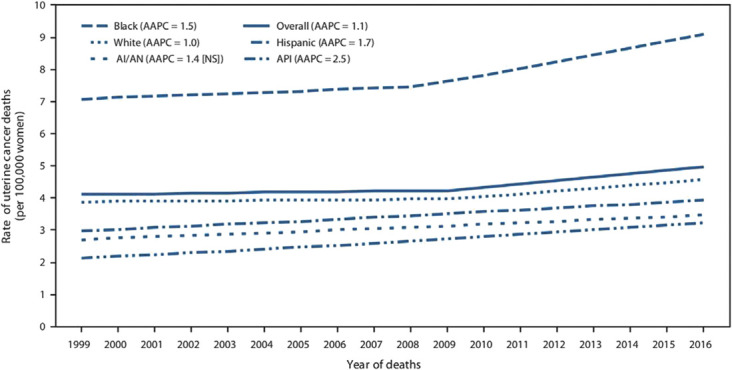
Fig. 2.. Trends* in age-adjusted uterine cancer death rates by racial and ethnic group§ —United States, 1999–2016. Reprinted from Henley SJ, Miller JW, Dowling NF, et al. Uterine cancer and mortality—United States, 1999–2016. MMWR, 2018;67 (48):1333–1338. The source of the figure cited in Henley SJ et al is CDC's National Center for Health Statistics National Vital Statistics System. *Trends were measured with average annual percent change (AAPC) in rates and were considered to increase or decrease if P<.05; otherwise rates were considered stable. AAPC is the weighted average of the annual percent change over the period 1999–2016 using a Joinpoint regression model (up to 2 joinpoints). Per 100,000 women, age-adjusted to the 2000 U.S. standard population. Uterine cancer deaths were defined as deaths from cancers of corpus uteri (International Classification of Diseases 10th Edition [ICD-10] codes C54.0–C54.3, C54.8, C54.9) and uterus, not otherwise specified (C55.9). §Mutually exclusive racial/ethnic groups are based on information about race/ethnicity that was collected separately and combined for this report. White, Black, American Indian/Alaska Native (AI/AN), and API, Asian/Pacific Islander (API) race categories are all non-Hispanic. Hispanic persons can be any race. NS, not significant.
Figure
Figure
No available caption

References

    1. Centers for Disease Control and Prevention. Community Health and Program Services (CHAPS): health disparities among racial/ethnic populations. U.S. Department of Health and Human Services; 2008
    1. Chelmow D, Brooks R, Cavens A, Huber-Keener K, Scott DM, Sheth SS, et al. Executive summary of the Uterine Cancer Evidence Review Conference. Obstet Gynecol 2022:139:626–43. doi: 10.1097/AOG.0000000000004711 - DOI - PMC - PubMed
    1. Sherman ME, Devesa SS. Analysis of racial differences in incidence, survival, and mortality for malignant tumors of the uterine corpus. Cancer 2003;98:176–86. doi: 10.1002/cncr.11484 - DOI - PubMed
    1. Doll KM, Winn AN. Assessing endometrial cancer risk among US women: long-term trends using hysterectomy-adjusted analysis. Am J Obstet Gynecol 2019;221:318.e1–9. doi: 10.1016/j.ajog.2019.05.024 - DOI - PubMed
    1. Henley SJ, Miller JW, Dowling NF, Benard VB, Richardson LC. Uterine cancer incidence and mortality – United States, 1999–2016. MMWR Morb Mortal Wkly Rep 2018;67:1333–8. doi: 10.15585/mmwr.mm6748a1 - DOI - PMC - PubMed

Publication types