Outcome of lifestyle intervention in relation to duration of pre-diabetes: the Pathobiology and Reversibility of Prediabetes in a Biracial Cohort (PROP-ABC) study
- PMID: 35273012
- PMCID: PMC8915300
- DOI: 10.1136/bmjdrc-2021-002748
Outcome of lifestyle intervention in relation to duration of pre-diabetes: the Pathobiology and Reversibility of Prediabetes in a Biracial Cohort (PROP-ABC) study
Abstract
Introduction: In studies that enrolled people with prevalent pre-diabetes of unknown duration, lifestyle intervention (LI) delayed progression to type 2 diabetes (T2D) but did not reverse pre-diabetes in most participants. Here, we assessed the effects of LI among individuals with pre-diabetes of known duration to determine whether outcomes are related to duration of pre-diabetes.
Research design and methods: The Pathobiology and Reversibility of Prediabetes in a Biracial Cohort study initiated LI in subjects with incident pre-diabetes during follow-up of initially normoglycemic African Americans and European Americans with parental T2D. Participants were stratified into those initiating LI after <3, 3-5, or >5 years of pre-diabetes diagnosis. Assessments included anthropometry, body fat, fasting and 2-hour plasma glucose (FPG, 2hPG), and insulin sensitivity and secretion. The outcomes were normal glucose regulation (NGR; ie, normal FPG and 2hPG), persistent pre-diabetes, or T2D. Participants who maintained normal FPG and normal 2hPG levels during follow-up served as the control. The control subjects did not receive lifestyle or other intervention to alter the course of glycemia or body weight.
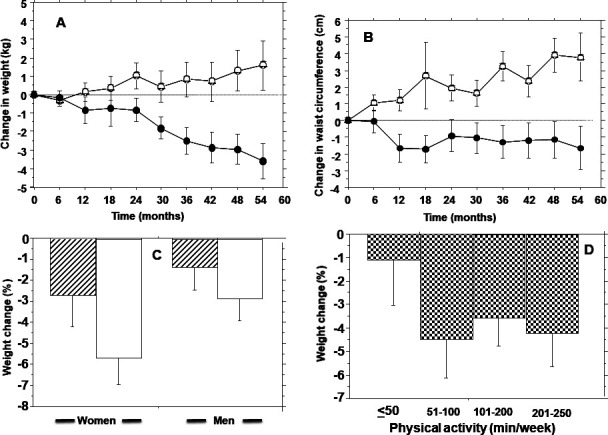
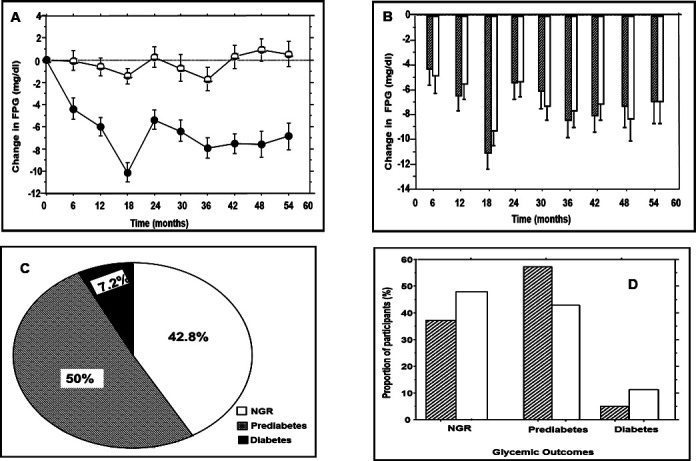
Results: Of 223 participants (age 53.3±9.28 years, body mass index 30.6±6.70 kg/m2), 72 (control) maintained normoglycemia during follow-up and 138 subjects with incident pre-diabetes initiated LI after 4.08±2.02 years (range 3 months-8.3 years) of diagnosis. Compared with control, LI participants showed decrease in glucose, weight, and body fat; 42.8% reverted to NGR, 50% had persistent pre-diabetes, and 7.2% developed T2D after 5 years. These outcomes were similar across race and pre-diabetes duration strata, but greater glycemic decrease occurred when LI was initiated within 5 years of pre-diabetes diagnosis.
Conclusions: Ninety-three per cent of adults with parental T2D who initiated LI within 3 months to 8.3 years of developing pre-diabetes did not progress to T2D; nearly half reverted to NGR.Trial registration number NCT02027571.
Keywords: diet; ethnic groups; exercise; prediabetic state.
© Author(s) (or their employer(s)) 2022. Re-use permitted under CC BY-NC. No commercial re-use. See rights and permissions. Published by BMJ.
Conflict of interest statement
Competing interests: None declared.
Figures

References
-
- Centers for Disease Control and Prevention, US department of health and human services . National diabetes statistics report, 2020. estimates of diabetes and its burden in the United States, 2020. Available: https://www.cdc.gov/diabetes/pdfs/data/statistics/national-diabetes-stat... [Accessed 27 Dec 2021].
-
- International Diabetes Federation . IDF diabetes atlas. 9th edn. Brussels, Belgium: International Diabetes Federation, 2019.
Publication types
MeSH terms
Substances
Associated data
Grants and funding
LinkOut - more resources
Full Text Sources
Medical