


Uptake of the multi-arm multi-stage (MAMS) adaptive platform approach: a trial-registry review of late-phase randomised clinical trials
- PMID: 35273052
- PMCID: PMC8915371
- DOI: 10.1136/bmjopen-2021-055615
Uptake of the multi-arm multi-stage (MAMS) adaptive platform approach: a trial-registry review of late-phase randomised clinical trials
Abstract
Background: For medical conditions with numerous interventions worthy of investigation, there are many advantages of a multi-arm multi-stage (MAMS) platform trial approach. However, there is currently limited knowledge on uptake of the MAMS design, especially in the late-phase setting. We sought to examine uptake and characteristics of late-phase MAMS platform trials, to enable better planning for teams considering future use of this approach.
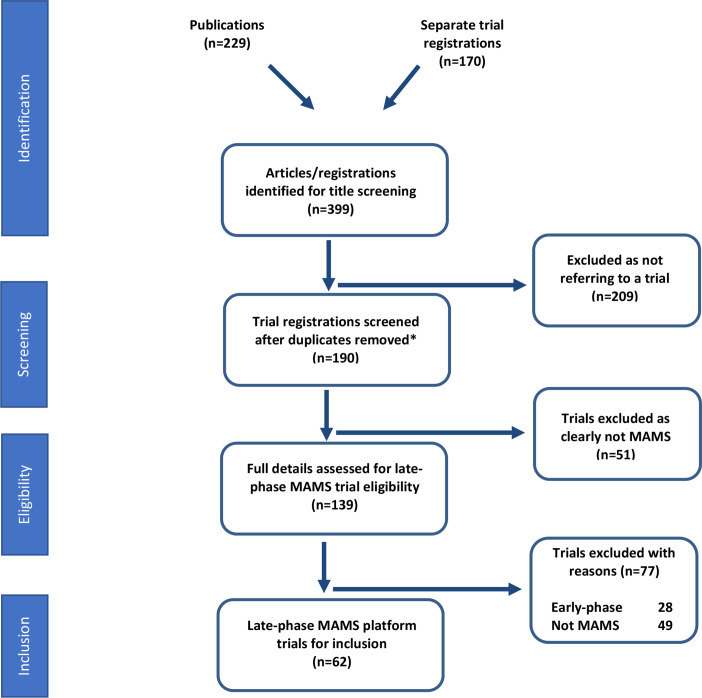
Design: We examined uptake of registered, late-phase MAMS platforms in the EU clinical trials register, Australian New Zealand Clinical Trials Registry, International Standard Randomised Controlled Trial Number registry, Pan African Clinical Trials Registry, WHO International Clinical Trial Registry Platform and databases: PubMed, Medline, Cochrane Library, Global Health Library and EMBASE. Searching was performed and review data frozen on 1 April 2021. MAMS platforms were defined as requiring two or more comparison arms, with two or more trial stages, with an interim analysis allowing for stopping of recruitment to arms and typically the ability to add new intervention arms.
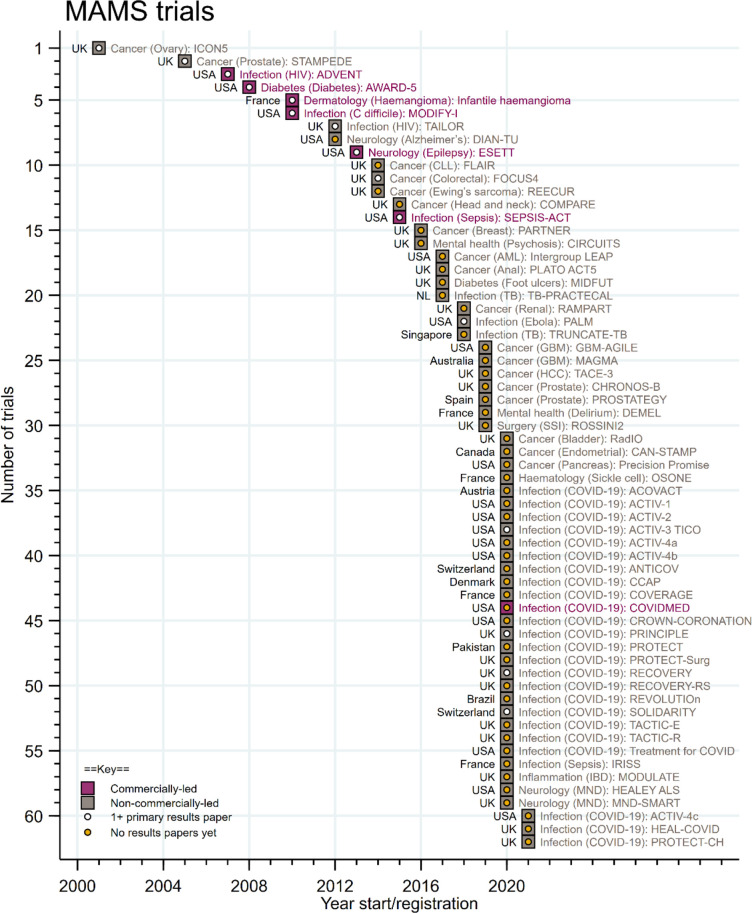
Results: 62 late-phase clinical trials using an MAMS approach were included. Overall, the number of late-phase trials using the MAMS design has been increasing since 2001 and been accelerated by COVID-19. The majority of current MAMS platforms were either targeting infectious diseases (52%) or cancers (29%) and all identified trials were for treatment interventions. 89% (55/62) of MAMS platforms were evaluating medications, with 45% (28/62) of the MAMS platforms having at least one or more repurposed medication as a comparison arm.
Conclusions: Historically, late-phase trials have adhered to long-established standard (two-arm) designs. However, the number of late-phase MAMS platform trials is increasing, across a range of different disease areas. This study highlights the potential scope of MAMS platform trials and may assist research teams considering use of this approach in the late-phase randomised clinical trial setting.
Prospero registration number: CRD42019153910.
Keywords: clinical pharmacology; clinical trials; infectious diseases; oncology; public health.
© Author(s) (or their employer(s)) 2022. Re-use permitted under CC BY. Published by BMJ.
Conflict of interest statement
Competing interests: MRS reports grants and non-financial support from Astellas, grants from Clovis, grants and non-financial support from Janssen, grants and non-financial support from Novartis, grants and non-financial support from Pfizer, grants and non-financial support from Sanofi, during the conduct of the study; personal fees from Lilly Oncology, personal fees from Janssen, all outside of the submitted work.
Figures
References
-
- Zwierzyna M, Davies M, Hingorani AD, et al. Clinical trial design and dissemination: comprehensive analysis of ClinicalTrials.gov and PubMed data since 2005. BMJ 2018;361:k2130. 10.1136/bmj.k2130 - DOI - PMC - PubMed
-
- Djulbegovic B, Kumar A, Soares HP, et al. Treatment success in cancer: new cancer treatment successes identified in phase 3 randomized controlled trials conducted by the National cancer Institute-sponsored cooperative oncology groups, 1955 to 2006. Arch Intern Med 2008;168:632–42. 10.1001/archinte.168.6.632 - DOI - PMC - PubMed
Publication types
MeSH terms
Grants and funding
LinkOut - more resources
Full Text Sources
Medical
Miscellaneous
