


Long-term incidence of posterior capsular opacification in patients with non-infectious uveitis
- PMID: 35277585
- PMCID: PMC8917155
- DOI: 10.1038/s41598-022-08325-7
Long-term incidence of posterior capsular opacification in patients with non-infectious uveitis
Abstract
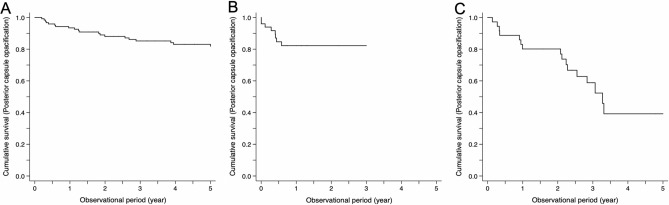
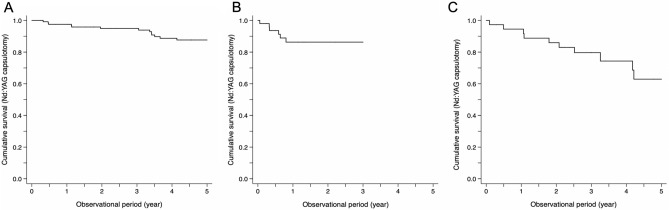
Little is known about the long-term incidence of posterior capsule opacification (PCO) after cataract surgery in patients with uveitis. This retrospective study included 211 eyes of 146 patients with non-infectious uveitis who underwent cataract surgery and implantation of an Acrysof SN60WF (Surface: plasma-treated, Optic and Haptic: hydrophobic acrylic), iSert XY-1 (Surface: UV-ozone-treated, Optic and Haptic: hydrophobic acrylic), or iSert 251/255 (Surface: UV-ozone-treated, Optics: hydrophobic acrylic, Haptic: polymethyl methacrylate). The cumulative incidences of PCO and subsequent yttrium-aluminum-garnet (Nd:YAG) capsulotomy over the 5-year follow-up were analyzed, and patients who were implanted with different intraocular lenses (IOLs) were compared. Mixed-effects Cox proportional hazard models showed that, compared with the Acrysof group, the iSert XY-1 group had higher risks of PCO (adjusted HR, 7.26; 95% CI, 1.82-28.8) and Nd:YAG capsulotomy (adjusted HR, 6.50; 95% CI, 1.55-27.2). Similar results were obtained when the Acrysof group was compared with the iSert 251/255 group for PCO (adjusted HR, 8.22; 95% CI, 2.35-28.7) and Nd:YAG capsulotomy (adjusted HR, 8.26; 1.90-36.0). These data suggest that a plasma-treated surface, hydrophobic acrylic optic and hydrophobic acrylic haptic, of the IOL could enhance biocompatibility even under inflammatory conditions, thus suppressing PCO development.
© 2022. The Author(s).
Conflict of interest statement
The authors declare no competing interests.
Figures
References
Publication types
MeSH terms
Substances
LinkOut - more resources
Full Text Sources
Medical
