


A compound score to screen patients with hereditary transthyretin amyloidosis
- PMID: 35279758
- PMCID: PMC9293821
- DOI: 10.1007/s00415-022-11056-4
A compound score to screen patients with hereditary transthyretin amyloidosis
Abstract
Background: Hereditary transthyretin amyloidosis (ATTRv) is a rare, debilitating and fatal disease, mostly characterized by progressive axonal peripheral neuropathy. Diagnosis is still challenging and diagnostic delay in non-endemic area is about 3-4 years. The aim of this study was to arrange a clinical and electrophysiological score to select patients with axonal neuropathy that deserve screening for TTR mutation.
Methods: Thirty-five ATTRv patients and 55 patients with chronic idiopathic axonal polyneuropathy (CIAP) were retrospectively analyzed. Clinical and electrophysiological findings at first evaluation were collected. Based on significant results between the two groups, a compound (clinical and electrophysiological) score was arranged, and ROC analysis was performed to identify the ideal cut-off able to discriminate between the two groups.
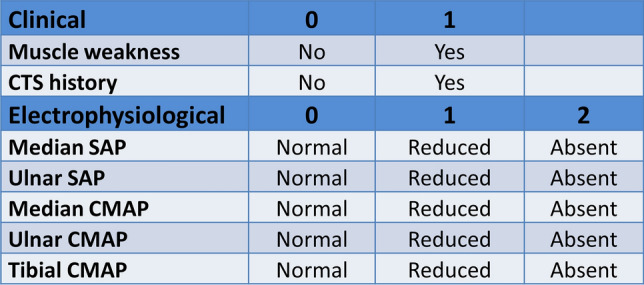
Results: ATTRv patients presented a later age at onset, more frequent muscle weakness and carpal tunnel syndrome history. On the other hand, electrophysiological analysis showed that ATTRv patients had lower CMAP and SAP amplitude in all examined nerves. We arranged a compound score constituted by 7 total items, ranging from 0 to 12. ROC analysis showed an Area Under the Curve = 0.8655 and we set the cut-off ≥ 5 points to discriminate ATTRv patients with a sensitivity of 96.6% and a specificity of 63.6%.
Conclusion: Our study demonstrated that our compound score with cut-off ≥ 5 allows to discriminate ATTRv patients among subject affected by axonal polyneuropathy with a sensitivity > 95%. Thus, our compound score is a quick, easy and effective screening tool.
Keywords: Carpal tunnel syndrome; Neuropathy; Neurophysiology; Screening tool; TTR amyloidosis.
© 2022. The Author(s).
Conflict of interest statement
The authors declare that they have no competing interests.
Figures

References
-
- Luigetti M, Romozzi M, Bisogni G, Cardellini D, Cavallaro T, Di Paolantonio A, Fabrizi GM, Fenu S, Gentile L, Grandis M, Marucci G, Massucco S, Mazzeo A, Pareyson D, Romano A, Russo M, Schenone A, Tagliapietra M, Tozza S, Vita G, Sabatelli M. hATTR pathology: nerve biopsy results from italian referral centers. Brain Sci. 2020;10(11):780. doi: 10.3390/brainsci10110780. - DOI - PMC - PubMed
-
- Coelho T, Maia LF, Martins da Silva A, Waddington Cruz M, Planté-Bordeneuve V, Lozeron P, Suhr OB, Campistol JM, Conceição IM, Schmidt HH, Trigo P, Kelly JW, Labaudinière R, Chan J, Packman J, Wilson A, Grogan DR. Tafamidis for transthyretin familial amyloid polyneuropathy: a randomized, controlled trial. Neurology. 2012;79(8):785–792. doi: 10.1212/WNL.0b013e3182661eb1. - DOI - PMC - PubMed
-
- Adams D, Gonzalez-Duarte A, O'Riordan WD, Yang CC, Ueda M, Kristen AV, Tournev I, Schmidt HH, Coelho T, Berk JL, Lin KP, Vita G, Attarian S, Planté-Bordeneuve V, Mezei MM, Campistol JM, Buades J, Brannagan TH, 3rd, Kim BJ, Oh J, Parman Y, Sekijima Y, Hawkins PN, Solomon SD, Polydefkis M, Dyck PJ, Gandhi PJ, Goyal S, Chen J, Strahs AL, Nochur SV, Sweetser MT, Garg PP, Vaishnaw AK, Gollob JA, Suhr OB. Patisiran, an RNAi therapeutic, for hereditary transthyretin amyloidosis. N Engl J Med. 2018;379(1):11–21. doi: 10.1056/NEJMoa1716153. - DOI - PubMed
MeSH terms
Substances
Supplementary concepts
LinkOut - more resources
Full Text Sources
Research Materials
Miscellaneous
