


The Impact of Accelerated HF-rTMS on Canine Brain Metabolism: An [18F]-FDG PET Study in Healthy Beagles
- PMID: 35280129
- PMCID: PMC8907524
- DOI: 10.3389/fvets.2022.800158
The Impact of Accelerated HF-rTMS on Canine Brain Metabolism: An [18F]-FDG PET Study in Healthy Beagles
Abstract
Background: Repetitive transcranial magnetic stimulation (rTMS) has been proven to be a useful tool for the treatment of several severe neuropsychiatric disorders. Accelerated (a)rTMS protocols may have the potential to result in faster clinical improvements, but the effects of such accelerated paradigms on brain function remain to be elucidated.
Objectives: This sham-controlled arTMS study aimed to evaluate the immediate and delayed effects of accelerated high frequency rTMS (aHF-rTMS) on glucose metabolism in healthy beagle dogs when applied over the left frontal cortex.
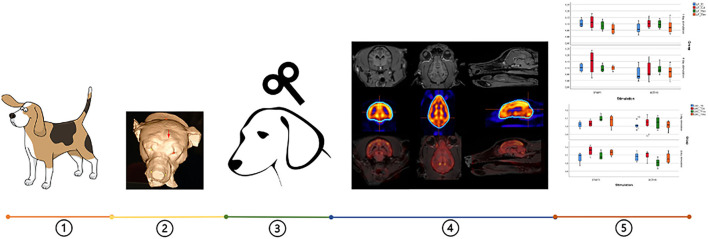
Methods: Twenty-four dogs were randomly divided into four unequal groups: five active (n = 8)/ sham (n = 4) stimulation sessions (five sessions in 1 day), 20 active (n = 8)/ sham (n = 4) stimulation sessions (five sessions/ day for 4 days), respectively. [18F] FDG PET scans were obtained at baseline, 24 h poststimulation, after 1 and 3 months post the last stimulation session. We explicitly focused on four predefined regions of interest (left/right prefrontal cortex and left/right hippocampus).
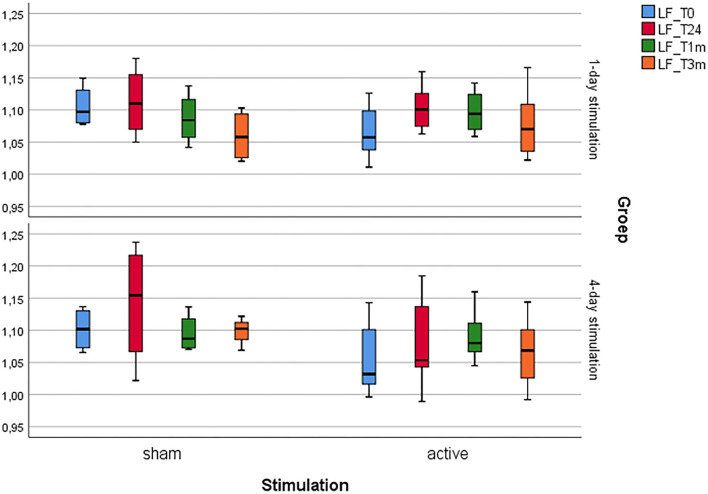
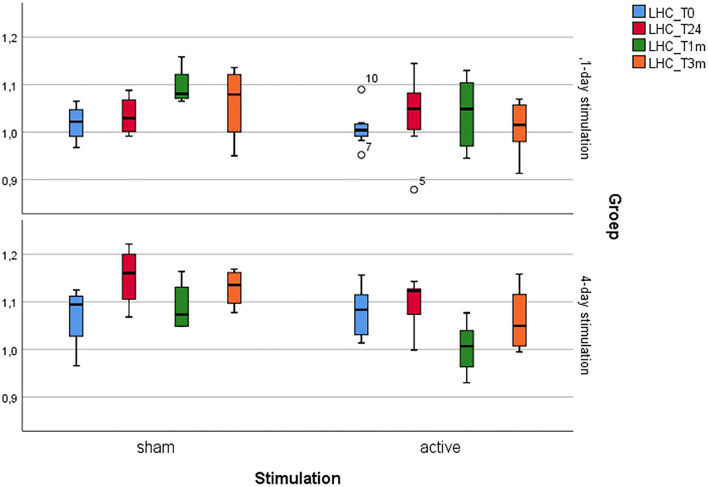
Results: One day of active aHF-rTMS- and not sham- significantly increased glucose metabolism 24 h post-active stimulation in the left frontal cortex only. Four days of active aHF-rTMS only resulted in a nearly significant metabolic decrease in the left hippocampus after 1 month.
Conclusions: Like in human psychiatric disorders, active aHF-rTMS in healthy beagles modifies glucose metabolism, although differently immediately or after 1 month post stimulation. aHF-rTMS may be also a valid option to treat mentally disordered dogs.
Keywords: [18F]-FDG brain imaging; aHF-rTMS; canine model; neuropsychiatric disorders (NPD); repetitive transcranial magnetic stimulation.
Copyright © 2022 Xu, Peremans, Courtyn, Audenaert, Dobbeleir, D'Asseler, Achten, Saunders and Baeken.
Conflict of interest statement
The authors declare that the research was conducted in the absence of any commercial or financial relationships that could be construed as a potential conflict of interest.
Figures
References
LinkOut - more resources
Full Text Sources
Research Materials
Miscellaneous
