Review
. 2022 Mar 5:15:1667-1698.
doi: 10.2147/JIR.S351918. eCollection 2022.

The Rising Era of "Immunoporosis": Role of Immune System in the Pathophysiology of Osteoporosis

Affiliations
Review

The Rising Era of "Immunoporosis": Role of Immune System in the Pathophysiology of Osteoporosis

Rupesh K Srivastava et al. J Inflamm Res. .

Abstract

Discoveries in the last few years have emphasized the existence of an enormous breadth of communication between bone and the immune system in maintaining skeletal homeostasis. Originally, the discovery of various factors was assigned to the immune system viz. interleukin (IL)-6, IL-10, IL-17, tumor necrosis factor (TNF)-α, receptor activator of nuclear factor kappa B ligand (RANKL), nuclear factor of activated T cells (NFATc1), etc., but now these factors have also been shown to have a significant impact on osteoblasts (OBs) and osteoclasts (OCs) biology. These discoveries led to an alteration in the approach for the treatment of several bone pathologies including osteoporosis. Osteoporosis is an inflammatory bone anomaly affecting more than 500 million people globally. In 2018, to highlight the importance of the immune system in the pathophysiology of osteoporosis, our group coined the term "immunoporosis". In the present review, we exhaustively revisit the characteristics, mechanism of action, and function of both innate and adaptive immune cells with the goal of understanding the potential of immune cells in osteoporosis. We also highlight the Immunoporotic role of gut microbiota (GM) for the treatment and management of osteoporosis. Importantly, we further discuss whether an immune cell-based strategy to treat and manage osteoporosis is feasible and relevant in clinical settings.

Keywords: adaptive immune cells; bone cells; gut microbiota; immunoporosis; innate immune cells; osteoporosis.


Conflict of interest statement

The authors report no conflicts of interest for this work.

Figures

None
Graphical abstract
Figure 1
Figure 1
Bone Remodeling Cycle under physiological and pathological condition: The remodeling process is characterized by a sequential series of four phases: 1) Activation and Resorption phases, which is governed by the systemic concentration of RANKL and M-CSF that induce the differentiation of hematopoietic stem cells (HSCs) derived OC precursors into mature multinucleated OCs. In resorption phase, mature osteoclasts with unique ruffled border induce resorption of bone by secreting cathepsin K, H+, and Cl− in sealing zone and after resorption detaches from the bone surface and undergoes apoptosis (programmed cell death mechanism). 2) Reversal phase: mesenchymal derived OBs differentiate in the presence of Wnt, BMPs, and TGF-β and are recruited to the resorbed site. 3) Formation phase: OBs lay down the new organic bone matrix which ultimately undergoes 4) Mineralization phase. Under estrogen deficient conditions or inflammatory conditions, RANKL is also provided by other immune cells that lead to enhancement in osteoclastogenesis and thus more bone resorption which ultimately leads to osteoporosis.
Figure 2
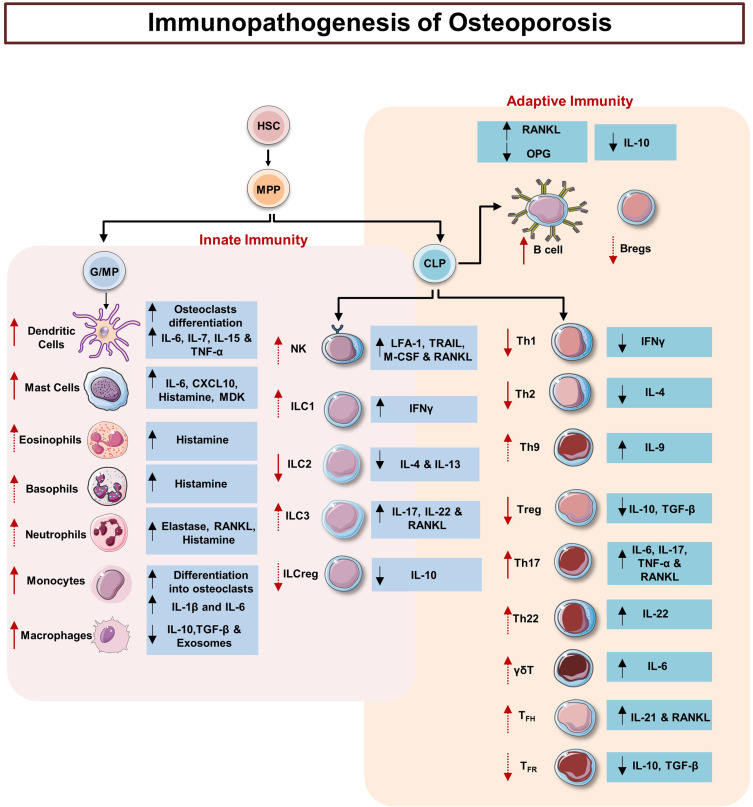
Figure 2
Immunopathogenesis of Osteoporosis: Schematic diagram representing the role of immune cells and their signature cytokines in the pathophysiology of osteoporosis. Solid red arrows represent established roles whereas dotted red arrows represent the proposed mechanism of action.
Figure 3
Figure 3
Immunomodulation of bone remodelling and potential therapeutic checkpoints: (A) Differentiation of osteoclasts is a multi-step process where various immune cells viz. Breg, Treg, Th1, and Th2 by producing anti-inflammatory cytokines such as IL-10, TGF-β, IFNγ, and IL-4 suppress the differentiation of osteoclasts precursors to mature osteoclasts and thus suppress osteoclastogenesis. On the contrary, by producing inflammatory cytokines Th17 enhance osteoclastogenesis either in a direct or indirect manner. (B) Tregs enhance osteoblastogenesis via CD8+ Tregs and Th17 suppress osteoblastogenesis via IL-17 cytokine or by enhancing macrophage mediated reduction of osteoblasts differentiation.
Figure 4
Figure 4
Inflammaging and Osteoporosis: (A) Various factors such as dysfunctioning of mitochondria, autophagy/mitophagy, dysbiosis of gut microbiota (GM), senescence of cells, cell debris, pathogen associated molecular patterns (PAMPs), death associated molecular patterns (DAMPs) and altered metabolites promote the activation of NLR family pyrin domain containing 3 inflammasome in macrophages. Activation of macrophages leads to conversion of the inactive form of IL-1β cytokine to the active form along with IL-18 cytokine. These osteoclastogenic cytokines further skew the balance towards bone resorption, thereby enhancing bone loss. (B) Dogma representing the nexus between ageing, Inflammaging, and age-related diseases including osteoporosis.
Figure 5
Figure 5
Harnessing “GUT-IMMUNE-BONE” axis in Bone Health: GUT microbiota (GM) acts on the non-digestible carbohydrates (NDOs) such as fructo-oligosaccharides (FOS), galacto-oligosaccharides (GOS) etc. and convert them into various Gut Associate Metabolites (GAMs): Short chain fatty acids (SCFAs), ie, acetate (C2), propionate (C3), butyrate (C4), pentanoate (C5), and hexanoate (C6). Moreover, primary bile acids produced by liver such as cholic acid and deoxycholic acid are converted into secondary bile acids (by the GM) such as lithocholic acid (LCA), etc. These GAMs can cross the intestinal lining and upon entry into lamina propria modulate Breg, Tregs, and Th17 cells which further regulate bone remodelling after reaching BM. Also, GAMs can directly regulate bone remodelling via the peripheral circulation, thereby maintaining bone health.
Figure 6
Figure 6
Immunoporotic role of ILCs: Schematic representation of proposed mechanism of the role of ILCs in Osteoporosis. GM modulation strategies (prebiotics, probiotics, and synbiotics) can be employed for enhancing bone health via modulating the plasticity of ILCs (ILC1, ILC2, and ILC3).

References

    1. de Villiers TJ, Goldstein SR. Bone health 2022: an update. Climacteric. 2022;25(1):1–3. doi:10.1080/13697137.2021.1965408 - DOI - PubMed
    1. Dobbs MB, Buckwalter J, Saltzman C. Osteoporosis: the increasing role of the orthopaedist. Iowa Orthop J. 1999;19:43–52. Available from: http://www.ncbi.nlm.nih.gov/pubmed/10847516 - PMC - PubMed
    1. Arron JR, Choi Y. Bone versus immune system. Nature. 2000;408(6812):535–536. doi:10.1038/35046196 - DOI - PubMed
    1. Boyce BF, Xing L. Functions of RANKL/RANK/OPG in bone modeling and remodeling. Arch Biochem Biophys. 2008;473(2):139–146. doi:10.1016/j.abb.2008.03.018 - DOI - PMC - PubMed
    1. Srivastava RK. Osteoimmunology The i Nexus i between bone and immune system. Front Biosci. 2018;23(2):4600. doi:10.2741/4600 - DOI - PubMed