Review
. 2022 Feb 23:13:837001.
doi: 10.3389/fphys.2022.837001. eCollection 2022.

Adipose-Derived Extracellular Vesicles: Systemic Messengers and Metabolic Regulators in Health and Disease

Affiliations
Review

Adipose-Derived Extracellular Vesicles: Systemic Messengers and Metabolic Regulators in Health and Disease

Simon T Bond et al. Front Physiol. .

Abstract

Adipose tissue is comprised of a heterogeneous population of cells that co-operate to perform diverse physiological roles including endocrine-related functions. The endocrine role of adipose tissue enables it to communicate nutritional and health cues to other organs, such as the liver, muscle, and brain, in order to regulate appetite and whole body metabolism. Adipose tissue dysfunction, which is often observed in obesity, is associated with changes in the adipose secretome, which can subsequently contribute to disease pathology. Indeed, secreted bioactive factors released from adipose tissue contribute to metabolic homeostasis and likely play a causal role in disease; however, what constitutes the entirety of the adipose tissue secretome is still poorly understood. Recent advances in nanotechnology have advanced this field substantially and have led to the identification of small, secreted particles known as extracellular vesicles (EVs). These small nano-sized lipid envelopes are released by most cell types and are capable of systemically delivering bioactive molecules, such as nucleic acids, proteins, and lipids. EVs interact with target cells to deliver specific cargo that can then elicit effects in various tissues throughout the body. Adipose tissue has recently been shown to secrete EVs that can communicate with the periphery to maintain metabolic homeostasis, or under certain pathological conditions, drive disease. In this review, we discuss the current landscape of adipose tissue-derived EVs, with a focus on their role in the regulation of metabolic homeostasis and disease pathology.

Keywords: adipose tissue; adipose tissue secretome; brown adipose tissue; exosome; extracellular vescicles; metabolic homeostasis; white adipose tissue.


Conflict of interest statement

The authors declare that the research was conducted in the absence of any commercial or financial relationships that could be construed as a potential conflict of interest.

Figures
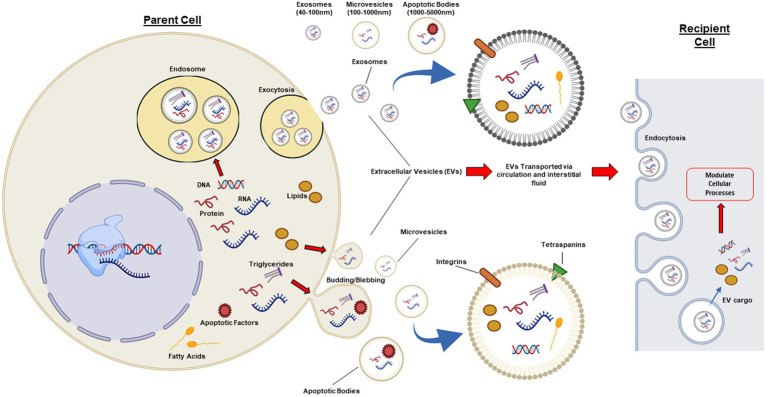
Figure 1
Figure 1
Cellular pathways involved in extracellular vesicle biogenesis. Extracellular vesicles (EVs) are a heterogeneous population of lipid bound vesicles that are released by the majority of mammalian cell types into the extracellular space and circulation. EVs consist of three main subtypes: exosomes (40–100 nm); microvesicles (100–1,000 nm); and apoptotic bodies (1,000–5,000 nm), which differ in their size, content, biogenesis, and release. Exosomes are generated and released via a pathway involving exocytosis, whereas microvesicles and apoptotic bodies are released via a budding/blebbing pathway. EV cargo includes nucleic acids, proteins, and lipids, which are highly regulated by the health status of the parent cell. Once in the extracellular space or circulation, EVs can target adjacent cells and peripheral tissues. EVs have common surface markers (tetraspanins: CD63, CD9, CD81, and CD82) and can have specific surface markers for cell targeting, such as integrins. EVs can elicit effects in recipient cells via cell receptor interactions or via absorption and release of biological cargo into the cytoplasm of the recipient cell. Figure created with BioRender.com.
Figure 2
Figure 2
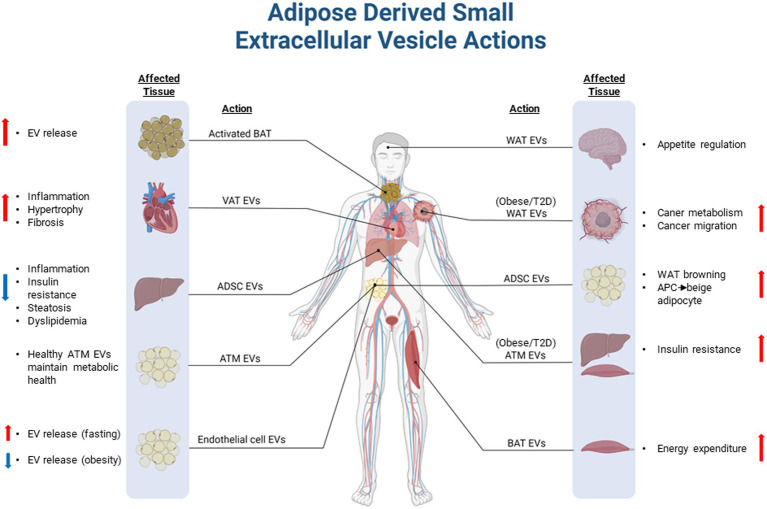
Overview of adipose-derived small extracellular vesicles in health and disease. Extracellular vesicles (EVs) derived and released from adipose tissues can modulate physiological processes in peripheral tissues. In healthy individuals, adipose EVs may play an important endocrine and paracrine role to maintain metabolic homeostasis through reciprocal communication with peripheral tissues and other cell types residing in adipose tissue depots. EVs shed from unhealthy adipose tissue, which often occurs in diseases such as obesity and type 2 diabetes, can exacerbate or drive pathologies associated with disease complications. VAT, Visceral adipose tissue; EVs, Extracellular vesicle; ATM, Adipose tissue macrophage; WAT, White adipose tissue; BAT, Brown adipose tissue; APC, Adipocyte progenitor cell; ADSC, Adipose-derived stem cell; and T2D, Type 2 Diabetes. Figure created with BioRender.com.

References

    1. An Y., Lin S., Tan X., Zhu S., Nie F., Zhen Y., et al. (2021). Exosomes from adipose-derived stem cells and application to skin wound healing. Cell Prolif. 54:e12993. doi: 10.1111/cpr.12993, PMID: - DOI - PMC - PubMed
    1. Borges F. T., Reis L. A., Schor N. (2013). Extracellular vesicles: structure, function, and potential clinical uses in renal diseases. Brazilian J. med. Biol. Res. 46, 824–830. doi: 10.1590/1414-431x20132964 - DOI - PMC - PubMed
    1. Camino T., Lago-Baameiro N., Bravo S. B., Molares-Vila A., Sueiro A., Couto I., et al. (2021). Human obese white adipose tissue sheds depot-specific extracellular vesicles and reveals candidate biomarkers for monitoring obesity and its comorbidities. Trans. Res. 239, 85–102. doi: 10.1016/j.trsl.2021.01.006, PMID: - DOI - PubMed
    1. Chen Y., Buyel J. J., Hanssen M. J. W., Siegel F., Pan R., Naumann J., et al. (2016). Exosomal microRNA miR-92a concentration in serum reflects human brown fat activity. Nat. Commun. 7:11420. doi: 10.1038/ncomms11420, PMID: - DOI - PMC - PubMed
    1. Chen Y. S., Lin E. Y., Chiou T. W., Harn H. J. (2020). Exosomes in clinical trial and their production in compliance with good manufacturing practice. Tzu-chi Med. J. 32, 113–120. doi: 10.4103/tcmj.tcmj_182_19, PMID: - DOI - PMC - PubMed

LinkOut - more resources