. 2022 Mar 4:34:e00717.
doi: 10.1016/j.btre.2022.e00717. eCollection 2022 Jun.

Ferulic acid derivatives inhibiting Staphylococcus aureus tetK and MsrA efflux pumps

Affiliations

Ferulic acid derivatives inhibiting Staphylococcus aureus tetK and MsrA efflux pumps

Patrícia Gonçalves Pinheiro et al. Biotechnol Rep (Amst). .

Abstract

Background: Bacterial resistance to multiple drugs has recently emerged as a serious health problem. Concomitantly, the characterization of new substances with potential antimicrobial activity has been less frequent in the drug development industry. The overexpression of genes encoding efflux pumps that expel antimicrobial drugs from the intracellular environment, lowering these to subinhibitory concentrations, are among the resistance mechanisms predisposing microorganisms to high drug resistance. Staphylococcus aureus is a bacterium found in the normal microbiota of the skin and mucous membranes, and is an opportunistic microorganism capable of causing infections with high rates of morbidity and mortality. TetK is an efflux pump characterized by its ability to provide bacterial resistance to antibiotics from the tetracycline class. This study aimed to evaluate the inhibitory effect of ferulic acid and four of its esterified derivatives against resistant Staphylococcus aureus strains.

Method: Ferulic acid derivatives were obtained by esterification and then characterized by hydrogen and carbon-13 nuclear magnetic resonance analysis. The minimum inhibitory concentrations (MIC) of ferulic acid and its esterified derivatives, ethidium bromide, and antibiotics were obtained using the microdilution test, while the efflux pump inhibition test was conducted by examining reduction in the MICs.

Results: Propylferulate was seen to reduce the minimum inhibitory concentration (MIC) of both the control substance ethidium bromide and the tested antibiotic, indicating that this compound is promising for the use of efflux pump inhibition of IS-58 strains.

Conclusions: This study provides strong evidence that the molecular basis for this activity is potentially due to the MsrA and TetK efflux pumps. However, further investigations are necessary to prove this hypothesis and elucidate the potentiating mechanism of the modulatory effect.

Keywords: Efflux pump; Ferulic acid; Staphylococcus aureus.


Conflict of interest statement

The authors declare that they have no known competing financialinterestsor personal relationships that could have appeared to influence the work reported in this paper.

Figures

Scheme 1
Scheme 1
Synthesis of esterified ferulic acid derivatives.
Fig 1
Fig. 1
1H NMR spectral (300 MHz, CD3OD) of the ferulic acid
Fig 2
Fig. 2
13C NMR spectral (75 MHz, CD3OD) of the ferulic acid.
Fig 3
Fig. 3
13C NMR – DEPT 135 spectral (75 MHz, CD3OD) of the ferulic acid.
Fig 4
Fig. 4
13C NMR – DEPT 135 (75 MHz, CD3OD). (a) Methyl ferulate. (b) Ethyl ferulate. (c) Propyl ferulate. (d) n-butyl ferulate.
Fig 4
Fig. 4
13C NMR – DEPT 135 (75 MHz, CD3OD). (a) Methyl ferulate. (b) Ethyl ferulate. (c) Propyl ferulate. (d) n-butyl ferulate.
Fig 5
Fig. 5
Minimum Inhibitory Concentration (MIC) of ethidium bromide alone or in association with the compounds under analysis (ferulic acid and its esterified derivatives) against S. aureus RN-4220 strains. **** p < 0.0001 indicates significant differences between groups. Statistical significance was determined by a one-way ANOVA and Tukey's post-hoc test.
Fig 6
Fig. 6
Minimum Inhibitory Concentration (MIC) of ethidium bromide alone or in association with the compounds under analysis (ferulic acid and its esterified derivatives) against S. aureus IS-58 strains. **** p < 0.0001 indicates significant differences between groups. Statistical significance was determined by a one-way ANOVA and Tukey's post-hoc test.
Fig 7
Fig. 7
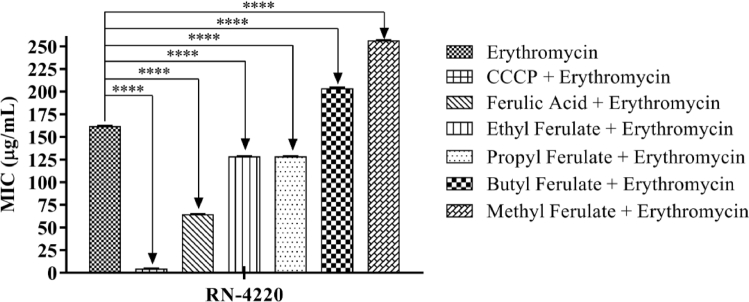
Minimum Inhibitory Concentration (MIC) of erythromycin in association with the studied compounds (ferulic acid and its esterified derivatives) against the multiresistant RN-4220 S. aureus strain **** p < 0.0001 indicates significant differences between groups. Statistical significance was determined by a one-way ANOVA and Bonferroni's post hoc test.
Fig 8
Fig. 8
Minimum Inhibitory Concentration (MIC) of tetracycline in association with the studied compounds (ferulic acid and its esterified derivatives) against the multiresistant IS-58 S. aureus strain **** p < 0.0001 indicates significant differences between groups. Statistical significance was determined by a one-way ANOVA and Bonferroni's post hoc test.

References

    1. Tong S.Y.C., Davis J.S., Eichenberger E., Holland T.L., Fowler V.G. Staphylococcus aureus infections: Epidemiology, pathophysiology, clinical manifestations, and management. Clin Microbiol Rev. 2015;28(2015):603–661. doi: 10.1128/CMR.00134-14. - DOI - PMC - PubMed
    1. Oluwatuyi M., Kaatz G.W., Gibbons S. Antibacterial and resistance modifying activity of Rosmarinus officinalis. Phytochemistry. 2004;65:3249–3254. doi: 10.1016/j.phytochem.2004.10.009. - DOI - PubMed
    1. Levy S.B. Antibiotic resistance - The problem intensifies. Advanced Drug Delivery Reviews. 2005;57:1446–1450. doi: 10.1016/j.addr.2005.04.001. - DOI - PubMed
    1. Neu H.C. The crisis in antibiotic resistance [See comments] Sci. 1992;257:1064–1073. - PubMed
    1. Russell A.D. Do Biocides Select for Antibiotic Resistance? J Pharm Pharmacol. 2000;52:227–233. doi: 10.1211/0022357001773742. - DOI - PubMed

LinkOut - more resources